
Complaint Alleges Officers Violated Pursuit and Use-of-Force Policies While Seeking to Arrest Man Over Technical Ankle Monitor Violation
SAN FRANCISCO — The San Francisco Public Defender’s Office has released surveillance footage showing plainclothes police officers pursuing a 56-year-old man riding an electric scooter before an officer tackled him, sending him into a bus shelter pole in a fatal encounter that attorneys say began over an alleged technical violation involving his ankle monitor.
Edwin Adams died following the Oct. 12 encounter with San Francisco police officers, who were attempting to arrest him on a warrant issued because his electronic monitoring device allegedly had not been properly charged.
The Public Defender’s Office has filed a formal complaint with the Department of Police Accountability, alleging that officers engaged in an unlawful vehicle pursuit, used excessive force and subsequently provided a misleading account of the incident to the public.
The complaint, dated Nov. 6 and signed by Zac Dillon and Brian Cox of the Public Defender’s Integrity Unit, requests a full investigation and appropriate disciplinary action against the officers involved.
“Police chose to pursue Mr. Adams in multiple unmarked vehicles and then violently tackle him from his scooter,” said Dillon, a senior policy analyst with the Public Defender’s Office Integrity Unit.
“SFPD’s public account of this incident was sparse and misleading, omitting the police actions that immediately preceded the collision, which led to Mr. Adams’s death,” Dillon added.
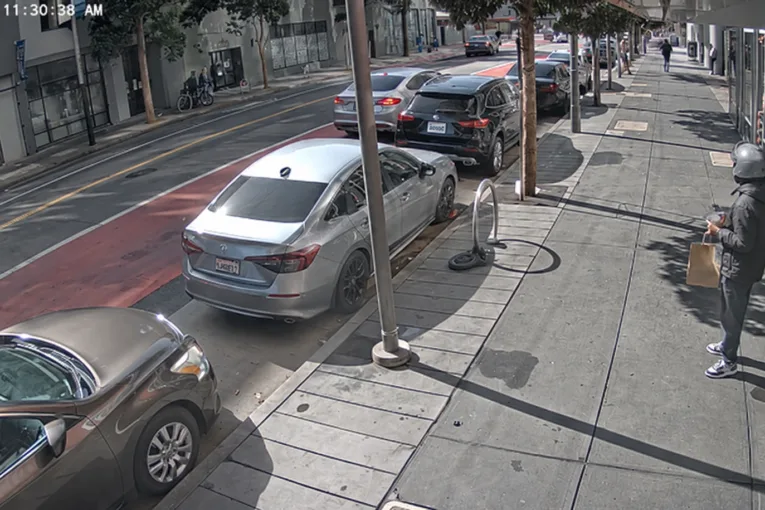
The surveillance footage released by the Public Defender’s Office shows Adams traveling along Mission Street on an electric scooter as an unmarked police vehicle stops in the roadway ahead of him.
According to the complaint, Adams veered to avoid the vehicle before a plainclothes officer emerged and shoved him from the scooter.
The complaint includes a sequence of still images showing Adams approaching the vehicle, an officer exiting and crouching, and the subsequent physical encounter.
The Public Defender’s Office maintains that the officer’s actions caused Adams to strike a metal pole, resulting in his death.
At the time of his death, Adams was awaiting trial on nonviolent drug charges and was participating in a pretrial electronic monitoring program administered by the San Francisco Sheriff’s Department.
The warrant was a Sheriff’s Affidavit Warrant, commonly known as a SAW, issued over an allegation that Adams had failed to properly charge the battery in his ankle monitor.
According to the Public Defender’s Office, Adams had no other outstanding warrants.
His attorney, Deputy Public Defender Meenha Lee, said she did not learn that the warrant had been issued until after her client’s death.
“Mr. Adams was a father and a brother, and his family is grieving his untimely death,” Lee said. “Police pursuits are inherently dangerous. They are supposed to be reserved for situations where the need to intervene outweighs the very real risks, because they can so easily lead to tragedies like this one.”
The Public Defender’s Office said it had repeatedly asked the Sheriff’s Department to notify defense attorneys when Sheriff’s Affidavit Warrants were issued against their clients.
According to the office, the Sheriff’s Department has declined to provide those notifications, even though it promptly notifies prosecutors.
“Had our office been notified of the sheriff warrant, we could have helped him resolve the issue,” Lee said.
The complaint also challenges the San Francisco Police Department’s initial public explanation of Adams’ death.
Following the incident, SFPD told Mission Local that Adams had “collided with a street fixture and suffered injury.”
Police also indicated that officers were attempting to arrest Adams on an outstanding warrant, without publicly explaining that it involved an alleged electronic monitoring violation.
The Public Defender’s Office argues that those omissions created a misleading impression of the circumstances surrounding Adams’ death.
The complaint identifies three categories of alleged misconduct.
First, it alleges that officers violated SFPD’s vehicle pursuit policy, Department General Order 5.05, which generally restricts vehicle pursuits to circumstances involving reasonable suspicion of a felony or a violent misdemeanor.
Neither condition applied to Adams, according to the complaint, because the warrant involved an alleged nonviolent violation of electronic monitoring requirements.
The complaint acknowledges a complication in the department’s pursuit rules: SFPD policy directs motorized scooter pursuits to the department’s foot-pursuit policy, General Order 5.25.
However, the Public Defender’s Office argues that a policy designed for officers pursuing people on foot cannot reasonably govern officers using vehicles at high speeds.
“The provision does not entertain the possibility that an officer would use a car at high speeds to engage in a ‘foot pursuit,’” the complaint states.
The office maintains that officers conducting the pursuit in vehicles were subject to the restrictions governing vehicle pursuits.
Second, the complaint alleges that the officer who tackled Adams violated the department’s use-of-force policy, General Order 5.01.
That policy requires officers to use force that is objectively reasonable under the totality of circumstances known to them at the time.
The complaint argues that tackling a person traveling on an electric scooter without a helmet created an obvious risk of serious injury or death.
It further contends that the force used was disproportionate to the circumstances, particularly given the nonviolent nature of the alleged violation underlying the arrest warrant.
Third, the complaint alleges that the department’s public statements violated its standards of honesty and professional conduct.
General Order 2.01 identifies honesty, credibility, sound judgment and conduct that maintains public confidence as essential obligations of police officers.
The Public Defender’s Office argues that the department’s failure to disclose the pursuit and physical encounter in its initial public account warrants investigation into both the officers involved and those responsible for communicating information about the incident.
The complaint also notes that SFPD had not publicly released body-worn camera footage, identified the officers involved or provided a detailed account of the encounter.
The Public Defender’s Office said it had obtained surveillance footage from a camera at 1190 Mission St. but had not obtained the police incident report or body-worn camera recordings.
Beyond investigating the individual officers, the complaint asks the Department of Police Accountability to recommend broader changes in police transparency.
Specifically, it calls for the Police Commission to reinstate public town hall meetings following officer-involved shootings and expand the practice to deaths occurring in police custody or during pursuits.
San Francisco Public Defender Mano Raju said the circumstances of Adams’ death demonstrate the dangers of aggressive enforcement actions involving allegations that could potentially be resolved without an arrest.
“High-speed police pursuits of people riding electric scooters can have deadly consequences. Police should not be putting lives at risk over situations that could be resolved without a dangerous pursuit,” Raju said.
Raju also criticized the Sheriff’s Department’s failure to notify defense attorneys about the electronic monitoring warrant.
“The Sheriff’s Department also should have notified our office about the technical issue with Mr. Adams’s ankle monitor so that we could have helped resolve it safely and humanely,” he said.
“It is tragic and unjust that Mr. Adams lost his life this way. His family deserves answers, and the public deserves a full and accurate accounting of what happened.”
The complaint asks the Department of Police Accountability to investigate the officers’ actions and determine whether discipline is warranted. Its allegations have not been independently adjudicated, and the materials provided do not establish whether SFPD or the Sheriff’s Department has responded to the complaint.
The Public Defender’s Office has made available both the surveillance footage at normal speed and a second version of the footage.
The complaint further calls for an examination of how police departments communicate information about deaths involving officers, particularly when initial public statements omit details later revealed through independent video evidence.
To comment please go to one of these social media platforms:
Facebook: https://www.facebook.com/DavisVanguard
LinkedIn: https://www.linkedin.com/company/peoples-vanguard-of-davis-inc/
Instagram: https://www.instagram.com/davisvanguard/
X: https://x.com/davisvanguard
Bluesky: https://bsky.app/profile/vanguardnewsgroup.bsky.social
Subscribe to the Vanguard News letters. To make a tax-deductible donation, please visit davisvanguard.org/donate or give directly through ActBlue. Your support will ensure that the vital work of the Vanguard continues.
