
“I can’t wake up happy
I just took a knife
to the strings that attach me
every day’s passing
everyone’s laughing
like JFK find my
brains in the back seat.”
—Machine Gun Kelly
To the extent that I write about prison stuff, I usually aim to make the inside more accessible and understandable to those outside of it, to help span the vast distance separating us. I think that this time, it may be a bridge too far, but I want to give it a shot anyways. Digging around in the past brings up a lot of things long buried; this is my shovel.
The concept of solitary confinement has a lot of negative connotations—as a society we get that it is bad and possibly inhumane—but it remains abstract because nothing in the outside world compares to it. While I found it cute to see folks on TV cheekily refer to being stuck at home during the pandemic as “like being in prison,” it wasn’t.
I got arrested for murder with special circumstances, a designation which means my case was eligible for capital punishment. After “step out of the car and put your hands above your head,” I went straight to the county jail’s death row. As someone who had never been so much as arrested before, this was a drastic change in my environment, on top of the great many other unpleasant experiences and realizations unfolding simultaneously.
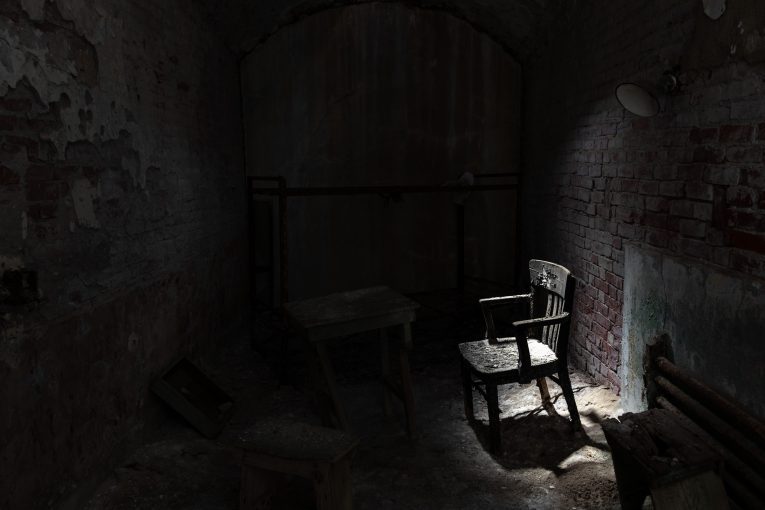
Death row in Stanislaus County is called X Tier. It is a stretch of thirteen single cells in a row on the top floor of the men’s jail downtown. Your living space is a narrow rectangle four feet wide by eight feet deep with a bunk, a sink, and a toilet. The walls are bare concrete. There are no windows. The wall with the door is all open bars, which lets in all the sounds of your environment: slamming doors, electric locks, prisoners shouting, police shouting, the blare of daytime television and commercials, and the rattle of the single pay phone on wheels being slung up and down the tier.
You are issued one canvas jumpsuit, one pair of orange flip-flops, two t-shirts, two pairs of socks, two pairs of boxers, one sheet, one wool blanket, and no pillow. None of them are new. Your bunk is a steel sheet bolted to the wall that measures exactly six feet long. If you are considerably taller than six feet, like me, your feet will hang off the end of your bunk, and your ankles will still hurt even decades later like mine do.
On X Tier there is no program; you spend twenty-four hours a day locked down, but you can come out for “yard” once a week for an hour. Yard takes place on the roof in a twenty-by-twenty cement area surrounded by chain-link fences lined with wooden slats so you can’t see anything beyond. There is a basketball hoop, which always struck me as odd because I never saw a basketball.
When you step foot outside your cell, for any reason besides the four A.M. cold shower, you are placed in what’s known as the black box. This is a special restraint that goes beyond waist chains and shackles. First, your wrists are cuffed in front of you, palms together. Then a chain is wound around your waist just beneath your ribs and the cuffs are secured to it with a black box to immobilize your wrists. If you put your hands together as if you were going to pray, then place your wrists at the base of your sternum with your elbows bowed wide, that is a fair approximation of the position the box puts you in. Being in such a pose for hours on end, like when you spend the day out to court, becomes torturous. Your ankles will also be shackled together so you can only walk by shuffling in your flip-flops.
Being in such isolation and restriction takes its toll. I entered jail with preexisting mental health concerns, so that toll only grew as the days passed. I spent sixteen months there, then I got convicted and shipped off to the state pen.
As someone already not great around people, the impact of my time in solitary manifested in immediate difficulty living in a tiny prison cell’s confined space with some random other person and their own issues. I managed for a few months in the reception center, during which we had yard only one time on a day when it was over a hundred degrees and otherwise remained on 24-hour lockdown. Then I tried to kill myself with a safety razor.
My efforts got me a hospital trip, 70-some odd surgical staples, and a jaunt to the prison psych ward. From there I bounced back and forth between the prison’s suicide watch, the hospital’s crisis bed, and the psych ward, all of which were 24-hour lockdown facilities. They hammered me with psych meds and said I had an adjustment disorder, but secretly I wanted to stay forever because there were no other people around.
Soon enough, though, they ejected me back into the general population. From there I was sent straight to the hole for refusing to live with anyone else. The thought of going in the cell with someone else evoked such overwhelming anxiety that I longed for the hole in solitary confinement. That too could not last forever, and eventually, I was transferred to another institution where they allowed me to live by myself for a year.
During that time, I managed to adjust to being around people, having conversations, walking around without being in chains or under armed escort, and I spent some time outside for the first time in almost three years. Prison has never been easy or pleasant, but compared to solitary, even such minor freedoms are a whole other world.
After being out of solitary confinement for fifteen years, I still struggle with many facets of life. I never feel comfortable with someone else in an enclosed space, though I’ve had a cellmate those entire fifteen years. Lots of institutional sounds still bother me a lot—keys, banging doors, too much noise or too much silence—and the despair that once nearly consumed me entirely still haunts the edges of my awareness.
I feel broken in ways I have a hard time putting into words. I don’t think solitary confinement achieved anything except making me feel even more separate from other people than I did already. Even so long after it ended, I still feel that way. Sometimes I wonder if there is truly a way back—not out of prison, I know that exists, but a way back to feeling human—and if I will ever find it.
I guess we’ll see.
To comment please go to one of these social media platforms:
Facebook: https://www.facebook.com/DavisVanguard
LinkedIn: https://www.linkedin.com/company/peoples-vanguard-of-davis-inc/
Instagram: https://www.instagram.com/davisvanguard/
X: https://x.com/davisvanguard
Bluesky: https://bsky.app/profile/vanguardnewsgroup.bsky.social
Subscribe to the Vanguard News letters. To make a tax-deductible donation, please visit davisvanguard.org/donate or give directly through ActBlue. Your support will ensure that the vital work of the Vanguard continues.
