
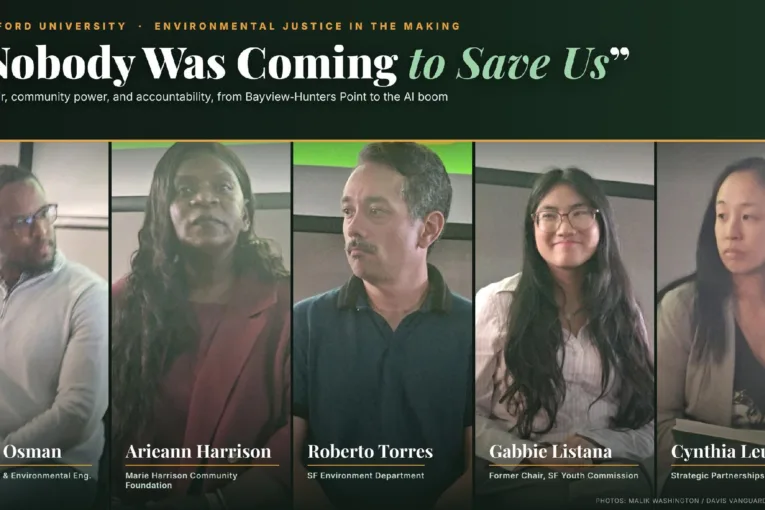
At Stanford, Arieann Harrison carries her mother’s legacy forward and challenges government, academia, and the AI industry to share power with the community that has fought for clean air all along
STANFORD, Calif. — Arieann Harrison did not come to Stanford to ask for permission. She came to bear witness.
“I’m here today to tell you that I am radioactive,” she told a hushed room at Stanford University’s panel “Environmental Justice in the Making.”
Harrison is founder and executive director of the Marie Harrison Community Foundation. She said testing through seven laboratories found uranium, plutonium, and other radioactive substances in her body, along with elevated levels of heavy metals. She shared it not to win sympathy but to make a point the rest of the evening could not escape. In Bayview-Hunters Point, environmental injustice is not an abstraction to be modeled. It is carried in the bodies of the people who live there.
Then she asked the question that hung over everything that followed: What would families in Atherton, Palo Alto, or Pacific Heights demand if their own children had to carry that sentence?
Bayview-Hunters Point sits 40 miles north of the Stanford campus. Few people have done more to force that question onto the public agenda than the woman asking it.
A Daughter of the Movement
Harrison’s activism began in an apartment building in Bayview-Hunters Point. As a young mother, she watched her children and the children around her fall sick and could not get a straight answer about why. So she did what her mother had taught her. She picked up the phone, called city officials and public health authorities, and kept calling until someone came to inspect.
Her mother, Marie Harrison (1948–2019), is remembered across San Francisco as the mother of environmental justice in the Bayview. Marie organized tenants at Geneva Towers and helped lead the fight against the old PG&E power plant at Hunters Point. She spent years demanding accountability at the Hunters Point Naval Shipyard, the federal Superfund site that has shaped the fears and the politics of southeastern San Francisco for generations.
When Marie died in 2019, many expected the movement she built to lose its center. Instead, her daughter made it larger. The following year, Harrison said, young people from across the Bay Area came to Bayview-Hunters Point for a major community mobilization, and the lesson they took away became her organizing creed.
“We realized that in District 10 nobody was coming to save us,” Harrison said. “We was all we had and we had to save ourselves.”
From Protest to Power
That creed has become a record of accomplishment.
Harrison is a lifelong Bayview resident. Through the foundation named for her mother, she runs the Community Pollution Patrol Network, the Hunters Point Biomonitoring Initiative, an academic scholarship program, and Solutions for Women, according to her biography on the Bay Area Air District’s Community Advisory Council, where she holds a seat.
Her most consequential victory may be one most San Franciscans have never heard of. In September 2022, the Marie Harrison Community Foundation and the Bayview Hunters Point Community Advocates petitioned the Air District to designate Bayview-Hunters Point and Southeast San Francisco for a state-mandated Community Emissions Reduction Plan under Assembly Bill 617. The California Air Resources Board approved the selection in February 2023. Harrison’s foundation then served as the Air District’s community co-lead, recruiting the residents who formed the steering committee that shaped the plan. The public review draft, a 238-page blueprint for cutting pollution in her neighborhood, was released this September.
It is hard to find a clearer example of what she means when she says a community must save itself. Residents did not wait to be invited into government. They wrote themselves into it.
“It’s Environmental Racism”
At Stanford, Harrison named the cause without hedging. She traced the toxic burden on her neighborhood to the way San Francisco was built: segregation, discriminatory housing practices, and decades of placing heavy industry next to Black families and other communities of color.
“There’s no other way to put it,” she said. “It’s environmental racism.”
She described the toll in personal terms: asthma, respiratory disease, cancer, infants who don’t survive, people who die too young. Her sister, she said, was diagnosed with breast cancer at 19. She cited an infant mortality rate of 11.2 and a 15-year gap in life expectancy that she attributes to the conditions residents live with.
None of it was delivered as a lament. It was delivered as an indictment, and as a call to act.
Holding Government to Its Word
Roberto Torres, an environmental policy and equity specialist with the San Francisco Environment Department, gave a candid assessment of the government he serves.
“I think government failed really miserably at trying to protect our communities,” Torres said.
He wants environmental justice built permanently into how agencies make decisions, so that protection doesn’t depend on which official happens to care. Harrison welcomed that goal and then raised the bar with one sentence.
“A rule is not worth having a rule if it’s not enforced,” she said.
Hers is the perspective of someone who has spent years watching promises come and go. She called for what she knows makes protections real: more environmental inspectors, more engineers, public reporting, and consequences when the law is broken. Her standard is a government that is still there after the press conference ends.
Ahead of the Curve on AI
Torres warned that the rush to build data centers for artificial intelligence could repeat the mistakes of the industrial era. He pointed to large new demands for power and water, and to facilities approved before anyone consults the people who live next door.
On this issue Harrison had already acted. Weeks before the Stanford panel, she testified before the San Francisco Board of Supervisors’ Land Use and Transportation Committee in support of a moratorium on new data centers. She urged supervisors to “stand on business when it comes to the health outcomes of our districts.” On Oct. 6, the board voted unanimously for a 45-day moratorium written by District 10 Supervisor Shamann Walton, and Mayor Daniel Lurie signed it Oct. 16. The ordinance directs the Planning Department to study energy, water, air quality, land use, and community impacts.
The questions in front of the city are the ones Harrison has asked for years. If AI needs new power plants, diesel backup generators, and transmission lines, whose neighborhood will host them? Who will breathe what they release? And who will collect the benefits?
Powering the Future Without New Smokestacks
During the question-and-answer session, I asked the panel how these data centers will be powered and what that will cost the communities around them.
Cynthia Leung, director of strategic partnerships at WeaveGrid, has worked in solar development, battery storage, and energy infrastructure. She pointed to resources California already has.
“We’re talking right now about how do we basically mobilize the deployed batteries across California, the EVs across the state, to use that as an efficient way to bring power to the grid now,” Leung said.
Vehicle-to-grid technology lets properly equipped electric vehicles and home batteries send power back to the grid when it is needed. It will not run a large AI campus around the clock by itself, and no one on the panel suggested otherwise. Leung’s broader point fit with Harrison’s: the best megawatt may be the one that doesn’t require a new smokestack in somebody’s neighborhood.
The University’s Responsibility
Khalid Osman is an assistant professor of civil and environmental engineering at Stanford and a center fellow, by courtesy, at the Stanford Woods Institute for the Environment. He explained why scholars must learn from residents like Harrison instead of simply studying them.
His interest started with a loss he couldn’t remember. Growing up in Portland, Oregon, he learned that his family’s photographs from his earliest years had been destroyed in a flood. Later he studied Vanport, the largely Black wartime city outside Portland that was wiped out by the Columbia River flood of 1948.
“When you displace people, you lose social cohesion,” Osman said. Scatter a community and you also scatter the relationships it needs to organize and fight back.
His later work on water infrastructure and the Flint water crisis shaped what he now teaches his students: listen before you design. Residents’ knowledge, he said, should shape the research questions, the methods, and the policies. Seated beside a woman who has turned her neighbors into a pollution patrol and a biomonitoring network, he made the case concrete.
The Next Generation
Gabbie Listana, former chair of the San Francisco Youth Commission, grew up in the Tenderloin and South of Market. She said young people in neighborhoods like hers often lack the environmental education to recognize the harms around them, and that once they have it, they can change policy through testimony, resolutions, and organizing.
She told her generation it doesn’t have to choose between career success and responsibility to community. Harrison is proof. In her mother’s name, she has built an organization that educates residents and funds scholarships for young people, so they can carry the work further than she could alone.
Follow the Money
Harrison closed in on accountability with the precision of someone who has sat through hundreds of public meetings.
“There’s a lot of money coming into the district, but it’s not reaching the people on the ground,” she said.
Environmental justice funding usually passes through a long chain of agencies, consultants, nonprofits, contractors, and universities. Harrison’s challenge comes down to four questions every public official should be ready to answer:
- How much environmental justice money has been allocated to Bayview-Hunters Point, and from which sources?
- Which organizations and contractors received it?
- What measurable changes in health, housing, jobs, or infrastructure resulted?
- How much decision-making power did residents actually hold?
Few residents have earned the standing to ask. Harrison has.
Integrity Over Money
Near the end of the evening, Harrison told the audience that she was once offered a substantial sum of money to stay quiet about a problem in her community. She did not name who made the offer or how much it was.
She did say why she refused.
“Because the outcome of the community was greater than my personal need at the time,” Harrison said.
The room went quiet. In a movement where trust is hard to win and easy to lose, that answer told the audience what kind of leader was sitting in front of them.
Marie’s Tree
The evening ended with a tribute. Marie’s Tree: Implosions and Injustice in San Francisco, by journalist Tom Molanphy, will be published by Green Writers Press on Nov. 18. The book follows Marie Harrison’s fight from the brown water that ran from the taps at Geneva Towers, to the PG&E stacks near her home, to her fear of radiation from the shipyard. Arieann Harrison will join a discussion of the book at Clio’s Books in Oakland on Dec. 2.
The publisher quotes Marie Harrison’s own definition of the cause: “Clean land and clean water and clean air is a God-given right. Environmental justice is the free access to that.”
The Legacy, Alive
The environmental justice movement was not born in sustainability reports or climate pledges. Residents like Marie Harrison built it by knocking on doors, filling hearing rooms, and refusing to accept that some neighborhoods are acceptable places to put the hazards.
At Stanford, her daughter showed that the movement has not just survived. It has gained ground. Where her mother demanded a seat at the table, Arieann Harrison has helped write the plan on that table. She has trained neighbors to monitor the air, pushed regulators to put her community first, and stood before city leaders to insist that the AI boom not repeat the mistakes of the industrial one.
Panelists agreed that progress should be measured by whether a child in Bayview can grow up without carrying more risk than a child in Palo Alto, whether residents have real authority over what is built near their homes, and whether institutions answer when a community demands accountability.
By that measure, Harrison is not waiting to see whether the institutions will deliver. She is already doing the work and holding them to it.
“Nobody was coming to save us,” she said.
So she came herself, and she brought her community with her.
About the Author
Malik Washington is an investigative journalist, U.S. Army veteran, and CEO of Destination Freedom Media Group, an independent nonprofit newsroom he co-founded with Gale Washington that publishes in partnership with the Davis Vanguard. A published journalist for more than 14 years, his work has appeared in the Davis Vanguard and Black Voice News, and examines the systems that shape communities: housing, public safety, environmental equity, economic justice and government oversight. His recent reporting from San Francisco’s Bayview-Hunters Point has covered the Hunters Point Naval Shipyard litigation, the District 10 supervisorial race and conditions in public housing. His reporting centers the voices of those most impacted and challenges institutions to do better.
