
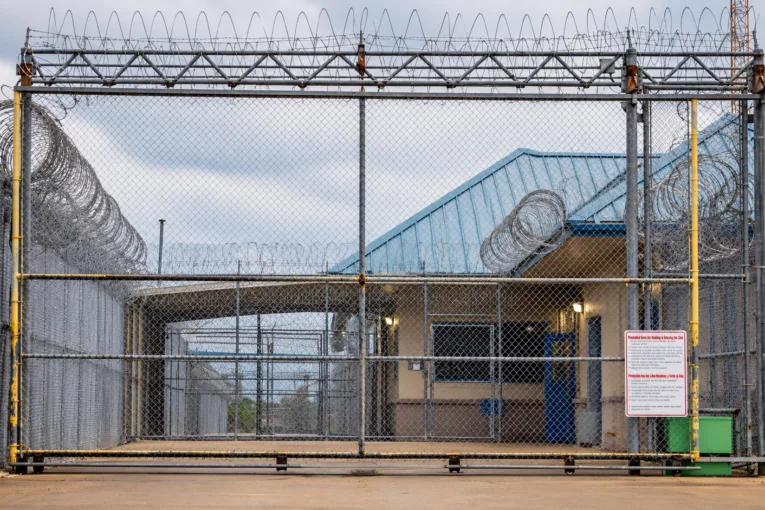
BOSTON, Mass. — Four legal services organizations filed a federal lawsuit Wednesday challenging a Department of Homeland Security policy that conceals the locations of thousands of immigration detainees facing deportation, arguing that the restrictions prevent attorneys and families from locating people in federal custody and undermine access to legal representation.
The lawsuit, filed Oct. 28 in the U.S. District Court for the District of Massachusetts, challenges a September policy removing detainees with final orders of removal from Immigration and Customs Enforcement’s Online Detainee Locator System.
Greater Boston Legal Services, Rian Immigrant Center, Florence Immigrant and Refugee Rights Project and Amica Center for Immigrant Rights allege that the policy violates the Administrative Procedure Act, Freedom of Information Act and First Amendment.
For more than 16 years, ICE’s online locator has allowed attorneys and family members to identify facilities holding people in immigration custody.
According to the complaint, DHS changed the policy in September without public notice, removing location information for detainees with final removal orders and instructing personnel not to disclose their whereabouts in response to inquiries.
The change affected more than 16,000 of approximately 69,000 people in ICE custody as of September, according to The Associated Press.
The plaintiffs argue that the restrictions interfere with their ability to communicate with clients, prepare legal filings and challenge potentially unlawful detention or deportation.
Although individuals with final removal orders have generally completed their initial immigration proceedings, they may still pursue legal remedies, including reopening cases, challenging detention or seeking protection from removal to countries where they face persecution or torture.
The lawsuit alleges that attorneys have struggled to locate clients after transfers between detention facilities, resulting in delayed or missed filings and reduced capacity to provide representation.
Attempts to obtain information through ICE telephone lines have frequently resulted in lengthy waits, disconnected calls or no response, according to the complaint.
An alternative ICE system for scheduling legal telephone calls operates at only a limited number of detention facilities, leaving attorneys without a reliable means of locating some clients.
The American Civil Liberties Union of Massachusetts, which is involved in the litigation, argues that the restrictions obstruct access to the courts and make it more difficult for detained immigrants to pursue available legal remedies.
“No one should be denied a meaningful opportunity to defend their rights because the government has made it impossible for their lawyer to find them,” said Jacquelynne Bowman, executive director of Greater Boston Legal Services.
“This arbitrary new administrative change leaves hundreds of thousands of people at risk of potentially life-altering consequences without essential legal help.”
Jackie Kelley, director of immigration legal services at the Rian Immigrant Center, also criticized the policy’s impact on representation.
“If we cannot locate our clients, we cannot pursue the relief for which they are legally eligible,” Kelley said. “This policy obstructs that right when our clients need it most.”
The plaintiffs contend that DHS implemented the policy without adequate explanation, making it arbitrary and capricious under the Administrative Procedure Act.
They also allege that the restrictions interfere with their First Amendment rights to communicate with existing and prospective clients and violate federal public disclosure requirements.
In the complaint, the organizations describe the detention network as “an even more impenetrable abyss in which people cannot be located by their loved ones or counsel.”
The federal government disputes the characterization that detainees are being hidden.
In a statement reported by The Associated Press, DHS maintained that detained immigrants retain ways to communicate with attorneys and family members.
The department also argued that individuals with final deportation orders should be removed from the country.
The plaintiffs are asking the court to vacate the policy and plan to seek an order suspending it while litigation proceeds, according to the National Immigration Law Center.
The case, Greater Boston Legal Services v. Mullin, remains pending, with no judicial determination that the policy violates federal law.
To comment please go to one of these social media platforms:
Facebook: https://www.facebook.com/DavisVanguard
LinkedIn: https://www.linkedin.com/company/peoples-vanguard-of-davis-inc/
Instagram: https://www.instagram.com/davisvanguard/
X: https://x.com/davisvanguard
Bluesky: https://bsky.app/profile/vanguardnewsgroup.bsky.social
Subscribe to the Vanguard News letters. To make a tax-deductible donation, please visit davisvanguard.org/donate or give directly through ActBlue. Your support will ensure that the vital work of the Vanguard continues.
