
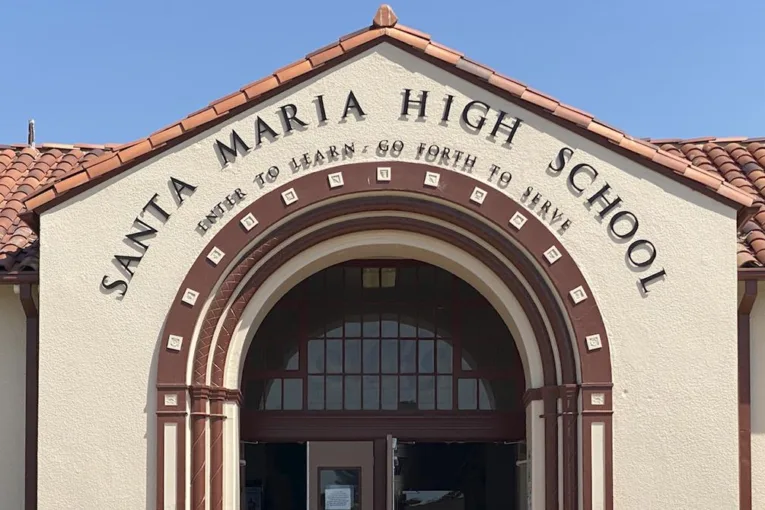
SANTA MARIA, Calif. — A 20-year-old U.S. citizen with disabilities was injured after federal immigration agents allegedly tackled and detained him while he was walking to Santa Maria High School on Oct. 21, prompting calls for an independent investigation into the use of force and the treatment of people with disabilities during immigration enforcement operations.
The student, who has limited verbal communication skills and receives special education services, was apparently mistaken for someone federal agents were seeking, according to the Santa Barbara Independent.
The student was walking to school Wednesday morning when agents allegedly approached, tackled and restrained him inside a vehicle less than half a mile from campus.
According to local reports, agents questioned him about his citizenship and physically restrained him before determining that he was not the individual they were seeking.
After releasing him, the agents allowed the student to continue walking to school, where staff noticed his injuries and called an ambulance. He was subsequently transported to a hospital for treatment.
Santa Maria City Councilmember Gloria Soto said the student suffered a wrist injury requiring surgery, along with bruises and cuts. Surveillance footage obtained from a nearby business reportedly helped establish the involvement of federal immigration agents.
The incident has generated conflicting accounts about whether the student resisted officers and whether the force used against him was justified.
U.S. Immigration and Customs Enforcement acknowledged that officers were conducting a targeted enforcement operation in Santa Maria but disputed allegations that agents used excessive force.
According to an ICE statement reported by El País, agents believed the student matched the description of an individual they were seeking.
To comment please go to one of these social media platforms:
Facebook: https://www.facebook.com/DavisVanguard
LinkedIn: https://www.linkedin.com/company/peoples-vanguard-of-davis-inc/
Instagram: https://www.instagram.com/davisvanguard/
X: https://x.com/davisvanguard
Bluesky: https://bsky.app/profile/vanguardnewsgroup.bsky.social
Subscribe to the Vanguard News letters. To make a tax-deductible donation, please visit davisvanguard.org/donate or give directly through ActBlue. Your support will ensure that the vital work of the Vanguard continues.
The agency claimed the student refused officers’ commands and assumed a fighting stance, prompting agents to physically restrain him while attempting to establish his identity.
ICE also maintained that the student did not request medical attention during the encounter.
However, the agency’s explanation has raised questions about whether the student’s limited verbal communication skills affected his ability to understand or comply with officers’ instructions.
The 805 Rapid Response Network, a volunteer organization that monitors immigration enforcement activity in the region, documented the incident and gathered information from witnesses.
The organization criticized the agents’ conduct and raised concerns about the treatment of a student with disabilities who was attempting to reach school.
Soto also challenged the federal government’s account and called for an independent investigation into the detention and the injuries the student sustained.
She requested a special City Council meeting to address community concerns surrounding the incident and questioned whether immigration agents had adequately considered the student’s disabilities before using force.
The Santa Maria Joint Union High School District also addressed the encounter.
Superintendent Antonio Garcia informed families that the Santa Maria Police Department had forwarded information about the incident to the Santa Barbara County District Attorney’s Office, the California attorney general and ICE’s regional office in Los Angeles.
The incident raises questions about constitutional protections during immigration enforcement operations, particularly the Fourth Amendment’s prohibition against unreasonable searches and seizures.
Federal immigration agents, like other law enforcement officers, must have a legally sufficient basis to detain an individual. An investigative detention generally requires reasonable suspicion supported by specific, articulable facts, while the use of force must be objectively reasonable under the circumstances.
A mistaken identification does not automatically make a detention unconstitutional. However, the legal justification for stopping someone and the reasonableness of the force used are separate questions.
The student’s disabilities could also be relevant to an assessment of the encounter, particularly if his communication limitations affected his ability to understand or respond to officers’ commands.
The case has drawn attention to the risks faced by people with disabilities during encounters with law enforcement, especially when officers interpret delayed responses, confusion or an inability to communicate as deliberate noncompliance.
The encounter occurred amid increased immigration enforcement activity in Santa Maria, where local organizations have reported operations near schools, workplaces and residential neighborhoods throughout October.
The student’s U.S. citizenship, the reported severity of his injuries and the conflicting accounts of the detention have intensified calls for scrutiny of federal agents’ identification procedures and use-of-force practices.
The central questions remain whether agents had sufficient grounds to detain the student, whether they reasonably interpreted his behavior and whether the force used against him was justified under the circumstances.
