
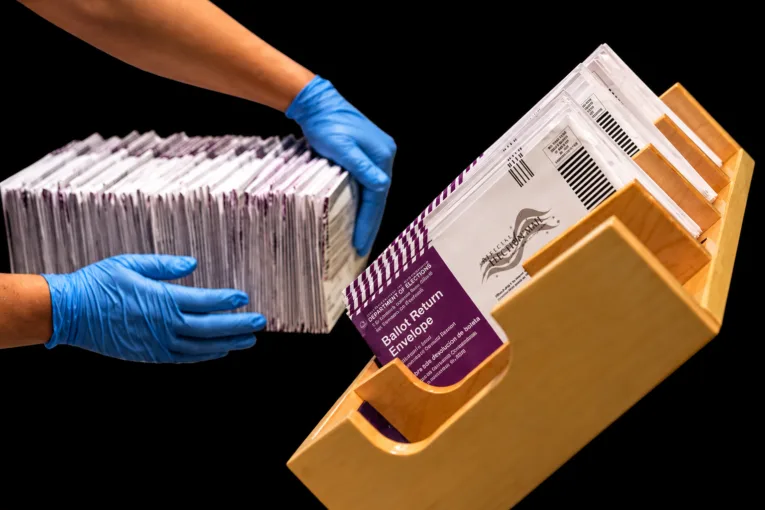
SACRAMENTO, Calif. — A federal judge Wednesday rejected the Trump administration’s emergency effort to prevent California from counting the ballots of approximately 20,000 registered voters suspected of being noncitizens, ruling that the government’s last-minute demands threatened constitutional protections and risked disenfranchising eligible voters just days before the November election.
In a sharply worded 26-page ruling, U.S. District Judge David O. Carter denied the Justice Department’s request for a temporary restraining order that would have required California election officials to segregate and withhold the ballots from the count while federal authorities investigated the voters’ citizenship status.
“Never before in American history has the federal government, on the eve of an election, sought to coerce a state and local government to abandon their own Constitutional elections procedures and bend to the will of the Executive Branch,” Carter wrote.
“But California and its people are sovereign, too,” the judge added.
The ruling represents the second legal setback for the administration this week, following a decision Monday by the U.S. Court of Appeals for the Ninth Circuit rejecting an emergency appeal that sought to bypass the district court.
Wednesday’s decision addresses the substance of the administration’s emergency request, finding that the federal government had failed to justify extraordinary judicial intervention in an election already underway.
The Justice Department had sought to force California to segregate ballots returned by approximately 20,000 voters whom federal officials claimed were likely noncitizens, relying on data developed by the Department of Homeland Security.
But the administration acknowledged that its list could include American citizens, raising concerns that eligible voters could have their ballots excluded without adequate evidence that they were ineligible.
The federal government’s original allegations were considerably broader. In July, the administration claimed that California had more than 190,000 noncitizens on its voter rolls before reducing that figure to approximately 20,000 when it pursued the litigation.
California Attorney General Rob Bonta argued that the administration had failed to provide the underlying data and methodology necessary for state officials to independently assess the allegations.
The state also maintained that the proposed restrictions would violate federal voting protections, interfere with California’s authority to administer elections and introduce substantial confusion into the voting process.
Carter’s ruling expressed serious concerns about the reliability of the government’s allegations and the potential consequences of acting on unverified claims of noncitizenship.
The judge also examined the constitutional division of authority between federal and state governments, emphasizing that the administration could not simply require California to alter its election procedures based on disputed allegations.
The decision addressed protections under the National Voter Registration Act, the Voting Rights Act and other federal election laws, along with the constitutional concerns raised by changing election procedures immediately before an election.
Carter warned that the consequences of interfering with the counting of ballots could extend beyond the voters directly affected.
“Eroded trust in our democracy is irreparable. Once a vote is segregated, lasting harm has occurred. If the Executive can discount votes and threaten an ongoing election due to unproven allegations, then our democracy is in danger. This Court declines to be a party to such process,” Carter wrote.
The judge also placed the dispute within the broader history of efforts to restrict ballot access, citing poll taxes, literacy tests and other barriers previously used to prevent Americans from voting.
“Every generation in our history has witnessed repeated clashes between those who seek to limit access to the ballot and those who fight to ensure it,” Carter wrote.
The court concluded that the administration’s request violated longstanding constitutional principles recognizing state authority over elections and could deprive more than 20,000 registered Californians of their voting rights.
“If Plaintiff’s last-minute request for relief were granted, either party could create chaos for their own political purposes to disrupt the election process,” Carter wrote.
In a statement Wednesday, Gov. Gavin Newsom welcomed the decision and accused the administration of attempting to interfere with California’s authority to conduct elections.
“For the second day this week, our country’s legal system is standing up to the President’s authoritarian attempts to remain in power unchecked and unchallenged,” Newsom said.
“For more than a year, California’s sovereignty has been under siege, and this lawsuit is his latest attack on the rule of law, the California Constitution, and the U.S. Constitution.”
Newsom said California would continue administering its election under state and federal law despite the administration’s challenge.
“California will continue to deliver a free and fair election that follows both state and federal law, as the Judicial Branch — importantly a co-equal branch of government — is deciding in real time, much to the Trump Administration’s dismay,” he said.
Bonta similarly characterized the decision as a victory for voting rights and the state’s authority to conduct elections without unwarranted federal interference.
“No administration can disenfranchise thousands of individuals or disrupt an ongoing election based on highly unreliable claims of noncitizenship,” Bonta said.
“Today’s ruling is yet another important victory for the rule of law and the right to vote. But this fight is not over. We will keep fighting to protect California’s elections from unlawful federal interference and get this baseless lawsuit dismissed.”
The attorney general’s office said the ruling supported California’s position that the administration lacked a sufficient legal basis for its requested intervention and had failed to substantiate the citizenship allegations underlying its proposed restrictions.
The state has also challenged the timing of the federal government’s actions, arguing that imposing new ballot-counting procedures during an ongoing election would create unnecessary confusion and potentially prevent eligible voters from participating.
The case comes amid a broader confrontation between the administration and state election officials over voter registration records, citizenship verification and federal authority over election administration.
The Trump administration has argued that its actions are necessary to prevent ballots from being cast or counted unlawfully by noncitizens, who are prohibited from voting in federal elections.
California officials have not disputed that prohibition but maintain that the federal government must provide reliable evidence and comply with constitutional and statutory protections before attempting to interfere with the ballots of registered voters.
The dispute also raises questions about the reliability of federal citizenship databases when used to assess voter eligibility, particularly for naturalized citizens whose records may not be accurately reflected in government systems.
Wednesday’s ruling does not resolve the underlying federal lawsuit. The court denied the administration’s request for immediate emergency relief, while California’s motion to dismiss the broader case remains pending.
For now, the decision leaves California’s existing ballot-counting procedures intact as voters continue participating in the November 3 election.
The judge’s concluding warning underscored the stakes of the administration’s request.
“Over 20,000 registered Californians would potentially lose the right that generations of Americans have fought to preserve,” Carter wrote. “The Government’s Application for Temporary Restraining Order is DENIED.”
To comment please go to one of these social media platforms:
Facebook: https://www.facebook.com/DavisVanguard
LinkedIn: https://www.linkedin.com/company/peoples-vanguard-of-davis-inc/
Instagram: https://www.instagram.com/davisvanguard/
X: https://x.com/davisvanguard
Bluesky: https://bsky.app/profile/vanguardnewsgroup.bsky.social
Subscribe to the Vanguard News letters. To make a tax-deductible donation, please visit davisvanguard.org/donate or give directly through ActBlue. Your support will ensure that the vital work of the Vanguard continues.
