
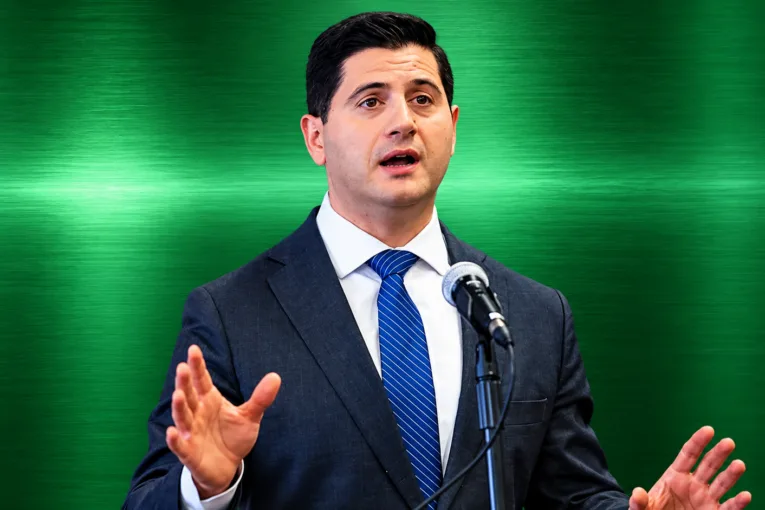
LOS ANGELES — A federal judge ruled Tuesday that Bill Essayli is unlawfully exercising the authority of the U.S. attorney for the Central District of California, finding that the Trump administration’s efforts to keep him in charge of the office after his temporary appointment expired violated federal law.
Senior U.S. District Judge J. Michael Seabright disqualified Essayli from overseeing two criminal cases, although enforcement of the order was delayed to allow the Department of Justice to seek a stay pending appeal.
According to ABC News, the decision represents another legal setback for the Trump administration’s efforts to install federal prosecutors without obtaining Senate confirmation.
Under federal law, an interim U.S. attorney appointed by the attorney general generally may serve for 120 days. Once that period expires, the appointment process is subject to additional statutory requirements.
Essayli was appointed acting U.S. attorney in 2025. As the statutory limit approached, the administration designated him first assistant U.S. attorney, allowing him to continue exercising leadership authority within the office.
In October 2025, Seabright ruled that Essayli could no longer lawfully serve as acting U.S. attorney because his temporary appointment had exceeded the statutory limit. However, Essayli remained in the office as first assistant U.S. attorney.
In Tuesday’s ruling, Seabright concluded that the administration’s subsequent arrangements had not resolved the underlying legal problem.
“Essayli is unlawfully serving as a ‘de facto’ United States Attorney,” Seabright wrote.
The ruling followed a decision by the U.S. Court of Appeals for the Ninth Circuit rejecting a similar arrangement involving Sigal Chattah, who had been serving as Nevada’s top federal prosecutor without Senate confirmation.
The appellate court determined that federal appointment requirements could not be circumvented simply by assigning an official a different title while allowing that person to continue exercising the authority of a U.S. attorney.
Following that decision, the Justice Department revised Essayli’s designation to exclude certain statutory powers reserved for U.S. attorneys.
At a hearing earlier this month, Assistant U.S. Attorney Alexander Robbins argued that the revised arrangement complied with federal law because Essayli no longer possessed those specific powers.
Seabright rejected that argument, finding that the changes did not meaningfully alter Essayli’s authority over the office.
“Withholding the three specific statutory powers mentioned in the revised designation order in reality withholds nothing,” Seabright wrote.
The decision drew praise from defense attorneys who had challenged Essayli’s authority.
In an interview with the Los Angeles Times, defense attorney H. Dean Steward, who previously filed a motion challenging Essayli’s appointment, called the ruling “a victory for the rule of law and the U.S. Constitution.”
“The Trump administration ignored the laws governing the appointment of U.S. attorneys and got caught in Los Angeles,” Steward said.
He further accused the administration of having “violated the law again and again in an effort to install minions as chief federal prosecutors.”
The ruling carries broader implications because Essayli has overseen a number of politically sensitive prosecutions and investigations in Southern California.
According to The Guardian, his office has pursued cases involving immigration enforcement and protesters opposing the Trump administration’s immigration policies.
Essayli has also been involved in allegations concerning California voter eligibility, asserting that thousands of registered voters were potentially noncitizens and urging that their ballots be set aside. California election officials have disputed those allegations.
Although Seabright’s ruling directly concerns Essayli’s authority in two criminal cases, it raises broader questions about the administration’s use of temporary appointments to maintain control over federal prosecutors’ offices without Senate confirmation.
Essayli disputed the decision and indicated that he intended to continue serving while the legal challenge proceeds.
“Ultimately, this question will be decided by the Supreme Court, and I look forward to serving in my current role until then,” Essayli said.
According to the Los Angeles Times, prosecutors were given five days to pursue an appeal. The disqualification order would take effect one week later unless Seabright or an appellate court granted additional relief.
The ruling does not automatically invalidate prosecutions previously handled by Essayli’s office, but it creates further uncertainty about the legal authority under which he has continued to supervise federal criminal cases.
To comment please go to one of these social media platforms:
Facebook: https://www.facebook.com/DavisVanguard
LinkedIn: https://www.linkedin.com/company/peoples-vanguard-of-davis-inc/
Instagram: https://www.instagram.com/davisvanguard/
X: https://x.com/davisvanguard
Bluesky: https://bsky.app/profile/vanguardnewsgroup.bsky.social
Subscribe to the Vanguard News letters. To make a tax-deductible donation, please visit davisvanguard.org/donate or give directly through ActBlue. Your support will ensure that the vital work of the Vanguard continues.requirements. The Justice Department may appeal, while the ruling raises broader questions about temporary appointments and Senate confirmation.
