
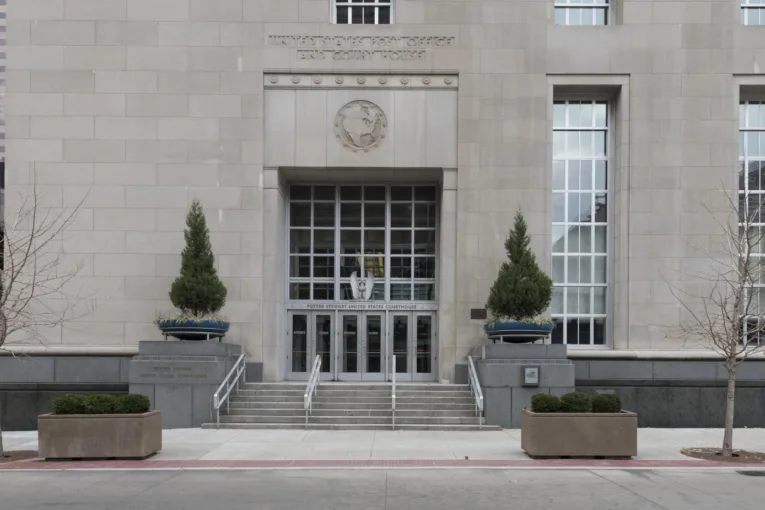
COLUMBUS, Ohio — A federal appeals court ruled Oct. 26 that a former Ohio police chief is not entitled to statutory immunity at the summary judgment stage of a lawsuit alleging he used criminal charges and an arrest warrant to retaliate against a consultant investigating complaints about his department.
In its opinion, the U.S. Court of Appeals for the Sixth Circuit found sufficient evidence for a jury to consider whether former Perry Township Police Chief Michael T. Pomesky acted maliciously or in bad faith toward consultant F. Dyann McDowell.
The ruling allows McDowell’s abuse-of-process claim to proceed but does not establish that Pomesky is liable.
Judge Rachel Bloomekatz, writing for the appellate panel, affirmed the district court’s denial of statutory immunity and returned the case for further proceedings.
According to the opinion, Perry Township hired McDowell and her consulting company, Training Marbles, in the summer of 2022 to review the township’s human resources practices, including complaints about Pomesky’s management of the police department.
Employees described conduct they considered intimidating and retaliatory, expressing concerns that participating in McDowell’s interviews could expose them to retaliation.
McDowell presented evidence that Pomesky monitored employees arriving for interviews and investigated an employee who alerted her to his presence.
The appellate court emphasized that, at this stage of the proceedings, it was required to view the evidence in the light most favorable to McDowell. Its account therefore does not constitute factual findings following a trial.
According to the opinion, McDowell became concerned about her safety after Pomesky suggested he knew where she lived, although she had never disclosed her address to him.
Suspecting that someone had accessed her personal information through a police database, McDowell falsely told Pomesky that she had received a notification about a database search.
McDowell said she hoped the statement would discourage further conduct she considered threatening. Instead, Pomesky investigated the claim and determined that no such notification existed.
He subsequently referred McDowell’s false statement to a prosecutor, who concluded that probable cause supported misdemeanor falsification and obstruction charges.
The dispute centers on Pomesky’s decision to obtain an arrest warrant rather than use a summons, which the opinion described as the customary procedure for comparable misdemeanor cases.
Under Ohio law, municipal employees generally receive statutory immunity from civil liability for conduct performed in connection with their governmental duties. That protection does not extend to conduct undertaken with malicious purpose, in bad faith or in a wanton or reckless manner.
Pomesky argued that his actions were legally authorized and supported by probable cause, rather than motivated by malice or bad faith.
The appellate panel rejected the argument that probable cause alone was sufficient to establish immunity.
The court explained that an abuse-of-process claim can arise even when legal proceedings are properly initiated and supported by probable cause. The alleged misconduct involves using those proceedings for an improper purpose.
Allowing probable cause to automatically establish immunity, the panel reasoned, would prevent claims against public officials even when evidence suggested that legal proceedings had been used maliciously.
The court also distinguished the immunity question from the underlying abuse-of-process claim.
Evidence sufficient to defeat statutory immunity does not necessarily establish every element of abuse of process or guarantee that McDowell will prevail.
According to the panel, a reasonable jury could conclude that Pomesky departed from customary procedures to discredit McDowell and interfere with her investigation.
Whether McDowell can prove those allegations remains unresolved.
The ruling allows the lawsuit to proceed while reinforcing the distinction between an official’s legal authority to initiate criminal proceedings and the possibility that such authority was exercised for an improper purpose.
To comment please go to one of these social media platforms:
Facebook: https://www.facebook.com/DavisVanguard
LinkedIn: https://www.linkedin.com/company/peoples-vanguard-of-davis-inc/
Instagram: https://www.instagram.com/davisvanguard/
X: https://x.com/davisvanguard
Bluesky: https://bsky.app/profile/vanguardnewsgroup.bsky.social
Subscribe to the Vanguard News letters. To make a tax-deductible donation, please visit davisvanguard.org/donate or give directly through ActBlue. Your support will ensure that the vital work of the Vanguard continues.
