
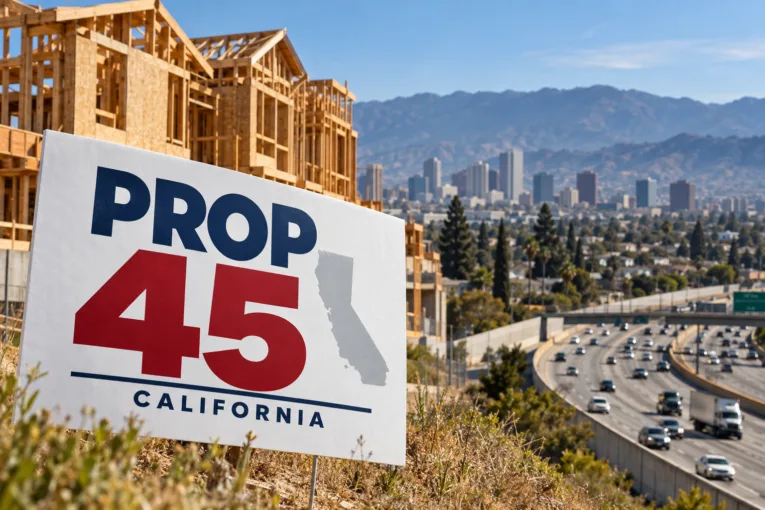
SACRAMENTO, Calif. — Proposition 45, a sweeping proposal to streamline environmental review for housing and infrastructure projects across California, has failed to win the support of several of the state’s prominent pro-housing organizations, exposing a divide over whether broad changes to the California Environmental Quality Act would accelerate needed housing or encourage sprawl and environmentally damaging development.
While supporters argue the measure could reduce delays and costs that have made housing and other essential infrastructure increasingly difficult to build, several prominent housing and urbanist organizations have either opposed Proposition 45 or declined to endorse it, warning that its provisions extend well beyond infill housing.
California YIMBY, one of the state’s most prominent organizations advocating increased housing production, has taken no position on Proposition 45, concluding that the measure presents legitimate arguments on both sides.
“While this measure does affect housing, it’s not primarily about housing,” California YIMBY wrote. “Rather, it’s about reining in an out of control CEQA process that has ballooned far beyond what the legislature intended in 1970 and made building large projects slow and expensive.”
The organization acknowledged that Proposition 45 incorporates several approaches housing advocates have supported for years, including firm permitting deadlines, objective standards, limitations on agency discretion and narrower remedies in litigation.
“The bottom line: there are good reasons to support this measure and good reasons to oppose it,” California YIMBY concluded. “Housing voters should consider it in light of broader concerns about climate and sustainability.”
The measure, sponsored by the California Chamber of Commerce, would amend CEQA to create expedited environmental review procedures for broad categories of projects, including most housing, transportation, water, health, wildfire mitigation, educational facilities, broadband and clean energy projects.
According to the California secretary of state, Proposition 45 would establish deadlines for agencies to complete environmental reviews, limit the alternatives agencies must consider and impose deadlines on lawsuits challenging project approvals. It would also restrict the evidence courts may consider and the remedies they may impose.
Supporters contend those changes are necessary because California’s existing approval system makes projects unnecessarily expensive and time-consuming.
“The failing status quo is making California unaffordable,” proponents argue in the official voter guide. “Prop. 45 fixes our broken system and lowers our high cost of living by cutting red tape to build housing, water, schools, hospitals, clean energy, and wildfire prevention faster—while maintaining California’s strong environmental protections.”
The official voter guide lists the California Council for Affordable Housing among Proposition 45’s supporters, along with the California Children’s Hospital Association and California Water Association.
But the measure has divided organizations that broadly agree California needs to build considerably more housing and that CEQA has sometimes been used to delay development.
East Bay for Everyone, a Bay Area housing advocacy organization, has come out against Proposition 45, arguing that recent legislative reforms have already provided substantial CEQA relief for infill development.
“Prop 45 aka BACA [Building a Better California Act] is about streamlining destructive sprawl—not infill housing,” the organization wrote.
East Bay for Everyone pointed to legislation enacted in 2025 that streamlined or exempted qualifying infill housing from CEQA review, arguing Proposition 45 would consequently provide some of its most significant housing benefits to development outside already developed communities.
The group contends the measure could make it easier to build single-family subdivisions, highways, water infrastructure and other projects necessary to support outward expansion.
“So if we’ve already streamlined infill housing under CEQA, what does Prop 45 do for infill housing? Nothing,” East Bay for Everyone wrote.
California YIMBY offered a more nuanced assessment but identified a similar concern. Its analysis notes that last year’s AB 130 created a CEQA exemption for broadly defined infill housing, while Proposition 45 would make it easier to build housing projects — primarily new subdivisions — that do not qualify for that exemption.
“While Prop 45 will speed public agency approvals for all housing, it will also make it easier to build car-dependent sprawl housing and the freeways and water infrastructure necessary to serve that sprawl,” California YIMBY wrote.
The organization nevertheless acknowledged that some greenfield development may be necessary to address California’s housing shortage and that many Californians want single-family homes on larger lots.
California YIMBY also pointed to potential development in wildfire-prone areas.
“We should not be building new homes in the fire-prone wildland urban interface because doing so puts people in harm’s way and exacerbates our insurance crisis,” the group wrote.
SPUR, the San Francisco Bay Area Planning and Urban Research Association, similarly declined to recommend either a yes or no vote after its board was unable to reach the supermajority required to adopt a position.
SPUR said it agrees that CEQA can create excessive risk, cost, uncertainty and delay and noted that Proposition 45 could accelerate infill housing, zero-emission energy projects and other development it supports.
The organization nevertheless expressed concern that the measure could also accelerate projects contributing to sprawl and environmental harm.
“The SPUR Board of Directors supports removing excessive risk, uncertainty, and delay from building infill housing, public transit, drinking water, hospitals, schools, and truly zero-emission infrastructure in the right places, but it remains deeply concerned about this measure’s potential negative impacts,” SPUR stated.
SPUR concluded the measure could streamline environmentally harmful projects regardless of their location or scale, potentially worsen pollution in environmental justice communities and make participation in environmental review more difficult. It also raised concerns about development on the urban edge and in hazard-prone areas.
The organization identified potential benefits as well, including reducing project delays and costs, speeding safety projects such as undergrounding power lines and making what it characterized as frivolous litigation easier to dismiss.
The debate underscores an increasingly important distinction in California’s housing politics: disagreement over Proposition 45 is not necessarily a disagreement over whether CEQA should be reformed.
California YIMBY, East Bay for Everyone and SPUR have supported environmental streamlining in various contexts, particularly for infill housing. Their disagreement with or reservations about Proposition 45 center substantially on whether its reforms are sufficiently targeted or extend too broadly to projects that could increase driving, pollution and development in environmentally sensitive or wildfire-prone areas.
Proposition 45 supporters counter that California cannot address its housing shortage, infrastructure deficiencies and high cost of living without broader changes to a regulatory system they argue allows essential projects to be delayed for years.
The Legislative Analyst’s Office describes the measure as creating an optional new process for projects Proposition 45 defines as “essential,” tightening deadlines for environmental reviews, permits and court challenges while changing the scope of both CEQA review and subsequent litigation.
The state estimates implementation would initially cost state and local governments in the high tens of millions of dollars annually and potentially more than $100 million, partly offset by fees. Longer-term fiscal effects could be positive or negative depending in part on how the measure changes what projects are ultimately built and their environmental impacts.
The divide among housing advocates therefore centers less on whether California should make it easier to build than on what projects should receive streamlined treatment, where those projects should be built and how much environmental and judicial review should remain as the state confronts its housing and affordability crisis.
To comment please go to one of these social media platforms:
Facebook: https://www.facebook.com/DavisVanguard
LinkedIn: https://www.linkedin.com/company/peoples-vanguard-of-davis-inc/
Instagram: https://www.instagram.com/davisvanguard/
X: https://x.com/davisvanguard
Bluesky: https://bsky.app/profile/vanguardnewsgroup.bsky.social
Subscribe to the Vanguard News letters. To make a tax-deductible donation, please visit davisvanguard.org/donate or give directly through ActBlue. Your support will ensure that the vital work of the Vanguard continues.
