
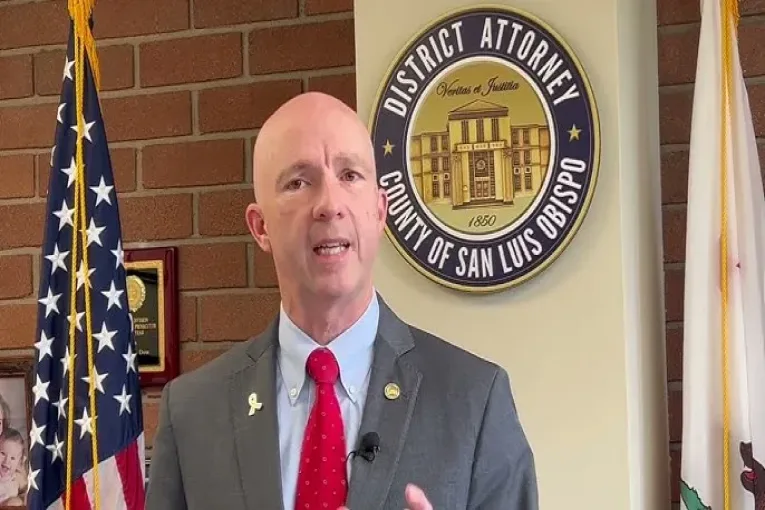
SAN LUIS OBISPO, Calif. — San Luis Obispo County District Attorney Dan Dow announced Thursday that his office is investigating 63 voter registrations flagged by federal authorities as potentially belonging to noncitizens, even as the county’s top election official reported that some individuals on the list had already been confirmed as U.S. citizens.
The announcement came one day after a federal judge rejected the Trump administration’s attempt to segregate more than 20,000 California ballots based on similar citizenship allegations, finding that the federal government had failed to provide credible evidence supporting its claims.
According to a news release, Dow’s Bureau of Investigation is examining two sets of election-related referrals: a list of 63 suspected noncitizens provided by federal authorities and separate referrals from the San Luis Obispo County Clerk-Recorder concerning possible unlawful voting in the current election.
The federal referral originated with an Oct. 22 letter from Bilal A. Essayli, first assistant U.S. attorney for the Central District of California, to County Clerk-Recorder and Registrar of Voters Elaina Cano.
The letter identified 63 individuals whom the Department of Homeland Security believed were registered to vote in San Luis Obispo County but might not be U.S. citizens.
Federal officials requested that any vote-by-mail ballots associated with those individuals be set aside and not processed until their citizenship could be verified.
The letter also sought confidential voter registration information, including Social Security numbers, identification documents and registration applications, according to reporting by the New Times of San Luis Obispo.
However, Cano questioned the accuracy of the federal allegations and rejected the request to alter established election procedures.
According to a report by KCBX, Cano said her office had examined some of the names provided by federal authorities and found that individuals with active voter registrations were confirmed U.S. citizens.
“Most of them are either inactive or canceled,” Cano said of the remaining registrations.
The findings raised questions about the reliability of the federal list and whether it provided sufficient grounds to challenge the eligibility of registered voters.
Cano also emphasized that federal and state law establish specific procedures for determining voter eligibility and challenging vote-by-mail ballots.
“The demands presented in the DOJ’s letter are not a substitute for those legally prescribed procedures,” Cano said in a statement reported by KEYT.
“A list of individuals alleged to be ineligible to vote does not, on its own, authorize our office to set aside their ballots or disregard established election law,” she added.
Cano cited California Elections Code Sections 15105 and 15106, which govern challenges involving vote-by-mail voters and establish requirements for the evidence necessary to support those challenges.
She also said her office would protect confidential voter information and comply with lawful investigations without abandoning the legal requirements governing election administration.
“We take allegations of improper voter registration seriously and will always cooperate with lawful investigations conducted through appropriate channels,” Cano said. “But cooperation does not mean setting aside the laws we are sworn to uphold.”
Dow, meanwhile, said his office would independently investigate the referrals and pursue charges if evidence established that individuals had voted unlawfully.
“Every eligible voter in San Luis Obispo County should vote, and every lawful vote deserves to be protected,” Dow said.
“If anyone who is not lawfully registered votes in San Luis Obispo County, my office will investigate and pursue criminal charges,” he added.
The district attorney’s office emphasized that inclusion on the federal list does not establish that an individual committed a crime.
“Being named on a list is not proof of a crime,” the office stated in its release.
Prosecutors said any decision to file criminal charges would depend on evidence independently gathered and reviewed by investigators.
Under California Elections Code Section 18560, fraudulent voting by an individual who is not legally entitled to vote can constitute a criminal offense. Federal law also generally prohibits noncitizens from voting in elections involving federal offices.
The San Luis Obispo investigation comes amid a broader legal dispute between the Trump administration and California officials over federal efforts to identify suspected noncitizens on voter registration lists.
On Oct. 28, U.S. District Judge David O. Carter denied the federal government’s request for a temporary restraining order that would have required California officials to segregate ballots associated with more than 20,000 registered voters.
In his 26-page ruling, Carter found that the Justice Department had not demonstrated a likelihood of success on the merits and that the requested intervention threatened to disrupt California’s election procedures days before the Nov. 3 election.
The dispute began in July when the Department of Homeland Security informed California Secretary of State Shirley Weber that as many as 190,832 noncitizens might be registered to vote in the state.
Weber questioned the accuracy of the allegations and requested information about the methodology used to identify the individuals.
According to Carter’s order, DHS did not provide the requested explanation.
On Oct. 13, federal officials delivered a list of more than 20,000 suspected noncitizens to Los Angeles County Registrar-Recorder Dean Logan, directing the county to determine within 48 hours whether the individuals were citizens.
The federal government sought to prevent election officials from processing or counting ballots associated with individuals whose citizenship could not be confirmed.
However, the county’s preliminary review revealed significant problems with the list.
Of the more than 20,000 records, only 7,035 contained addresses in Los Angeles County, according to the court’s order.
A sample review of 200 records found that many registrations were canceled or inactive, while more than 71% of individuals on the broader list had never voted in previous elections.
Carter also noted that federal officials had failed to provide election administrators with sufficient information or a workable process for verifying the citizenship of the individuals identified.
The judge questioned whether the federal government had legal standing to bring the lawsuit and rejected its preliminary argument that federal criminal prohibitions on noncitizen voting superseded California’s election procedures.
California law already prohibits noncitizens from voting in federal elections and provides procedures for identifying and removing ineligible voters, Carter explained.
The judge found that the state’s existing requirements reinforced federal prohibitions rather than conflicting with them.
Carter also cited constitutional limits on the federal government’s ability to compel state and local officials to administer federal enforcement priorities.
“The DOJ’s actions are indicative of a broad, ongoing pattern of attempted election interference by federal officials,” Carter wrote.
The judge pointed to similar federal efforts to obtain voter registration information in other states, including cases in which courts had rejected the Justice Department’s demands.
He also cited problems with citizenship lists produced by federal authorities, including an instance in Nevada in which state officials determined that individuals identified by DHS as confirmed noncitizens were U.S. citizens.
In the California case, Carter concluded that granting the requested order could disrupt an election already underway and potentially prevent eligible voters from having their ballots counted.
“This case is about the right of every American citizen to vote in a free and fair election,” Carter wrote.
“Never before in American history has the federal government, on the eve of an election, sought to coerce a state and local government to abandon their own Constitutional elections procedures and bend to the will of the Executive Branch.”
The judge added, “But California and its people are sovereign, too.”
The ruling denied the government’s emergency request but did not resolve the underlying lawsuit or determine the eligibility of every voter identified by federal authorities.
The San Luis Obispo investigation is separate from the federal litigation involving Los Angeles County, although both concern voter registration information supplied by federal immigration authorities.
Cano’s preliminary findings that some individuals on the San Luis Obispo list were confirmed citizens raise additional questions about the accuracy of the information being used to initiate investigations.
Dow’s office has not announced criminal charges arising from the 63-person list, and the district attorney’s release did not establish that any individual identified by federal authorities had voted unlawfully.
With the Nov. 3 election approaching, the dispute highlights the distinction between investigating specific allegations of election fraud and restricting voting rights based on citizenship claims that have not been independently verified.
To comment please go to one of these social media platforms:
Facebook: https://www.facebook.com/DavisVanguard
LinkedIn: https://www.linkedin.com/company/peoples-vanguard-of-davis-inc/
Instagram: https://www.instagram.com/davisvanguard/
X: https://x.com/davisvanguard
Bluesky: https://bsky.app/profile/vanguardnewsgroup.bsky.social
Subscribe to the Vanguard News letters. To make a tax-deductible donation, please visit davisvanguard.org/donate or give directly through ActBlue. Your support will ensure that the vital work of the Vanguard continues.
