
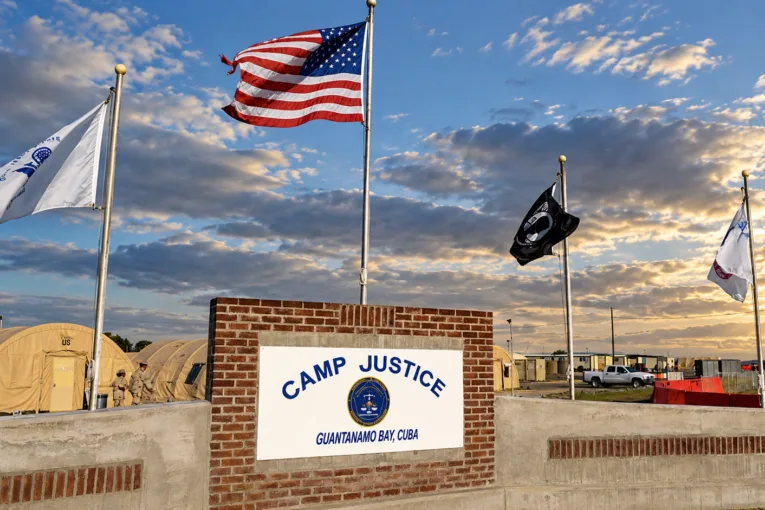
WASHINGTON, D.C. — The U.S. Supreme Court on Oct. 19 declined to review a dispute over plea agreements negotiated with three men accused of involvement in the Sept. 11, 2001, attacks, leaving in place a federal appellate ruling allowing the government to withdraw agreements that would have spared the accused the death penalty.
Khalid Sheikh Mohammed, Walid bin Attash and Mustafa al Hawsawi reached agreements in July 2024 under which they would plead guilty in exchange for life sentences without parole rather than face possible execution, according to SCOTUSblog.
The agreements were approved by Brig. Gen. Susan Escallier, the official overseeing the Guantanamo Bay military commissions. Two days later, then-Secretary of Defense Lloyd Austin intervened, reclaimed authority over the agreements and withdrew them, according to Justice Department filings.
Austin maintained that decisions concerning the death penalty in a prosecution involving the Sept. 11 attacks should rest with the defense secretary rather than subordinate military officials.
A military judge ruled in November 2024 that Austin’s withdrawal was invalid, finding that the prosecution had failed to identify “any source of law authorizing the Secretary of Defense to ‘withdraw’ Ms. Escallier’s authority.”
The U.S. Court of Military Commission Review subsequently upheld the military judge’s determination that the agreements remained enforceable.
However, a divided panel of the U.S. Court of Appeals for the District of Columbia Circuit overturned those decisions in July 2025, concluding that Austin possessed the authority to withdraw the agreements before the accused began fulfilling their obligations under them.
Judges Patricia Millett and Neomi Rao formed the majority, while Judge Robert Wilkins dissented.
The appellate court concluded that Austin “indisputably had legal authority to withdraw from the agreements,” according to Reuters.
Defense attorneys challenged both Austin’s authority to reverse the agreements and the appellate court’s intervention through extraordinary writs of mandamus and prohibition, arguing that the decision improperly displaced the military courts responsible for overseeing the prosecution.
“By granting the prosecution’s mandamus petition, the court of appeals permitted the Secretary of Defense to succeed in his untimely effort to withdraw the plea agreements, in defiance of controlling military law and effectively overriding the military courts closest to the matter,” the accused argued in their Supreme Court petition.
The defense maintained that the decision “thereby prolonged the best chance for finality in the September 11 case in a quarter century.”
The Justice Department defended Austin’s authority and the appellate court’s jurisdiction to intervene, arguing that the government was entitled to withdraw the agreements before the accused began performing their obligations.
Following the Supreme Court’s decision, a Justice Department spokesperson told Reuters that the ruling cleared the way to hold those responsible for the attacks accountable.
The Supreme Court issued no opinion explaining its denial of review. Justice Brett Kavanaugh did not participate in consideration of the petition filed by Mohammed and al Hawsawi.
The denial does not constitute a ruling on the merits of the legal dispute, but it leaves the appellate court’s decision in place and allows prosecutors to continue pursuing capital charges.
The proceedings have continued for more than two decades amid disputes over the admissibility of evidence obtained through CIA interrogations, allegations of torture, classified information and the procedures governing military commissions.
Legal researcher Edmarverson A. Santos, founder of Diplomacy and Law, described the case as “a prosecution affected by more than two decades of detention, disputed interrogation evidence, and repeated procedural challenges.”
“The prolonged proceedings reflect both the complexity of the criminal allegations and the difficulties associated with the military-commission system,” Santos wrote. “Their cumulative effects raise substantial fair-trial concerns, although the length of the proceedings alone does not establish that every applicable legal guarantee has been violated.”
The abandoned agreements would have required guilty pleas while eliminating the possibility of execution. They also offered a potential resolution to a prosecution that has remained unresolved since the accused were first brought before military commissions.
Families of those killed in the Sept. 11 attacks have expressed differing views about the agreements, with some supporting a trial and others viewing negotiated guilty pleas as a means of securing accountability after years of delays.
Mohammed and his co-defendants remain detained at Guantanamo Bay, with a military commission trial currently scheduled for June 2028, according to Axios.
The Supreme Court’s denial ends the accused’s immediate effort to revive the agreements through the nation’s highest court, but it does not determine their guilt or resolve the remaining legal disputes surrounding the prosecution.
To comment please go to one of these social media platforms:
Facebook: https://www.facebook.com/DavisVanguard
LinkedIn: https://www.linkedin.com/company/peoples-vanguard-of-davis-inc/
Instagram: https://www.instagram.com/davisvanguard/
X: https://x.com/davisvanguard
Bluesky: https://bsky.app/profile/vanguardnewsgroup.bsky.social
Subscribe to the Vanguard News letters. To make a tax-deductible donation, please visit davisvanguard.org/donate or give directly through ActBlue. Your support will ensure that the vital work of the Vanguard continues.
