
Much has been written about how the coming midterm election is the second midterm of Donald Trump’s time as president. Recent second midterms have been particularly bad for the party in power in almost every election since 1966, the sixth year of Democratic control of the White House under John F. Kennedy and Lyndon Johnson.
Other poor outcomes for the party in the White House occurred during the sixth year of the administrations of Richard Nixon and Gerald Ford in 1974, Ronald Reagan in 1986, George W. Bush in 2006 and Barack Obama in 2014.
The only exception to this trend in the modern era occurred during Bill Clinton’s second term. In 1998, when the opposition already held majorities in both houses of Congress, the president’s party picked up five seats in the House but remained in the minority.
While this can technically be thought of as Trump’s second midterm, another way of looking at the election might better reflect the current mood of the American electorate and help us consider how the election might turn out.
Instead of thinking about this as Trump’s second midterm, a more revealing perspective is that this is the third midterm since Trump was first elected president 10 years ago.
Midterm elections 10 years after a president was first elected have occurred only twice in American history. These elections took place in 1894 under Grover Cleveland and in 1942 under Franklin D. Roosevelt. Both turned out badly for the party in power.
In 1942, with the country immersed in World War II, the opposition picked up 45 seats in the House of Representatives and eight seats in the Senate.
Despite the losses, Roosevelt was able to maintain majorities in both houses of Congress because of his popularity and the large Democratic majorities established during his presidency.
A more interesting, and perhaps more relevant, election occurred in 1894.
The election of 1894 was the second midterm under Grover Cleveland, who had returned to office after winning the presidency in 1892, having lost reelection in 1888.
Like Trump, Cleveland returned to the White House after losing reelection and spending four years out of office. Cleveland’s return to the presidency made the election of 1894 the midterm at the 10-year mark since he was first elected in 1884.
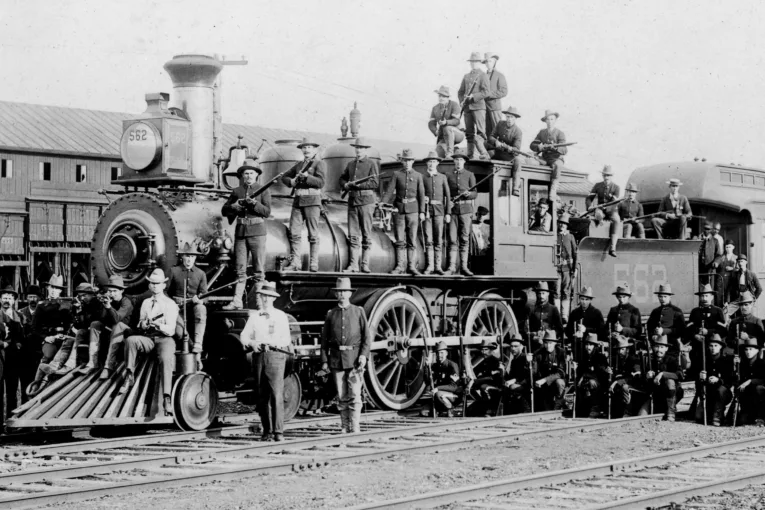
The election of 1894 occurred in the wake of the Pullman railroad strike.
To break the strike, the Cleveland administration determined that delivery of the mail fell under federal jurisdiction and could not be interfered with. The administration used interference with mail delivery as a justification for federal intervention in the strike.
The railroads carried mail cars on their trains, making disruptions caused by the Pullman strike a potential interference with mail delivery.
To enforce the unimpeded delivery of the mail, Cleveland deployed federal troops, including Black cavalry soldiers known as Buffalo Soldiers, to help suppress the strike.
An interesting historical detail is that railroad unions at the time excluded Black railroad employees from membership. It is possible that this complicated the relationship between the Buffalo Soldiers and the striking railroad workers.
By the time the midterm election occurred later in 1894, the electorate had witnessed the military being used against American workers on American soil.
The northern part of the country turned heavily against Cleveland’s party, and Democrats suffered a devastating defeat, losing more than 100 seats in the House of Representatives.
Democrats also lost ground in the Senate, although this occurred before the ratification of the 17th Amendment established direct election of U.S. senators.
While the issues facing the nation today differ from those of 1942 and 1894, some similarities are worth considering.
First, as in 1942, the nation is engaged in a military conflict. Despite the Trump administration’s denials that the conflict with Iran constitutes an actual war, its economic consequences are weighing on the pocketbooks of American voters.
Second, Trump’s use of the military through the federalization of the National Guard, its deployment to cities throughout the country and the heavy-handed actions of federal immigration officials in places such as Minneapolis have soured many Americans on his policies.
Time will tell how the election turns out, but if history is any guide, the midterm at the 10-year mark of the Trump era is likely to place a major check on his presidency.
There is one other observation worth considering.
When the founders established the bicameral Congress, the Senate was designed in part to protect states with smaller populations from domination by states with larger populations.
With this in mind, I am watching the farm states of Iowa, Kansas and Nebraska.
These states have been hit hard by market losses associated with Trump’s tariffs, the dismantling of the U.S. Agency for International Development and the high costs of diesel fuel and fertilizer.
While most observers are watching states such as Texas, Maine and Michigan, I am watching the three Senate races in these Midwestern farm states, whose political power has historically been especially pronounced in the United States Senate.
To comment please go to one of these social media platforms:
Facebook: https://www.facebook.com/DavisVanguard
LinkedIn: https://www.linkedin.com/company/peoples-vanguard-of-davis-inc/
Instagram: https://www.instagram.com/davisvanguard/
X: https://x.com/davisvanguard
Bluesky: https://bsky.app/profile/vanguardnewsgroup.bsky.social
Subscribe to the Vanguard News letters. To make a tax-deductible donation, please visit davisvanguard.org/donate or give directly through ActBlue. Your support will ensure that the vital work of the Vanguard continues.
