
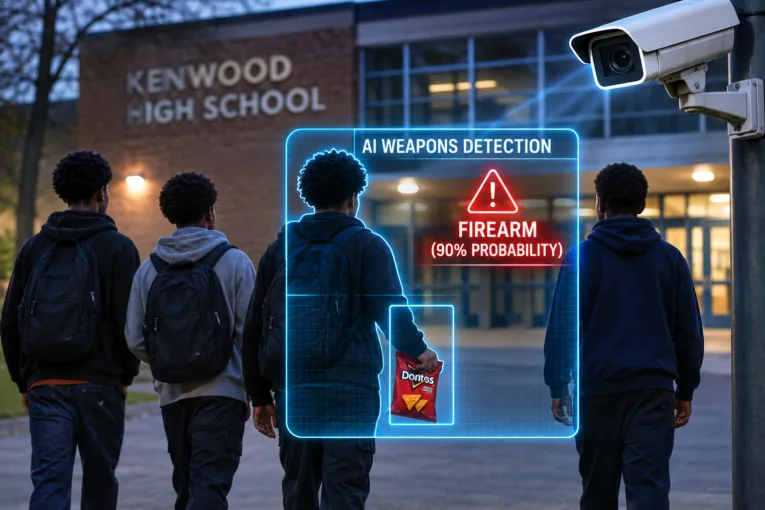
Lawsuit alleges school officials ignored a canceled AI weapons alert, leading armed police to detain, handcuff and search four teenagers outside their high school.
BALTIMORE COUNTY, Md. — Four Black current and former high school students filed a civil rights lawsuit Tuesday after an artificial intelligence surveillance system mistook a bag of Doritos for a firearm, triggering an armed police response in which officers ordered the teenagers to their knees, handcuffed them and searched their belongings.
The lawsuit, filed Nov. 17 in Baltimore County Circuit Court, alleges that the students’ constitutional rights were violated not simply because the technology malfunctioned, but because school administrators and police officers disregarded evidence that the alert was false, including a cancellation issued more than 10 minutes before police were dispatched.
The Lawyers’ Committee for Civil Rights Under Law filed the complaint on behalf of Taki Allen, Yui-Osa Ogbeide, Devon Thompson Jr. and Keith Winfield III against surveillance technology company Omnilert LLC, Baltimore County Public Schools, Baltimore County, school administrators and individual police officers.
The lawsuit alleges violations of the Fourth and 14th Amendments, Maryland constitutional protections against unreasonable searches and seizures, false imprisonment, negligence and other claims. The students are seeking compensatory and punitive damages, along with changes to school and police procedures governing AI-generated threats.
According to the 31-page complaint, the incident occurred Oct. 20, 2025, when the four teenagers were waiting outside Kenwood High School following football practice. Allen was eating a bag of Cool Ranch Doritos that his coach had distributed to players.
Shortly before 7:04 p.m., Omnilert Gun Detect, an AI-powered surveillance system integrated into the school district’s security cameras, identified Allen’s bag of chips as a firearm with 90% confidence.
The company’s human review team also failed to recognize the mistake and forwarded the alert to school administrators and police personnel.
But within two minutes, school safety officials and a Baltimore County police sergeant reviewed the image, determined that it showed a bag of chips rather than a gun and canceled the alert.
The cancellation was communicated through a second text message to the original recipients, and the system’s website displayed the alert as canceled.
Nevertheless, according to the complaint, Kenwood High School Principal Catherine “Kate” Smith reviewed the original alert more than 10 minutes later, failed to acknowledge the cancellation and sent a screenshot of Allen to a school resource officer.
At 7:19 p.m., Smith sent a message to other school administrators stating, “Omni alert is working. Kid standing on my patio right now. Looks like one of mine and looks like he’s armed. My SRO is calling it into the precinct now.”
The school resource officer subsequently forwarded the screenshot to the Baltimore County Police Department.
At 7:21 p.m., officers were dispatched to investigate a report of a suspicious person with a weapon.
At least six police cruisers arrived at the school, according to the complaint. Several officers exited their vehicles with firearms drawn.
The teenagers immediately raised their hands, but officers ordered them to their knees, handcuffed them and searched their bodies and belongings.
The complaint alleges that none of the students had committed a crime or engaged in suspicious behavior.
Three of the teenagers were not even depicted in the original AI alert.
When Thompson asked why he was being detained, an officer allegedly responded, “You were just with him, ok, so guilty by association if you want to say that.”
The lawsuit argues that the officers lacked individualized reasonable suspicion to detain any of the students and that their actions violated both constitutional protections and departmental policies.
After officers found no weapons, they examined the surveillance image and compared it with empty Doritos bags recovered from a nearby trash can.
One officer acknowledged that the system had mistaken the chips for a gun.
As officers departed, another reportedly complained about “stupid AI cameras.”
The complaint also recounts a warning delivered to the teenagers by supervising officer Corporal Michael Foehrkolb.
“Hey, thanks for not running away, that would have been a real problem,” he allegedly told them.
The lawsuit describes the encounter as terrifying for the teenagers, who feared that a sudden movement could result in their being shot.
It alleges that the handcuffs caused physical pain and left marks on their wrists. Thompson reportedly told officers that the restraints aggravated a previous wrist injury, but they did not loosen them.
The students also describe lasting psychological consequences, including anxiety around police, reluctance to remain on school grounds after hours and changes to their transportation arrangements.
Allen, who remains enrolled at Kenwood, reportedly began paying for rides home to avoid waiting outside the school.
The complaint also alleges that Smith and the school resource officer exchanged messages making light of the incident after learning that the supposed firearm was a bag of chips.
In one exchange reproduced in the lawsuit, the officer sent a message explaining that the object was a “bag of chips not a gun,” accompanied by a laughing emoji. Smith responded, “Bwahahaha.”
The lawsuit raises broader questions about the reliability of AI surveillance technology and the responsibilities of public officials who act on automated threat assessments.
According to the complaint, Baltimore County Public Schools deployed Omnilert Gun Detect across 165 schools between fall 2023 and spring 2024, integrating the technology with more than 7,000 existing security cameras.
The company markets its technology as capable of identifying firearms while distinguishing them from ordinary objects.
However, the lawsuit cites findings from Maryland’s Office of the Inspector General for Education indicating that more than 99% of alerts generated by the system in Baltimore County schools were false positives that did not require police intervention.
The complaint also alleges that the school district failed to establish adequate procedures for communicating canceled alerts and did not provide sufficient training to administrators and police officers.
According to the filing, Baltimore County police had previously responded to alerts involving objects that were not firearms, including children’s toys, a stapler and a glue gun.
The plaintiffs argue that the district’s failure to address those problems contributed directly to the October 2025 incident.
Omnilert, according to the complaint, defended its system following the incident, maintaining that its process “had functioned as intended.”
Damon Hewitt, president and executive director of the Lawyers’ Committee for Civil Rights Under Law, said the case illustrates the dangers of combining unreliable technology with inadequate human oversight.
“These students were failed not only by a technology that is prone to false alerts, but also by the very adults meant to keep them safe when we send them to school. Instead of this protection, they were met with guns and traumatized. And it could have been even worse,” Hewitt said.
“Overreliance on artificial intelligence technology mixed with inept communication and coordination among key officials is a toxic mix. We need a reckoning on how AI is being used, especially concerning public safety and kids.”
Leah Frazier, director of the organization’s Digital Justice Initiative, said the incident demonstrated the need for stronger safeguards as schools and law enforcement agencies increasingly adopt AI surveillance.
“Unregulated AI has profound consequences, especially when involving young people. As this technology gains more widespread adoption, it cannot happen at the expense of clear regulations, guardrails, and expectations for the adults that interact with it,” Frazier said.
“This should have never been escalated to the police. It simply should not have happened, and we filed this lawsuit to prevent this from ever happening again.”
Freida Winfield, whose son Keith was among those detained, described the danger the students faced while simply waiting for transportation home.
“The police told my son this could have been a real problem. No child in Baltimore County should face this kind of danger while waiting outside his own school for a ride home from his mother,” she said.
The complaint seeks court-ordered reforms requiring school officials and police to verify AI-generated threat reports, establish effective procedures for canceling false alerts and provide additional training and oversight.
It also seeks greater transparency about the technology’s performance and community involvement in decisions about its use.
The Lawyers’ Committee argues that the case illustrates how technological failures can compound existing concerns about racial disparities in policing, particularly when Black students are subjected to armed law enforcement responses without individualized evidence of wrongdoing.
The organization is joined in representing the students by Willkie Farr & Gallagher LLP and Engel Law Group, P.C.
According to the complaint, Omnilert Gun Detect remains operational at Kenwood High School, and the students contend that the policies and training deficiencies responsible for their detention have not been adequately corrected.
The lawsuit asks the court to award damages and order changes intended to prevent canceled AI alerts from producing similar police encounters.
To comment please go to one of these social media platforms:
Facebook: https://www.facebook.com/DavisVanguard
LinkedIn: https://www.linkedin.com/company/peoples-vanguard-of-davis-inc/
Instagram: https://www.instagram.com/davisvanguard/
X: https://x.com/davisvanguard
Bluesky: https://bsky.app/profile/vanguardnewsgroup.bsky.social
Subscribe to the Vanguard News letters. To make a tax-deductible donation, please visit davisvanguard.org/donate or give directly through ActBlue. Your support will ensure that the vital work of the Vanguard continues.
