
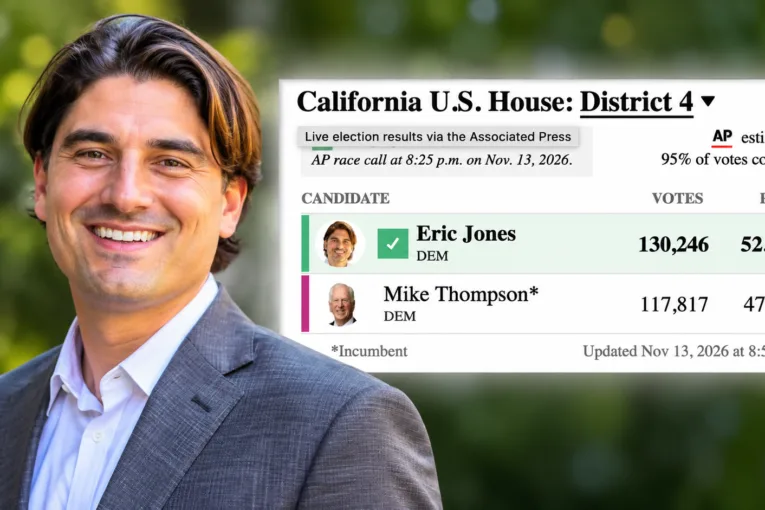
NAPA, Calif. — Fresh off his historic victory over 14-term incumbent Mike Thompson in California’s 4th Congressional District, Democrat Eric Jones is already working with an incoming class of lawmakers on an ambitious anti-corruption agenda, arguing that the new Democratic majority must restore congressional accountability, confront President Donald Trump and deliver economic relief to working Americans.
In two interviews with the Vanguard following the election, Jones described an incoming Democratic congressional class energized by its electoral success but conscious of the challenges of governing alongside a Republican president.
Jones defeated Thompson 52.5% to 47.5%, with 95% of votes counted when the Associated Press called the race Friday, Nov. 13, according to his campaign. The victory ends nearly three decades of representation by Thompson, who first entered Congress in 1999.
“The people of CA-04 have made their voices heard,” Jones said in his victory statement. “This victory does not belong to me. It belongs to every family that opened their door, every volunteer who made one more call, and every voter across all nine counties who decided that government has to work for them.”
Jones said his campaign knocked on more than 550,000 doors and held over 200 town halls across the nine-county district, building a coalition of working-class voters, young people and independents.
But Jones emphasized in his interviews that the victory was not simply a partisan rejection of Republicans or an ideological endorsement of Democrats.
“We know that it wasn’t an ideological mandate. It wasn’t a partisan mandate. It’s a we got to go fix our country mandate,” Jones told the Vanguard.
He described a sense of urgency among newly elected Democrats, many of whom have never held political office and are entering Congress following campaigns centered on economic frustration and declining public trust in government.
“The energy is fantastic,” Jones said. “And more than ever, we have a massive freshman class and we all know we have a job to do.”
Jones said the incoming lawmakers have already begun coordinating their legislative priorities, with an initial focus on government corruption, congressional stock trading, campaign finance and partisan gerrymandering.
He said members of the freshman class are developing proposals to present to Democratic leadership before the new Congress convenes in January.
“So we’ve got a bunch of folks, myself included, working on the initial anti-corruption agenda, and we are putting that in front of leadership early, as of now, before the swearing in to say, ‘This is a priority for our class,’” Jones said.
Among the proposals he identified were congressional term limits, restrictions on stock trading by members of Congress, changes to campaign finance rules and measures to address gerrymandering.
Jones argued that these issues could provide Democrats with an opportunity to challenge Trump on proposals that enjoy support across party lines.
“Those ideas, I believe when put in front of the president are so popular and they’re so just simple and obvious that it’s going to become this amazing political wedge if he doesn’t work with us on it,” Jones said.
He acknowledged that negotiations and compromises would be necessary but described the proposals as a foundation for rebuilding public confidence in government.
“It’s not partisan, it’s not political, it’s just the right stuff so that we can rebuild trust in government,” he said.
Asked about his personal legislative priorities, Jones returned repeatedly to the anti-corruption agenda, particularly restrictions on congressional stock trading.
“We’ve gotten this far and we’re still going to let members of Congress make tens of millions, if not hundreds of millions, if not billions of dollars off of stock trading,” he said. “We’re not going to address that.”
Jones argued that the influence of corporate money has fundamentally changed American politics, particularly since the Supreme Court’s 2010 Citizens United decision.
“The Citizens United has been like an amplifier on all the underlying issues,” Jones said.
He also expressed concern that technological changes, including artificial intelligence and the rapid expansion of data centers, are moving faster than Congress has demonstrated an ability to respond.
Jones suggested that the pace of those developments has exposed weaknesses among longtime lawmakers who have struggled to adapt to changing economic and political conditions.
“Do you really get just how corporatized both parties have become?” Jones asked, describing the questions he believes voters are increasingly asking elected officials.
The incoming congressman was particularly critical of the outgoing Congress and its willingness to challenge the executive branch.
Asked how Democrats could restore the balance of power between Congress and the presidency, Jones argued that lawmakers have failed to use the authority already available to them.
“I’m just not convinced we use all the tools at our disposal,” Jones said.
He attributed some of that failure to fear of Trump, suggesting that lawmakers have become reluctant to confront the president even when their constitutional responsibilities require it.
“What I’ve observed as a constituent, as an American, as a voter, is that people are scared of Donald Trump,” Jones said. “And whether you think he’s right or wrong, that’s not the basis on which to govern and serve your district, fear of your executive.”
Jones said the incoming Democratic class would need to demonstrate greater willingness to confront the administration, whether through legislative votes, oversight or other forms of political action.
“We have a new sense of courage to stand up and say no,” Jones said. “And if that means the appropriate actions of civil disobedience to show what we mean, we’ll do it. If it just means holding the line on votes, we’ll do it.”
He also criticized congressional absenteeism, citing a recent vote in which he said 11 Democrats failed to appear.
“I’ll show up. I’ll be ready to vote,” Jones said. “I get it’s complicated. These votes can move around a bit, but that’s our job.”
Jones acknowledged that Democrats could discover the limits of their authority once they begin governing, but he rejected the suggestion that those limitations should discourage them from trying.
“Maybe I’ll come back to you six months from now and we’ve exhausted every option and I’m just as helpless as the rest of them,” he said. “But I think that there’s a renewed sense of optimism because we know we have a duty and we’re not afraid to do it.”
Jones offered a mixed assessment of how American democratic institutions have withstood the pressures of the Trump presidency.
He praised voters for responding to partisan redistricting efforts and credited the courts with maintaining important checks on executive authority.
Jones described California’s response to Republican-led redistricting in Texas as appropriate, while criticizing gerrymandering by both parties.
“I think America’s held up in a funny way, if that makes sense,” Jones said.
He gave voters and the judiciary high marks but reserved his harshest criticism for Congress, which he argued has failed to fulfill its role as a coequal branch of government.
“Executive’s an executive, and our job is to temper the executive,” Jones said. “And I think we can do that now that we have the right players who have the right courage, who have the right message.”
Despite his criticism of Trump, Jones argued that Democrats could still secure cooperation from the president by focusing on economic issues that affect voters regardless of party affiliation.
He identified health care, prescription drug prices, utility bills and affordability as areas where the new majority could apply political pressure.
“Whether or not you can afford your utility bill is not partisan,” Jones said. “Whether or not you have access to decent quality healthcare or whether or not you can afford your most basics of medication, those are issues that if we deliver on and if we put the agenda that matters to Americans front and center, it’s going to be so hard for him to push back.”
Jones suggested that Republican lawmakers, particularly those representing rural communities, would face pressure from their constituents if the administration refused to cooperate on legislation addressing health care costs.
“If we don’t deliver on healthcare, it’s not just Democratic districts that are going to suffer, it’s rural Republican districts all across the country,” Jones said.
He argued that the incoming majority should use that shared economic pressure to force negotiations with the White House.
Jones also addressed immigration enforcement and the role of ICE, saying Americans broadly support immigration reform while objecting to the treatment of people in their communities.
“No one likes what they see on the streets,” Jones said. “We want immigration reform. We want to protect members of our community. We want the rule of law to be followed.”
He expressed optimism that the incoming Congress could address immigration policy but cautioned that meaningful reform would take time.
“I’m not going to say we’re going to solve it quickly, but there’s motivation and energy across everybody that we have to deliver,” Jones said.
Beyond Washington, Jones emphasized that representing the 4th Congressional District would require working directly with local officials and bringing federal resources back to the region.
He said he has already begun coordinating with newly elected members of the Northern California congressional delegation to identify opportunities for collaboration.
Jones identified water infrastructure, roads, electrical grid improvements and utility reform as priorities for the district.
“A lot of this stuff has nothing to do with Washington DC, but it has a lot to do with the power of a congressional seat,” Jones said.
He described the work as coordinating local, state and federal efforts to deliver projects and resources that communities need.
“It’s the coalition building and the work, the work of the job back home to really deliver,” he said.
Jones said the election demonstrated the importance of candidates who reflect the communities they seek to represent.
He pointed to the diversity of backgrounds among incoming Democratic lawmakers, including teachers, military leaders and religious figures, as evidence of a changing political landscape.
Jones also emphasized the generational shift taking place in Congress, arguing that younger lawmakers may be better positioned to respond to rapidly changing economic and technological conditions.
He suggested that voters across the country had become frustrated with political leaders who failed to recognize the urgency of those changes.
Jones credited his own victory to a 14-month campaign focused on rebuilding trust among voters who felt abandoned by the political system.
“We know in California, in our district specifically, there are so many people who feel left behind economically and politically,” Jones said.
He said the campaign’s message resonated with working-class voters, voters of color and younger Americans who had lost confidence that government could improve their lives.
“They just want someone to step up and fight for them, for their communities, for their families,” Jones said.
In his victory statement, Jones pledged to focus on lowering household costs, expanding Medicare and increasing housing affordability.
“The people of this district are dealing with utility bills that have doubled,” Jones said. “They are facing healthcare costs that are crushing them, and they are being priced out of the communities they grew up in. They have been told to wait long enough.”
Jones also thanked his wife, Rachel, and their children, Owen and Margot, along with the campaign staff and volunteers who helped defeat Thompson.
Brian Parvizshahi, Jones’ campaign manager, described the victory as the product of grassroots organizing rather than institutional political support.
“Nobody handed us this district. We earned it one conversation at a time, and the people of CA-04 have spoken,” Parvizshahi said.
For Jones, the transition from candidate to congressman-elect began almost immediately after election night.
Asked when he realized he had won, Jones said his thoughts quickly shifted from the campaign to the responsibilities of office.
“The moment I had a strong feeling that we were in the clear, it was a quick transmission moment to, okay, now we have to deliver,” Jones said.
He said that sense of obligation remains his overriding concern as he prepares to enter Congress.
“Now we got to go deliver,” Jones said.
To comment please go to one of these social media platforms:
Facebook: https://www.facebook.com/DavisVanguard
LinkedIn: https://www.linkedin.com/company/peoples-vanguard-of-davis-inc/
Instagram: https://www.instagram.com/davisvanguard/
X: https://x.com/davisvanguard
Bluesky: https://bsky.app/profile/vanguardnewsgroup.bsky.social
Subscribe to the Vanguard News letters. To make a tax-deductible donation, please visit davisvanguard.org/donate or give directly through ActBlue. Your support will ensure that the vital work of the Vanguard continues.
