
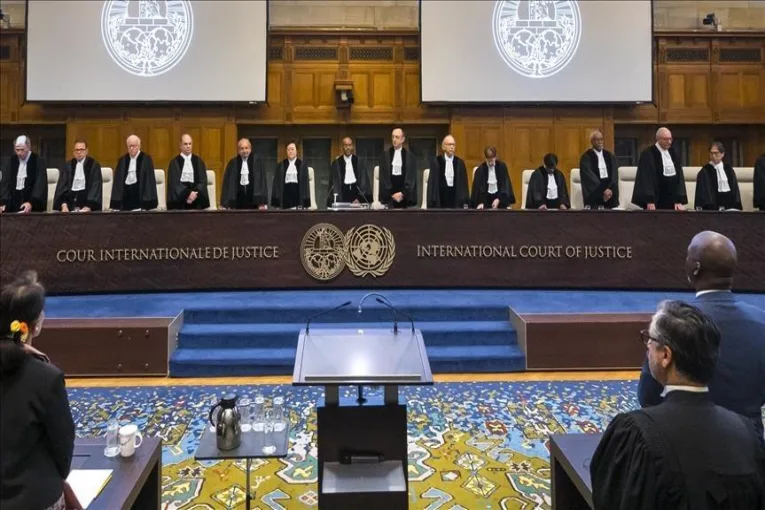
THE HAGUE, Netherlands — The United Nations’ top court ruled 9-6 Thursday that Myanmar committed genocide against the Rohingya people during a 2017 military campaign in Rakhine State, according to The Associated Press.
Among the 15 judges who participated in the landmark determination of state responsibility under the Genocide Convention was Navi Pillay, the recipient of last month’s Nobel Peace Prize, according to the AP.
International Court of Justice President Yuji Iwasawa declared that the court found Myanmar had violated its “obligations under the Genocide Convention” through the killings of thousands of Rohingya civilians and the perpetration of “widespread acts of sexual violence, as well as acts of extreme violence against children.”
According to the AP, in August 2017, Myanmar’s security forces launched what they termed a “clearance campaign” in response to an attack by a Rohingya insurgent group, resulting in “mass rapes and killings,” as well as the burning of thousands of homes.
The AP cited the court’s findings that Myanmar’s security forces killed about 10,000 Rohingya.
According to the International Court of Justice (ICJ) case records, the case was originally brought in 2019 by The Gambia, a Muslim-majority West African nation.
Despite having limited historical and geographical connections, The Gambia and Myanmar are both parties to the 1948 Genocide Convention. Under the international legal principle of erga omnes partes obligations, states party to the convention are entitled to bring cases concerning violations of the convention even when their own citizens are not victims.
The case is similar to South Africa’s case against Israel, brought before the ICJ in December 2023 over allegations of genocide against Palestinians in Gaza, in that both cases demonstrate that countries can bring cases before the ICJ even when their own citizens are not directly affected.
According to the ICJ’s case records, the court ordered Myanmar to implement provisional measures in January 2020 to protect the Rohingya minority from further acts of genocide. In July 2022, the court rejected Myanmar’s preliminary objections, finding that it had jurisdiction to hear The Gambia’s application.
Subsequent public hearings regarding the merits of the genocide allegations were held in January 2026.
According to The Gambia’s oral arguments during the January 2026 hearings, anti-Rohingya hate speech and propaganda circulated on Facebook through “clandestine accounts” attributed to Myanmar’s military.
During oral arguments, The Gambia stated that evidence linking these accounts to the military had been identified by Meta, Facebook’s parent company.
According to Arsalan Suleman, an attorney representing The Gambia before the ICJ, these Facebook accounts had “shared page administrators, shared digital cookies and shared IP addresses associated with the Myanmar military from which the accounts were accessed.”
Myanmar contested the evidence of genocidal intent during its oral arguments, stating that even if it could be proven that statements were posted by accounts linked to Myanmar’s military, it “does not automatically demonstrate genocidal intent on the part of Myanmar.”
According to professor Stefan Talmon, representing Myanmar, evidence of hate speech is not sufficient to establish the genocidal intent required under the Genocide Convention.
Beyond the Facebook-related arguments presented before the ICJ, a 2022 Amnesty International report, The Social Atrocity, argued that Meta’s algorithms contributed to human rights violations by amplifying harmful content on its platform.
The report argued that Meta’s efforts to increase user engagement led the company to create systems that prioritized the spread of “inflammatory, divisive, and harmful content,” including incitement to violence, because such content was more likely to “maximize engagement.”
The report further argued that Meta’s algorithms “proactively amplified and promoted content on the Facebook platform which incited violence, hatred, and discrimination against the Rohingya.”
Although Facebook’s role in spreading anti-Rohingya propaganda featured in arguments before the ICJ, the case focused on Myanmar’s responsibility under the Genocide Convention rather than Meta’s legal liability.
According to the AP, under the 1948 convention, the court had to establish that Myanmar’s security forces intended to destroy the Rohingya “in whole or in part” to determine that genocide had occurred.
Despite the court’s ruling, the refugee crisis stemming from displacement caused by military violence remains unresolved.
According to Reuters, more than 1.3 million Rohingya remain displaced across South and Southeast Asia, “including 1.2 million in sprawling refugee camps in Cox’s Bazar in Bangladesh, according to the United Nations.”
Refugees have expressed unwillingness to return without guarantees of their safety, dignity and basic rights. Reuters reported that “conditions for the safe return of Rohingya refugees do not currently exist.”
Although ICJ judgments are final and binding on the parties, the court lacks an independent enforcement mechanism. Under the U.N. Charter, a party may refer noncompliance with a judgment to the U.N. Security Council.
To comment please go to one of these social media platforms:
Facebook: https://www.facebook.com/DavisVanguard
LinkedIn: https://www.linkedin.com/company/peoples-vanguard-of-davis-inc/
Instagram: https://www.instagram.com/davisvanguard/
X: https://x.com/davisvanguard
Bluesky: https://bsky.app/profile/vanguardnewsgroup.bsky.social
Subscribe to the Vanguard News letters. To make a tax-deductible donation, please visit davisvanguard.org/donate or give directly through ActBlue. Your support will ensure that the vital work of the Vanguard continues.
