
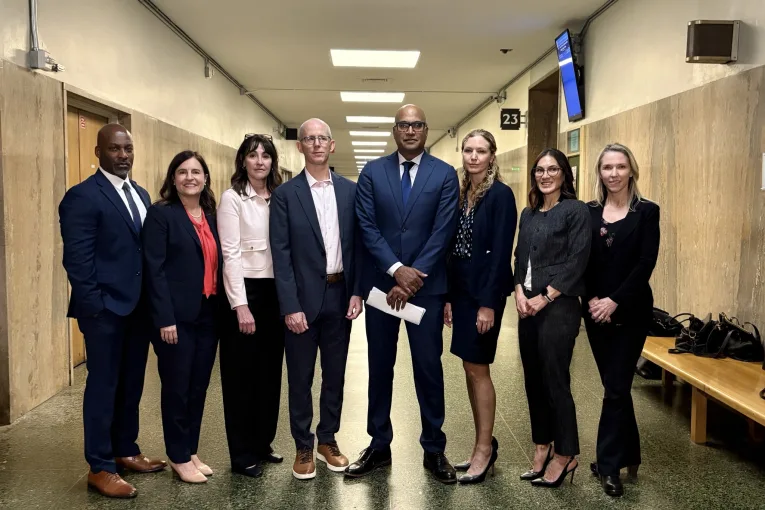
SAN FRANCISCO — The First District Court of Appeal heard oral arguments Thursday in a case that has drawn national attention to California’s public defense system and the ability of public defenders to limit their caseloads to meet their constitutional and ethical obligations.
At its center is San Francisco Public Defender Mano Raju, who was held in contempt and fined $26,000 by San Francisco Superior Court Judge Harry Dorfman in March 2026 for limiting the number of new cases his office could accept due to excessive workloads and ethical obligations to existing clients.
Raju’s legal team, represented by Kory DeClark of BraunHagey & Borden LLP, argued before the appellate court that the contempt judgment and sanctions disregarded the Sixth Amendment’s guarantee of effective counsel and the professional obligations of public defenders.
The hearing addressed whether the contempt order undermines the independence of public defenders to make professional judgments about their capacity to provide competent representation. A ruling is expected within the next 90 days.
The controversy began in May 2025 when the San Francisco Public Defender’s Office, facing excessive caseloads, made the decision to limit the number of new criminal cases it could accept.
The office cited ethical obligations under the California Rules of Professional Conduct and professional workload standards governing attorneys’ ability to provide competent representation. The decision was characterized as a necessary measure to prevent violations of clients’ constitutional rights.
“Across the country, public defender offices are grossly under-resourced compared to police and prosecutors. In San Francisco we have seen a significant increase in our workload and the length of time it takes cases to work their way through our overburdened courts,” Raju said in a statement released Thursday.
“I stand by my decision to adopt modern professional workload standards for public defenders to protect due process for our clients and ensure my staff have the capacity to provide the effective representation every client deserves.”
Raju has argued that his decision was not an act of defiance but a professional necessity, grounded in the reality of an underfunded and overburdened system.
The office’s move came amid staffing shortages, increasing workloads and delays in the criminal justice system, which Raju maintains have made it increasingly difficult for public defenders to meet their ethical obligations.
On March 10, 2026, Dorfman held Raju in contempt for violating court orders requiring the Public Defender’s Office to accept new case assignments.
On March 24, Dorfman imposed $26,000 in sanctions, representing $1,000 for each of the 26 cases the office had declined since January.
The contempt judgment has since drawn opposition from public defenders, legal scholars and civil rights advocates, who argue that the decision could set a dangerous precedent by allowing courts to override the professional judgment of defense attorneys.
DeClark argued before the appellate court that the contempt order lacks legal merit and undermines constitutional protections.
“The U.S. Constitution and California’s Rules of Professional Conduct require public defenders to provide effective representation to every client,” DeClark said in a statement.
“Extensive case law supports our position that a Superior Court judge lacks the authority to arbitrarily override the professional judgment of defense attorneys and their supervisors to assess their capacity to take on more cases.”
DeClark also acknowledged the numerous organizations and individuals who have submitted letters and amicus briefs in support of Raju’s decision to safeguard the due process rights of existing clients and manage excessive attorney workloads.
Among the organizations expressing support for Raju is the National Legal Aid & Defender Association.
California’s public defense system faces widespread staffing and workload challenges, with San Francisco’s crisis reflecting broader statewide and national concerns about the ability of public defenders to provide constitutionally adequate representation.
For decades, public defense organizations relied on national caseload standards recommending that attorneys handle no more than 150 felony cases or 400 misdemeanor cases annually.
More recent research, including the 2023 National Public Defense Workload Study, recognizes that attorneys’ workloads must account for the complexity of individual cases and the increasing demands associated with modern criminal litigation.
Excessive caseloads can compromise attorneys’ ability to investigate allegations, meet filing deadlines, communicate with clients and adequately prepare cases for trial, potentially jeopardizing the constitutional rights of people accused of crimes.
The crisis is particularly acute in San Francisco, where Raju reported in March that the number of active cases had increased 65% since 2019.
Raju attributed the increase in workloads in part to charging practices and the growing volume of surveillance evidence that defense attorneys must review.
According to The San Francisco Standard, criminal charges increased by nearly 50% from 2020, although the District Attorney’s Office reported that fewer cases were charged in 2025 than in 2019.
While the Public Defender’s Office budget increased from $42 million in 2020 to $58 million in 2025, the District Attorney’s Office had a budget of $96 million in 2025.
In April, San Francisco public defenders and support staff wore black in a silent protest against excessive caseloads and what they described as chronic underfunding.
Similar demonstrations took place in other states, including Wisconsin, Tennessee and New York, reflecting concerns about public defense workloads nationwide.
Yolo County Chief Public Defender Tracie Olson, who joined other California chief public defenders in supporting Raju during his March court appearance, expressed concern Thursday about the broader implications of the San Francisco case.
“What is happening in San Francisco should serve as a wake-up call to the State of California,” Olson said in a statement.
Olson’s office has also called attention to the challenges facing public defenders throughout California and the need for sustainable funding to ensure that counties can meet their constitutional obligations.
On March 24, 2026, the Yolo County Board of Supervisors unanimously adopted Resolution 26-28, calling for changes to California’s public defense funding system.
The resolution calls for evidence-based workload standards, sustainable staffing levels, greater funding equity between prosecution and defense, and ongoing state funding for public defense services.
The California Independent Commission on Public Defense is also examining the challenges facing indigent defense and the need for systemic reform.
California’s decentralized public defense funding system places substantial responsibility on individual counties, which must balance the constitutional obligation to provide effective legal representation with other local funding priorities.
Chief public defenders have called for greater state involvement in addressing disparities in funding and ensuring that attorneys have the resources necessary to meet professional workload standards.
In conjunction with Thursday’s hearing, 35 chief public defenders representing 33 California counties issued a joint statement supporting Raju and drawing attention to the systemic challenges facing public defense throughout the state.
California’s public defense crisis is part of a broader national concern about the implementation of the Sixth Amendment, which guarantees the right to counsel in criminal prosecutions.
Public defense advocates have argued that inadequate funding and excessive attorney workloads can contribute to wrongful convictions, inappropriate plea agreements and prolonged periods of pretrial incarceration.
Behind the legal battles are the lives of people accused of crimes and their families, who depend on public defenders to protect their constitutional rights.
In interviews with The San Francisco Standard in April, public defenders described the difficulties of balancing their responsibilities to individual clients with the demands of increasingly heavy caseloads.
Felony attorney Kwixuan Maloof reported handling between 50 and 60 cases while working between 60 and 80 hours per week. He described having insufficient time to meet with clients and thoroughly discuss their cases and potential defenses.
Misdemeanor trial attorney Amy Tao reported carrying between 100 and 150 cases, requiring her to make daily decisions about which clients’ needs to prioritize and which responsibilities could be postponed.
Raju told The Standard that excessive workloads can leave incarcerated clients waiting substantial periods before their attorneys can devote sufficient attention to their cases. He called for additional attorneys, investigators, social workers, paralegals and administrative staff.
The First District Court of Appeal’s decision could clarify the boundaries of public defense in California, including the circumstances under which public defenders can limit caseloads based on their ethical obligations and the authority of trial courts to require them to accept additional appointments.
If the contempt judgment stands, public defense advocates fear it could establish a precedent that discourages other public defenders from limiting case assignments, even when they believe additional appointments would compromise their existing clients’ representation.
Raju has maintained that his office remains committed to accepting the vast majority of new cases while assessing its capacity to provide constitutionally effective representation.
The matter remains pending before the First District Court of Appeal under case number A176141, with a ruling expected within 90 days.
To comment please go to one of these social media platforms:
Facebook: https://www.facebook.com/DavisVanguard
LinkedIn: https://www.linkedin.com/company/peoples-vanguard-of-davis-inc/
Instagram: https://www.instagram.com/davisvanguard/
X: https://x.com/davisvanguard
Bluesky: https://bsky.app/profile/vanguardnewsgroup.bsky.social
Subscribe to the Vanguard News letters. To make a tax-deductible donation, please visit davisvanguard.org/donate or give directly through ActBlue. Your support will ensure that the vital work of the Vanguard continues.
