

DAVIS, Calif. — Democratic congressional challenger Eric Jones has expanded his lead over longtime incumbent Rep. Mike Thompson in California’s 4th Congressional District, and in a Friday evening interview with the Vanguard, Jones expressed confidence in the direction of the race while arguing that the results reflect growing dissatisfaction with establishment politics and economic conditions facing working-class Americans.
According to election results reported late Friday, Jones had received 72,473 votes, or 51.6%, compared with 68,108 votes, or 48.4%, for Thompson. The 4,365-vote margin represented a 3.2-percentage-point advantage for Jones, with ballots still being counted.
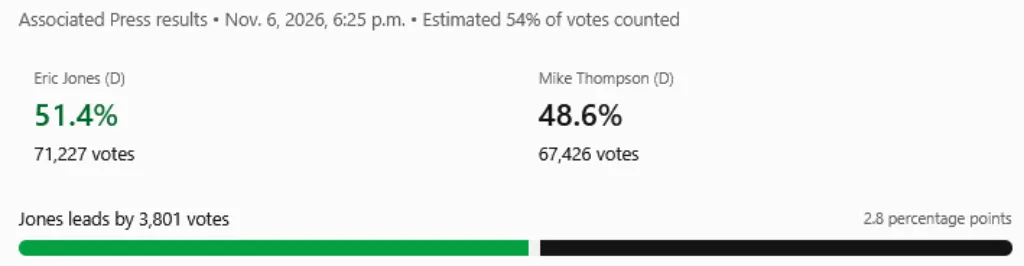
An earlier Associated Press update Friday evening showed Jones leading by 3,801 votes, with an estimated 54% of ballots counted. The race had not been called.
In a telephone interview with the Vanguard, Jones said his campaign had anticipated that later-counted ballots would favor his candidacy because of the composition of his electoral coalition.
“As you know, we’re very deliberate in California when it comes to elections. So the registrars are doing their duties and taking their time and counting every ballot,” Jones said.
“And we always knew that given our coalition, where our coalition is young, it’s diverse, it’s working class. Honestly, it’s the room that you saw on election night and that coalition tends to vote late.”
Jones said his campaign had anticipated a weaker showing in the earliest returns.
“So we knew that the early drop would be our worst, and we’ve seen more and more data points come in of everything improving from here,” he said. “And given that we’re already in a nice position that we’re feeling very confident.”
Jones credited volunteers and supporters who had worked on the campaign over the past 14 months, particularly during the final weeks before Election Day.
“The overwhelming emotion I’m feeling today and this gratitude, I think it finally hit me today because in the final innings there, we just had hundreds of volunteers and supporters on the phones knocking on doors,” he said.
“It was really, really, really special. So it’s a big thank you to everyone who has been fighting with us for 14 months on the campaign.”
The contest between Jones, 35, and Thompson, 75, has drawn attention because of its unusually high spending, generational differences and competing claims about political influence.
According to KQED’s reporting on the race, Jones contributed approximately $14.8 million of his own money to his campaign, setting a California record for self-funding in a congressional race.
Thompson raised approximately $5.5 million, none of it from his personal funds. Jones pledged not to accept corporate political action committee contributions, while Thompson argued that his challenger was attempting to purchase a congressional seat.
Federal Election Commission figures through Oct. 14 showed Jones’ campaign reporting approximately $18.1 million in total receipts and $16.5 million in spending, compared with $5.5 million raised and $5.3 million spent by Thompson’s campaign.
The two Democrats have relatively similar positions on several major policy issues, including health care, immigration enforcement and economic affordability, although they have emphasized different approaches and political priorities.
Thompson, a Vietnam War veteran who has served in Congress since 1999, is a senior member of the House Ways and Means Committee. He has emphasized his legislative experience and ability to secure federal resources for the district.
He has received support from prominent Democratic officials, including former House Speaker Nancy Pelosi, Gov. Gavin Newsom and U.S. Sens. Alex Padilla and Adam Schiff.
Jones, a former venture capitalist who moved to Napa in 2021, has campaigned on reducing corporate influence in politics and challenging established Democratic leadership. His supporters include progressive organizations and figures associated with the technology industry.
KQED reported that Jones grew up in a working-class family in Maine that sometimes relied on Medicaid, food assistance and veterans disability benefits. He moved to Napa with his wife after their son was born with a serious heart condition, seeking to live within driving distance of medical specialists at UCSF.
The district itself has changed substantially following California’s congressional redistricting, with nearly half its territory new to Thompson. In previous general elections, Thompson typically won approximately two-thirds of the vote.
Asked about the contentious campaign and criticism directed toward him, Jones attributed much of the opposition to political and financial interests aligned with established Democratic leadership.
“I think this is a reckoning for the corporate establishment, the corporate democratic establishment,” Jones said.
He claimed that approximately six corporate super PACs had entered the race against his campaign.
“I think the system is corrupt. And I think that there is an establishment class that believes in that way of doing politics,” Jones said.
Jones argued that his campaign had attracted voters who felt overlooked by traditional Democratic politics, including younger voters, lower-income communities and working-class families.
“I think that is really what this campaign was about and it’s become even more about old-fashioned political representation,” he said.
He described the campaign’s supporters as people who believed that established Democratic leaders were failing to address their economic and political concerns.
Jones also acknowledged that the campaign would need to rebuild relationships with those who opposed his candidacy if he ultimately wins the election.
“It puts the onus on me and our campaign to make sure that we are building the right relationships after the election and showing everyone that we are all equally invested, but we’re all invested in this district,” he said.
The conversation also turned to the broader national election results and what Jones believes they reveal about the political direction of the country.
Jones argued that economic insecurity remains a central source of voter frustration, even during periods of strong financial market performance.
“We can’t run from gas prices,” Jones said.
He described a growing gap between the economic conditions reflected in financial markets and those experienced by households struggling with everyday expenses.
“The economic reality we see in the stock market is not the economic reality we see in our daily lives,” he said.
Jones argued that dissatisfaction with economic conditions was producing demands for political change across geographic and partisan lines.
“It’s not even really a left or right thing. It’s different political persuasions with that core underlying belief that we got to get politics back to serving their communities,” he said.
He said Democrats needed to reconsider how they communicate with working-class voters, younger Americans and communities of color.
“Where the Democratic Party has failed, and now we’ve forgotten how to speak to the working class, and we’ve forgotten how to speak to young people, and we’ve lost our way with voters of color,” Jones said.
He argued that candidates who successfully connected with their communities had emerged across the country without relying on a centralized strategy from national Democratic leadership.
“That was people all across the country, individuals recognizing the moment and standing up to say, ‘I’m going to represent my community in a different way,'” he said.
Jones also addressed criticism of his background, including his professional experience in Silicon Valley and questions about his connection to the district.
He said his campaign had emphasized direct contact with voters through town halls, door knocking and telephone outreach.
“That’s why we do the town halls, that’s why we do the door knocking, that’s why we do the phone calls,” he said.
Jones described himself as someone who grew up receiving public assistance before achieving professional success.
“It wasn’t that long ago that I was that welfare kid who remembers viscerally why we need the social safety net, but also understands why we need the opportunity to dream as well,” he said.
Jones, who has two young children, said his experiences growing up and raising a family shaped his views about economic opportunity and the future of the country.
He argued that political corruption and declining economic opportunity had contributed to public dissatisfaction over the past decade.
“We got to take on the corruption and do politics a different way, and we got to, once again, be a country where we fight for economic opportunity for every single person, and we give every single person a shot,” Jones said.
The interview also addressed immigration enforcement and the Trump administration’s approach to immigration policy.
Jones said he believed Americans shared more common ground on immigration than the political debate suggested, but argued that both major parties had used the issue for political advantage.
“We haven’t had a political solution because both parties have weaponized immigration to their own benefit,” Jones said.
“We need comprehensive immigration reform. We are a country of immigrants. We are a country built on the American dream, and we are a country that’s compassionate.”
In interviews with KQED, Jones proposed requiring ICE agents to wear body cameras, prohibiting face coverings and moving the agency from the Department of Homeland Security to the Justice Department.
Thompson, meanwhile, pointed to his opposition to creating the Department of Homeland Security in 2002, his votes against additional DHS funding and his participation in efforts to challenge federal immigration enforcement practices.
On health care, both candidates have expressed support for Medicare for All. Jones has emphasized expanding Medicare benefits to include dental, vision, hearing and in-home care, while Thompson has highlighted his work on the Affordable Care Act and telemedicine access.
Asked what voters should watch as additional ballots are counted, Jones reiterated his confidence in the campaign’s position.
“I think that the body language and the feeling and the emotion you’re seeing from our campaign, the positivity, and the forward looking statements are all saying the same thing, that we feel really confident,” he said.
Jones said his campaign was continuing to communicate with voters while preparing for the possibility of taking office.
“We’re still talking to voters, we’re still talking to constituents. We’re preparing for the next step, and that’s because we see the trends all moving in our direction,” he said.
He emphasized that county election officials should be allowed to complete the ballot count.
“We’ll, again, let the registrars and the counties do the good work that they do to make sure everything is done properly,” Jones said.
Jones did not provide a timetable for when the race might be resolved, referring questions about the remaining ballots and election projections to a campaign adviser.
The race remains undecided as election officials continue processing outstanding ballots.
To comment please go to one of these social media platforms:
Facebook: https://www.facebook.com/DavisVanguard
LinkedIn: https://www.linkedin.com/company/peoples-vanguard-of-davis-inc/
Instagram: https://www.instagram.com/davisvanguard/
X: https://x.com/davisvanguard
Bluesky: https://bsky.app/profile/vanguardnewsgroup.bsky.social
Subscribe to the Vanguard News letters. To make a tax-deductible donation, please visit davisvanguard.org/donate or give directly through ActBlue. Your support will ensure that the vital work of the Vanguard continues.
