
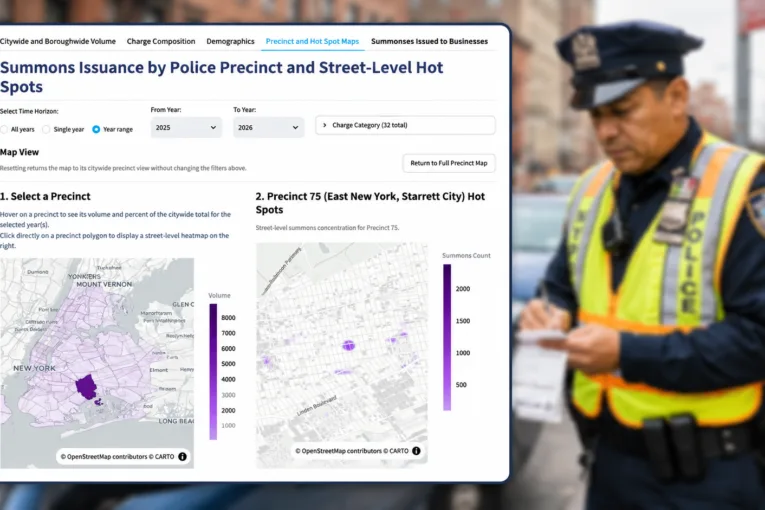
NEW YORK — Criminal summonses issued by the New York City Police Department increased nearly fivefold between 2021 and 2025, with Black and Hispanic New Yorkers receiving a disproportionate share of citations, according to a new public data dashboard tracking low-level enforcement across the city.
The New York City Criminal Summons Dashboard, launched Nov. 4 by the Data Collaborative for Justice (DCJ), provides information on criminal summonses issued by the NYPD from 2007 to the present, allowing users to examine enforcement patterns across neighborhoods and demographic groups.
Criminal summonses are issued for certain low-level misdemeanors, violations and infractions, typically requiring recipients to appear in criminal court rather than being arrested at the scene.
The dashboard tracks summons volume citywide and by borough, offenses across more than 30 categories, demographic characteristics of recipients and geographic concentrations of enforcement. It also provides information about summonses issued to businesses.
According to DCJ, the dashboard is intended to help policymakers, researchers and the public evaluate how police use summonses and whether enforcement practices vary across communities.
The data show substantial racial disparities in summons issuance. Black New Yorkers received 47.5% of summonses, while Hispanic New Yorkers received 34.3%, according to DCJ.
By comparison, U.S. Census Bureau figures show that Black residents account for approximately 21.9% of New York City’s population, while Hispanic or Latino residents account for approximately 28.5%.
Although the figures indicate disparities between summons issuance and population demographics, they do not independently establish the causes of those differences.
The dashboard also shows that summonses were concentrated in a relatively small number of police precincts in 2025, indicating substantial geographic variation in enforcement.
These findings reflect longstanding concerns raised by civil liberties organizations about the effects of low-level policing in predominantly Black and Latino neighborhoods.
In its report, Shattered: The Continuing, Damaging, and Disparate Legacy of Broken Windows Policing in New York, the New York Civil Liberties Union documented complaints of unequal police treatment and disproportionate enforcement in communities of color.
The organization has argued that aggressive enforcement of minor offenses can subject residents to repeated police encounters, court obligations and financial burdens without necessarily improving public safety.
Those consequences can arise even when summonses do not result in criminal convictions.
According to a 2025 DCJ report, fewer than 10% of criminal summonses ultimately result in convictions.
The report examines the consequences of summons enforcement through the concept of “process is the punishment,” referring to the burdens associated with criminal proceedings regardless of the final outcome.
Individuals receiving summonses may be required to miss work, arrange transportation or child care, obtain legal assistance and appear in court, even when their cases are ultimately dismissed.
The increase in summons issuance follows a historic low in 2021, when enforcement declined amid the COVID-19 pandemic and changes in policing practices.
Summons activity subsequently increased during former Mayor Eric Adams’ administration, which emphasized quality-of-life enforcement as part of its public safety strategy.
The NYPD established a Quality of Life Division to address recurring neighborhood complaints, including noise, illegal parking and other conditions affecting public spaces.
Supporters of quality-of-life enforcement maintain that addressing minor violations can improve neighborhood conditions and respond to residents’ concerns.
Civil liberties advocates, however, have criticized the approach as a return to broken-windows policing, which emphasizes enforcement of relatively minor offenses and has historically generated concerns about racial disparities.
The NYCLU has argued that such strategies disproportionately expose marginalized communities to police scrutiny and involvement in the criminal legal system.
The new dashboard allows users to compare enforcement activity over time, identify concentrations of summons issuance and examine demographic disparities using publicly accessible data.
DCJ says the tool is intended to support greater transparency and inform discussions about summons practices, providing a continuing record of how low-level criminal enforcement is distributed across New York City.
To comment please go to one of these social media platforms:
Facebook: https://www.facebook.com/DavisVanguard
LinkedIn: https://www.linkedin.com/company/peoples-vanguard-of-davis-inc/
Instagram: https://www.instagram.com/davisvanguard/
X: https://x.com/davisvanguard
Bluesky: https://bsky.app/profile/vanguardnewsgroup.bsky.social
Subscribe to the Vanguard News letters. To make a tax-deductible donation, please visit davisvanguard.org/donate or give directly through ActBlue. Your support will ensure that the vital work of the Vanguard continues.
