
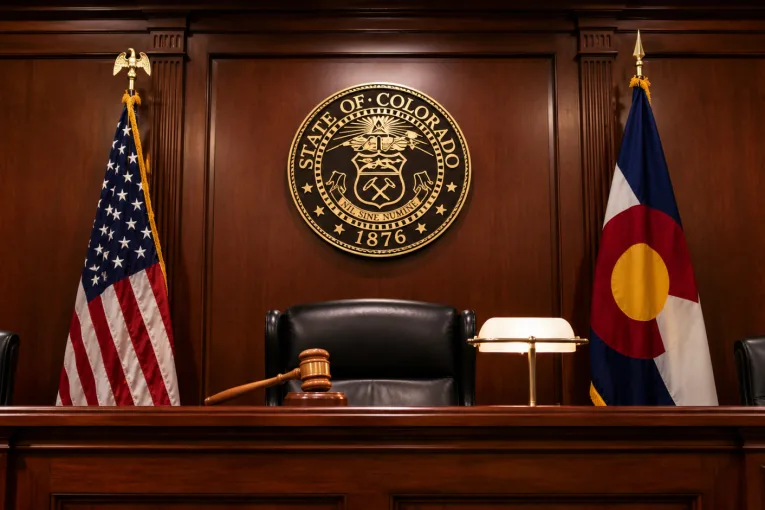
PUEBLO, Colo. — During a hearing in Pueblo County Court on Monday, Nov. 23, Judge Margaret Vellar denied a defense motion to exclude evidence obtained during an encounter between the accused and his community parole officer.
Defense counsel argued that parole officers should be subject to the same body-worn camera requirements as other law enforcement officers and that excluding them from those requirements created an inconsistency in law enforcement accountability.
The motion concerned an encounter during a parole home visit in which an officer, who was neither wearing nor equipped with a body-worn camera, observed the accused near a dumpster outside his residence before approaching and speaking with him.
The defense questioned whether Colorado’s body-worn camera law applied to community parole officers, arguing that the absence of a recording warranted excluding evidence obtained during the encounter.
Defense attorney King argued that the statute did not explicitly exempt parole officers from its requirements and that their authority to conduct searches, make arrests and detain individuals was comparable to that of other law enforcement officers.
“My argument is both a legal one, but also a moral one,” King stated, questioning why parole officers should be held to different accountability standards despite exercising similar authority.
King emphasized that parole officers exercise many of the same powers as other law enforcement officers and regularly interact with residents throughout Pueblo.
“On the day-to-day interactions, on the east side, on the north side, on the south side, in our neighborhoods, the parole officers are a noticeable presence,” King stated, adding that parole officers wear insignia identifying them as law enforcement.
The defense argued that differences in the classification of state parole officers and other law enforcement personnel should not determine whether their interactions with the public are recorded.
King also pointed to the legislative purpose of Colorado’s body-worn camera requirements, maintaining that the law was intended to promote accountability among officers exercising government authority.
The defense further referenced previous efforts by the Colorado Department of Corrections to implement body-worn cameras for parole officers, arguing that recording interactions would provide safeguards for both officers and the individuals they encounter.
King maintained that the statute’s definition of a peace officer should encompass community parole officers, notwithstanding an appellate decision interpreting the law more narrowly.
The prosecution offered no additional argument in response to the defense’s motion.
In explaining her ruling, Vellar referenced findings from an earlier Oct. 12 motions hearing concerning the encounter between the accused and his parole officer.
The judge then reviewed Colorado’s statutory definitions of peace officers, differentiating the broader classification of law enforcement personnel from the narrower definition used in the body-worn camera statute.
Citing the Colorado Court of Appeals decision in People v. Jelks, Vellar explained that although community parole officers qualify as peace officers under other provisions of state law, they are employed by the Colorado Department of Corrections rather than a political subdivision of the state.
Under the appellate court’s interpretation, community parole officers are therefore excluded from the body-worn camera requirements at issue.
The judge concluded that the officer had not violated the applicable statute by conducting the encounter without a body-worn camera and denied the defense’s motion.
Following the ruling, King questioned whether the court had considered statements from the legislator who drafted the law regarding its intended application to parole officers.
“I’m just looking at the language of the statute,” Vellar responded, explaining that her decision rested on what lawmakers had enacted rather than their stated intentions.
The court then addressed trial readiness. Defense counsel stated that the defense was not ready for trial because it was still awaiting a transcript from an earlier motions hearing.
The defense also explained that the accused had another pending case and that discussions concerning a possible global disposition were ongoing. According to defense counsel, such a resolution could result in the dismissal of the current case.
“The fact that you’re hoping for a resolution is not grounds for a continuance,” the judge responded.
The prosecution stated that it was prepared for trial but could not confirm the proposed resolution, explaining that it had no information about a potential global disposition.
The court ultimately scheduled another pretrial readiness conference for Nov. 30 at 2:30 p.m., allowing the parties to revisit trial readiness before the scheduled trial.
To comment please go to one of these social media platforms:
Facebook: https://www.facebook.com/DavisVanguard
LinkedIn: https://www.linkedin.com/company/peoples-vanguard-of-davis-inc/
Instagram: https://www.instagram.com/davisvanguard/
X: https://x.com/davisvanguard
Bluesky: https://bsky.app/profile/vanguardnewsgroup.bsky.social
Subscribe to the Vanguard News letters. To make a tax-deductible donation, please visit davisvanguard.org/donate or give directly through ActBlue. Your support will ensure that the vital work of the Vanguard continues.
