
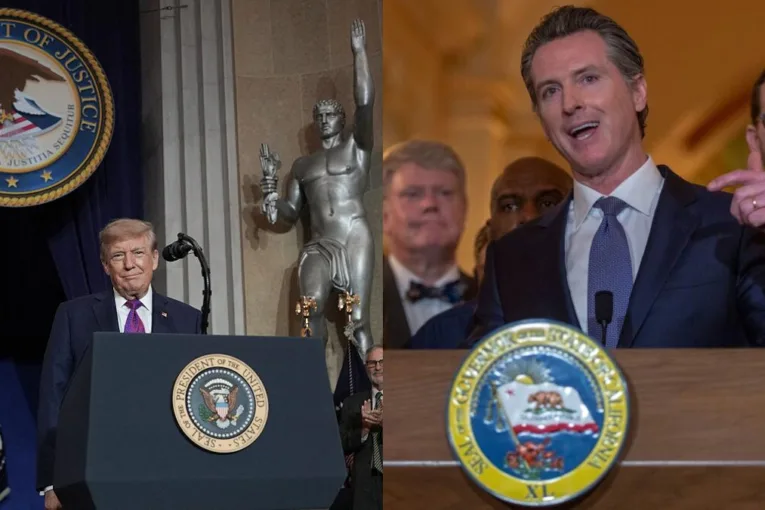
WASHINGTON — President Donald Trump used the U.S. Department of Justice on Monday as the backdrop for an attack on California Gov. Gavin Newsom over his decision to commute all 548 death sentences in California, vowing that his administration would attempt to overturn the governor’s action despite having identified no clear legal authority to do so.
Newsom responded by turning the debate toward Trump’s own exercise of executive clemency, accusing the president of pardoning wealthy political allies, depriving crime victims of financial restitution and attempting to exploit the suffering of victims’ families for political purposes.
The confrontation between Trump and Newsom represents an escalation of the political battle over capital punishment and offers an early indication of how the issue could figure into the 2028 presidential campaign.
But it also raises a question about the political calculus behind Trump’s intervention: whether an attack from a president who remains deeply unpopular in California could provide Newsom with political cover on an otherwise controversial issue.
Trump appeared at the Justice Department alongside Attorney General Todd Blanche, FBI Director Kash Patel and relatives of murder victims who oppose Newsom’s decision.
The president devoted considerable attention to describing the crimes committed by individuals sentenced to death in California, accusing Newsom of extending compassion to those convicted of murder while disregarding the suffering of victims and their families.
“Gavin Newsom and the radical left look at these heinous acts and their sympathy is not for the children of their parents, but for the monsters who extinguished innocent young lives,” Trump said.
“I guess it’s politics. I don’t know how it’s good politics. I think it’s terrible politics.”
Trump characterized Newsom’s decision as “one of the most shocking acts of injustice our country has ever seen” and described the governor’s action as a betrayal of victims’ families.
Among those appearing with Trump was Sandy Friend, whose 8-year-old son, Michael Lyons, was kidnapped and murdered. Friend expressed anguish over Newsom’s decision and challenged the governor to meet with her directly.
Trump also indicated that Blanche and others within the Justice Department were working to overturn the commutations.
However, the president did not explain how the federal government could intervene in an exercise of clemency involving state criminal convictions and authority explicitly granted to the governor under the California Constitution.
Newsom announced on Nov. 5, two days after the midterm elections, that he intended to commute the sentences of everyone on California’s death row to life imprisonment without the possibility of parole.
The decision does not overturn any convictions, authorize the release of anyone from prison or eliminate existing restitution obligations.
Under the California Constitution, the governor has the authority to grant pardons, reprieves and commutations, although the concurrence of at least four California Supreme Court justices is required in cases involving individuals twice convicted of a felony.
The proposed commutations are already the subject of a legal challenge brought by 30 California district attorneys, with questions surrounding the scope of the governor’s clemency authority and the California Supreme Court’s role in reviewing his decisions.
Trump’s intervention introduces a separate question concerning federal authority over state criminal justice decisions.
The president’s constitutional clemency power extends to federal offenses, not state convictions. Likewise, the president does not possess a general constitutional power to reverse clemency decisions made by governors.
In a statement released Monday, Newsom sought to contrast his commutations with Trump’s extensive use of presidential pardons.
Newsom argued that while his decision would leave everyone affected incarcerated for life, Trump has used his pardon authority to free individuals convicted of serious crimes and eliminate financial obligations intended to compensate victims or benefit public programs.
“I won’t take lectures on accountability from a President who has used the pardon power to help wealthy friends and business associates avoid accountability while victims are left fighting to recover what was stolen from them,” Newsom said.
The governor’s office cited a report by Democrats on the House Judiciary Committee estimating that Trump’s clemency decisions had eliminated approximately $1.7 billion in financial obligations.
Those obligations include not only restitution owed directly to victims but also fines and other financial penalties, some of which would otherwise support programs serving crime survivors.
In an accompanying video, Newsom accused Trump of operating a system of justice in which wealth and political connections determine who receives mercy.
“If you’re poor, Black or Brown, you get the needle. If you are rich and know Donald Trump, you get a pardon and a personal phone call,” Newsom said.
“A Justice Department that prosecutes his enemies and pardons himself and his friends — that’s not law enforcement. That’s a protection racket.”
Newsom also recalled Trump’s history of supporting the death penalty, including his intervention in the 1989 Central Park jogger case, in which five Black and Latino teenagers were wrongfully convicted before their convictions were ultimately vacated.
The governor’s office argued that California’s experience with wrongful convictions illustrates the inherent danger of maintaining a punishment that cannot be reversed.
Trump, meanwhile, used Monday’s appearance to announce plans to expand the federal government’s pursuit of capital punishment and expedite federal executions.
The president said he would issue a directive instructing federal prosecutors to seek the death penalty in cases involving the murders of children, as well as cases involving rapists and human traffickers who kill their victims.
“Once juries have spoken, capital punishment will be swift and certain,” Trump said.
During the final months of Trump’s first term, his administration carried out 13 federal executions. The Biden administration subsequently imposed a moratorium on federal executions, and Biden commuted the sentences of 37 of the 40 people on federal death row shortly before leaving office.
Trump’s renewed push for capital punishment comes at a time when national support for the death penalty has fallen to its lowest level in more than five decades.
According to a recent Gallup poll, 49% of Americans support the death penalty for people convicted of murder, the lowest level since 1971.
Perhaps more significant in the context of Newsom’s potential presidential ambitions is the partisan divide. Just 28% of Democrats support capital punishment, compared with approximately 73% of Republicans.
California voters have twice rejected ballot measures that would have abolished the death penalty, most recently in 2016. However, the state has not carried out an execution since January 2006.
Whether Trump’s attack will generate additional opposition to Newsom’s decision within California remains unclear.
Pre-election polling by the Public Policy Institute of California placed Trump’s job approval at just 27% among likely California voters, illustrating the potential limitations of his influence in the state.
For Newsom, whose national profile has increasingly been defined by his confrontations with the Trump administration, the president’s intervention could change the political dynamics surrounding the commutations.
Rather than defending his decision solely against California prosecutors and victims’ rights organizations, Newsom now has an opportunity to frame the dispute as a confrontation over competing approaches to criminal justice, executive clemency and the relationship between the federal government and California.
Trump’s intended audience, however, may extend well beyond California.
By highlighting particularly disturbing murder cases and featuring relatives of victims, Trump offered a preview of how Republicans could seek to portray Newsom as insufficiently concerned with public safety should the governor pursue the presidency.
Newsom has indicated that he will decide in January whether to run.
The use of Justice Department headquarters for Monday’s event also raises questions about the increasingly direct role the Trump White House has assumed in the department’s affairs.
Presidents have traditionally been cautious about appearances at the Justice Department, in part to preserve the department’s independence from partisan political considerations.
Monday’s event was particularly notable because the department is already investigating Newsom and his wife, according to reporting by The Washington Post. Neither has been charged with a crime.
While Trump and Newsom exchanged accusations Monday, some victims’ advocates argued that the confrontation failed to address their underlying concerns about the commutation process.
In a statement issued Monday evening, the Crime Victims Alliance criticized Newsom for responding to Trump’s appearance by focusing on presidential pardons rather than addressing the concerns of California crime survivors who oppose the commutations.
The organization alleged that victims and surviving family members had repeatedly sought meetings with Newsom but that their requests had been denied, while survivors supportive of the governor’s decision had been afforded opportunities to meet with him.
“A commitment to victim engagement requires listening to all victims, not only those who support a preferred policy outcome,” the organization stated.
The alliance also raised concerns about proposed Board of Parole Hearings regulations involving individuals serving life without parole, arguing that future changes to sentencing policies could eventually undermine the permanence of those sentences.
However, the organization acknowledged that the proposed regulations do not currently apply to the individuals affected by Newsom’s death row commutations and that those individuals would remain sentenced to life without the possibility of parole.
Newsom’s office issued a second statement Monday, highlighting crime survivors who support the commutations and reject the premise that capital punishment is necessary to achieve justice.
Among them was Jess Nichol, whose sister Polly Klaas was kidnapped and murdered in 1993.
Nichol has called for greater investment in counseling, medical care and financial assistance for survivors rather than maintaining a death penalty system that can prolong legal proceedings for decades.
Her position stands in contrast to that of other victims’ relatives who appeared alongside Trump on Monday.
The governor’s office acknowledged that survivors hold differing views on capital punishment and that those who oppose his decision deserve to be heard.
“Survivors and victims of crime deserve justice, support that lasts, and services that help them heal — not politicize their pain,” Newsom said. “We can hold people accountable for the most terrible crimes without asking the state to take another life.”
To comment please go to one of these social media platforms:
Facebook: https://www.facebook.com/DavisVanguard
LinkedIn: https://www.linkedin.com/company/peoples-vanguard-of-davis-inc/
Instagram: https://www.instagram.com/davisvanguard/
X: https://x.com/davisvanguard
Bluesky: https://bsky.app/profile/vanguardnewsgroup.bsky.social
Subscribe to the Vanguard News letters. To make a tax-deductible donation, please visit davisvanguard.org/donate or give directly through ActBlue. Your support will ensure that the vital work of the Vanguard continues.
