
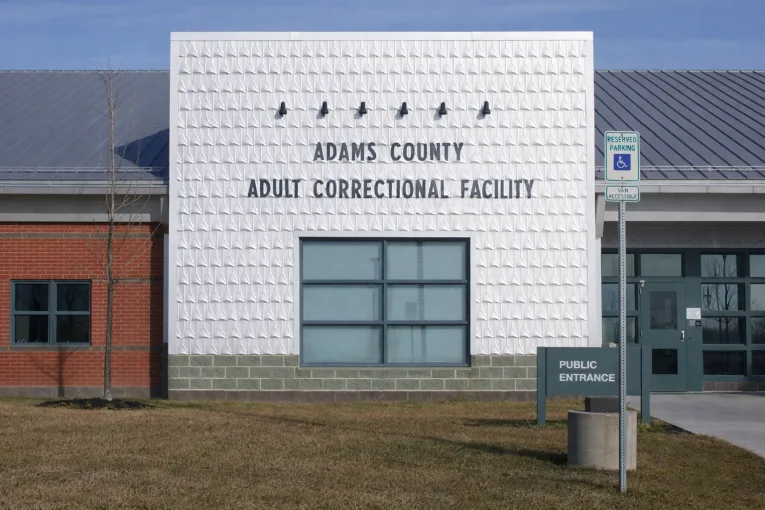
DENVER — Fair and Just Prosecution filed an amicus curiae brief Wednesday urging the Colorado Supreme Court to reverse a district court decision that upheld a long-standing ban on in-person jail visitation in Adams County, arguing the policy undermines public safety and exploits incarcerated people and their families.
Fair and Just Prosecution filed the brief March 30, calling on the court to overturn the lower court ruling, according to a press release from the organization.
The Adams County Detention Facility has banned in-person visitation since 2006 and later implemented fees for video and telephone communication as part of a profit-sharing agreement with private communication providers, the brief states.
While the policy has been justified as a way to reduce contraband, the brief argues that most contraband is introduced by jail staff in exchange for bribes.
The brief, filed alongside the Law Enforcement Action Partnership, highlights the negative impact of visitation bans on both public safety and the mental health of incarcerated people.
Separation from loved ones, the brief argues, contributes to instability upon release and increases the likelihood of recidivism.
“The positive public safety effects of in-person visits are well-documented,” the brief states. “A Minnesota study […] found that even one in-person, face-to-face visit reduced recidivism by 13% for new crimes and by 25% for technical violations.”
The filing also underscores the individual harm caused during the legal process, noting that family separation during pretrial detention can increase anxiety and pressure individuals to plead guilty and accept excessive sentences.
According to Fair and Just Prosecution, pay-for-service communication models impose additional financial burdens on incarcerated people and their families, who are already responsible for purchasing basic necessities such as toiletries and supplemental food.
The brief emphasizes that those most affected are often individuals who remain in custody pretrial due to an inability to pay bail and who have not been convicted of a crime.
It further argues that the ban fails to meet the constitutional requirement of serving a “legitimate penological purpose,” asserting that financial motivations and profit-sharing arrangements undermine claims that the policy is rooted in safety concerns.
“The pay-sharing provisions in the contracts directly incentivize the county to restrict in-person visits in order to funnel incarcerated people and their families to for-profit communication,” the brief states. “These provisions demonstrate that the motivation for ending in-person visits is not rooted in the safety of jail populations or staff, but in increasing revenue.”
The brief also contends that the policy harms community trust in the justice system by eroding legitimacy and reducing public willingness to cooperate with law enforcement.
The amici urged the Colorado Supreme Court to grant the petition and restore in-person visitation, arguing that limiting family contact without sufficient justification violates constitutional protections.
“The evidence is clear that in-person visits reduce violence, support mental health, and lead to safer reentry,” said Fair and Just Prosecution Executive Director Aramis Donell Ayala, according to the press release. “Charging families for phone or video calls while eliminating in-person visits puts profit ahead of public safety and exploits vulnerable communities, deepening inequality and undermining fairness.”
Follow the Vanguard on Social Media – X, Instagram and Facebook. Subscribe the Vanguard News letters. To make a tax-deductible donation, please visit davisvanguard.org/donate or give directly through ActBlue. Your support will ensure that the vital work of the Vanguard continues.
