
SACRAMENTO, Calif. — California’s Proposition 36 is increasing incarceration, overburdening courts and failing to connect people to treatment, according to new data and testimony from justice system leaders who said the measure is exacerbating the very crises it was intended to solve.
At a virtual press briefing Wednesday hosted by Californians for Safety and Justice, researchers, legal experts and law enforcement officials described what they characterized as a widening gap between the promises made to voters and the outcomes now emerging across the state.
“In 2024, Prop 36 was introduced,” said Tinisch Hollins, executive director of Californians for Safety and Justice. “It was a tough on crime ballot measure that really played on the public anxiety around retail theft, the public health crisis around fentanyl, and homelessness.”
Hollins said the measure was framed as a treatment-oriented solution but instead has reinforced punitive approaches. “The failure of this really lies in the fact that we are punishing addiction and survival behaviors and not treating the root causes of addiction,” she said.
She added that “addiction can’t be solved by incarceration,” arguing that a public health approach is necessary.
New findings presented during the briefing suggest the measure is driving increased incarceration while falling short on treatment access.
Maureen Washburn of the Center on Juvenile and Criminal Justice said the data shows Prop 36 “is setting us off towards a dangerous return to mass incarceration.”
“It’s not doing what it pledged it would, which is connect people suffering from addiction with treatment services,” Washburn said.
According to Washburn, jail populations increased by nearly 3,000 people statewide in the first year after implementation, and more than 1,000 people had been admitted to state prison on Prop 36-related charges as of early 2026.
She said the data reflects a pattern of enforcement focused on low-level drug and theft offenses tied to addiction.
“We know that putting people suffering from addiction behind bars is counterproductive,” Washburn said.
The panelists highlighted the limited reach of treatment under the law.
“The measure of success for Prop 36 is 17%,” Washburn said. “That is the share of Prop 36 felony drug cases that have resulted in treatment.”
She noted that this figure represents only initial entry into treatment programs, not completion. “Less than 1 in 5 cases are actually getting connected to any kind of treatment program,” she said.
Even fewer cases result in successful outcomes. “.3%, that’s less than 1% of Prop 36 felony drug cases are resulting in a dismissal of charges following successful completion of treatment,” Washburn said.
“That means the vast majority, 99.7%, are somewhere along the process in the criminal justice system, and that is an abject failure,” she added.
Panelists also pointed to disparities in how the law is applied across counties. Washburn said “there are stark geographic disparities,” noting that charging rates can vary dramatically depending on location.
She further highlighted the racial disparities, stating that “communities of color are bearing the brunt of Prop 36.”
Speakers argued that the law’s shortcomings are not due to a lack of funding but rather how existing resources are allocated. Washburn pointed to billions in realignment funds that remain largely untracked and underutilized for treatment.
Retired Judge Brett R. Alldredge echoed concerns about accountability and oversight of those funds.
“There are counties in this state that receive in excess of $100 million dollars every single year… to do the very same things that now we’re talking about,” he said.
He described a lack of transparency in how those resources are used.
“The counties continue to hoover this massive amount of money with absolutely no requirement for review or accountability,” Alldredge said.
Alldredge said the broader failure reflects structural issues predating Prop 36.
“Its failed promise… is built on a false premise in the first place,” he said.
Mano Raju, public defender for San Francisco, described the law’s impact on the court system and legal practice.
“I was planning to… give it an F,” Raju said. “But that is far too generous.”
“When you have 17% of people even being referred to treatment, and 0.3% completing, that is an abomination,” he said.
Raju argued that the law is being used primarily to increase prosecutorial leverage.
“What it is being used for is another tool for prosecutors to overcharge cases and coerce plea markets,” he said.
He described cases where individuals already in treatment are still pulled into the criminal system, creating inefficiencies. “Complete waste of court resources, complete waste of judicial resources, complete waste of prosecutorial resources,” Raju said.
Raju argued that meaningful recovery requires support systems rather than punishment.
“What works is truly seeing people and meeting them where they’re at,” he said.
Law enforcement perspectives presented at the briefing also challenged the effectiveness of criminalization.
Diane Goldstein, a retired lieutenant and executive director of the Law Enforcement Action Partnership, said her experience shows the limits of enforcement-based approaches.
“The justice system isn’t built to solve public health crises,” Goldstein said.
“Addiction and homelessness are complex public health challenges,” she said. “We have to break from the mindset that views them as crimes that can be solved through enforcement alone.”
Goldstein added that repeated arrests do not lead to long-term solutions.
“We end up measuring the wrong things, activity, arrests, citations, sweeps instead of outcomes that include stability, recovery, and long-term safety,” she said.
She described the current approach as counterproductive.
“Proposition 36 is clearly a step backwards for us, using coercion, punishment, and incarceration to compel treatment,” Goldstein said.
Troy Vaughn, executive director of the Los Angeles Regional Reentry Partnership, spoke from both professional and personal experience, emphasizing the urgency of expanding treatment capacity.
“Addiction and homelessness are not just social issues. They are public health crises affecting every corner of California,” Vaughn said.
“We cannot simply arrest or punish our way out of a public health crisis,” he added.
Vaughn highlighted systemic barriers to treatment access, including long wait times.
“I was told that it would be six months… waiting for treatment,” he said, adding that “in addiction, six months is often the difference between life and death.”
He pointed to broader gaps in care, noting that “only about 1 in 10 people who need treatment actually receive it.”
Vaughn warned that current policies perpetuate cycles of relapse and incarceration.
“Instead of stabilizing people, what we’re doing right now is we’re recycling through the system and making the problem worse,” he said.
He emphasized that recovery requires sustained support.
“Treatment without enough capacity does not work. Mandates without support lead to failure,” Vaughn said.
Speakers repeatedly stressed that relapse is a normal part of recovery, not a failure deserving punishment.
Vaughn said, “Anyone who understands recovery knows this relapse is often part of the recovery process.”
The panel also addressed broader misconceptions about public safety. Goldstein said, “Safety is something we build. It requires investment, trust, and shared responsibility.”
She added that “when people have access to housing, care, and support, communities become more stable.”
Participants urged a shift toward evidence-based, health-centered approaches.
Hollins said the state must “course correct this policy failure” by investing in treatment infrastructure and prevention.
Washburn underscored that the current trajectory risks reversing decades of progress. “Prop 36 is failing not because of a lack of funding, but because it was built… on a false premise that a criminal justice approach can solve what’s fundamentally a public health problem,” she said.
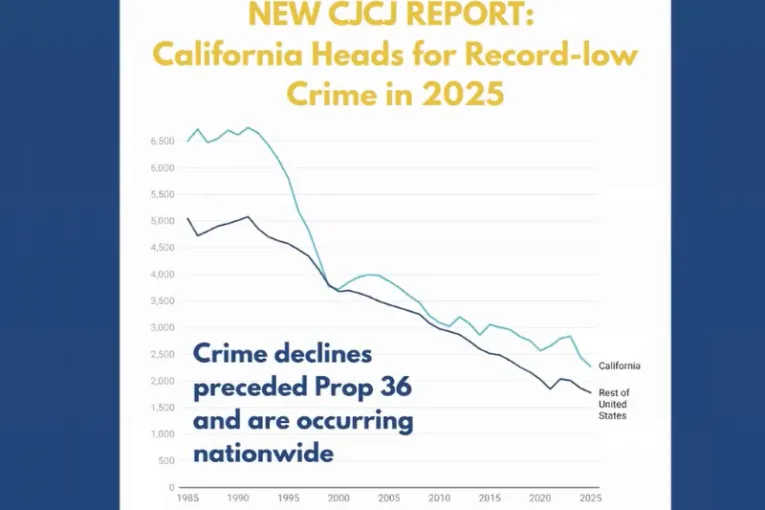
Speakers also cautioned against linking crime trends to the measure, noting that California is experiencing declining crime rates independent of Prop 36.
As the discussion concluded, panelists emphasized that the stakes extend beyond policy debates to human lives. Vaughn framed the issue in stark terms.
“The question is simple,” he said. “Will we keep building systems that punish people for being sick?”
“Recovery is possible. Restoration is real,” Vaughn added. “If we do this right… we won’t just change systems. We’ll save lives.”
Follow the Vanguard on Social Media – X, Instagram and Facebook. Subscribe the Vanguard News letters. To make a tax-deductible donation, please visit davisvanguard.org/donate or give directly through ActBlue. Your support will ensure that the vital work of the Vanguard continues.
