
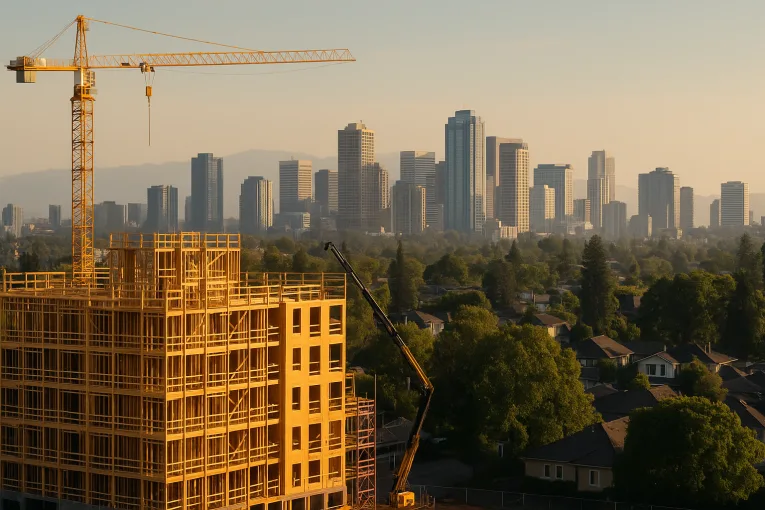
California has finally taken a meaningful step toward addressing its housing crisis — and from a libertarian perspective, it’s long overdue. The state’s recent decision to effectively gut the California Environmental Quality Act (CEQA) for most urban residential development is more than just a win for YIMBYs and developers. It’s a rare and critical victory for individual property rights, economic mobility, and constitutional sanity in a state long shackled by regulatory overreach.
As CalMatters put it, “With the passage of a state budget-related housing bill, the California Environmental Quality Act will be a non-issue for a decisive swath of urban residential development.” What that means in practice is that most new apartment buildings will no longer be vulnerable to CEQA-based litigation — lawsuits that often have nothing to do with environmental protection and everything to do with blocking new housing. This is a major blow to the “not in my backyard” (NIMBY) forces who, for years, have used CEQA as a legal cudgel to maintain the status quo.
Assemblymember Buffy Wicks, who introduced the CEQA reform bill, framed it clearly: “Saying ‘no’ to housing in my community will no longer be state sanctioned. This isn’t going to solve all of our housing problems in the state, but it is going to remove the single biggest impediment to building environmentally friendly housing.”
Libertarians have been saying this for decades. CEQA’s abuse illustrates what happens when well-intentioned laws get captured by entrenched interests. The law, originally passed to ensure that development considers environmental impacts, evolved into a tool wielded by privileged groups to delay, distort, and ultimately destroy housing proposals — particularly the dense, urban, and affordable housing California desperately needs.
As George Mason University law professor and libertarian scholar Ilya Somin writes, “California’s regulatory barriers to housing construction are what has put the state at the epicenter of the nation’s housing crisis, and CEQA is a big part of the reason why.” He adds that while exclusionary zoning remains a serious problem, “curtailing CEQA is still a major step in the right direction.”
But CEQA is just one part of a much larger problem — a deeply embedded legal structure that actively prevents people from building, renting, or buying homes, all in the name of preserving “community character” or “local control.” This is where Somin’s work becomes especially important.
In a coauthored article in the Texas Law Review, Somin and University of Wisconsin law professor Joshua Braver argue that exclusionary zoning laws — restrictions that prevent property owners from building anything but single-family homes, or that impose arbitrary lot sizes, parking requirements, and height limits — are not merely bad policy. They are unconstitutional.
“We argue that exclusionary zoning… violates the Takings Clause of the Fifth Amendment,” Somin and Braver write. “These laws have emerged as a major political and legal issue,” they add, “responsible for massive housing shortages… cutting off millions of people — particularly the poor and minorities — from economic and social opportunities.”
The Takings Clause is clear: when the government “takes” private property, it must provide “just compensation.” Traditionally, this has meant physical appropriation of land. But Somin and Braver point out that the founders understood property rights to include not just the right to exclude others, but also the right to use one’s property. As William Blackstone famously wrote, property consists in “the free use, enjoyment, and disposal of all his acquisitions.” And that right, in the late 18th and 19th centuries, included the ability to build a house.
What exclusionary zoning does, they argue, is effectively take that right away — severely limiting what owners can build and how they can use their land — without offering any compensation. In doing so, it violates both the original understanding of the Constitution and modern constitutional principles of fairness and representation.
From a libertarian standpoint, this is foundational. Property rights are not abstract ideals — they are the bedrock of liberty. When the government strips away your ability to decide what to do with your land, it denies you autonomy and economic freedom. Worse still, as Somin and Braver show, exclusionary zoning does this selectively, insulating the privileged while locking the disadvantaged out of opportunity.
This isn’t just a right-wing libertarian crusade. Braver is a progressive living constitutionalist. The two authors write that “we differ on many things, but agree here.” Their argument unites originalist theories with the representation-reinforcement theory of judicial review developed by John Hart Ely. In Democracy and Distrust, Ely argued that courts should act when democratic systems are rigged to entrench incumbent power and exclude outsiders.
That’s precisely what exclusionary zoning does. “The ‘ins’ are a community’s current residents,” Somin and Braver write, “and the ‘outs’ are potential residents.” Those already living in wealthy neighborhoods vote to block new development, thereby preserving their property values and local control. The people who would benefit most from new housing — lower-income families, young workers, immigrants — are politically voiceless. They can’t vote in the places where they can’t afford to live.
This is where the judiciary must step in. As Somin and Braver explain, “Judicial review can give voice to voiceless outsiders by providing them an opportunity to acquire the housing they need to move in.” They propose that courts recognize exclusionary zoning as a per se taking — which would require governments to pay compensation for the economic harm these laws impose. Since local governments couldn’t afford to pay out thousands of property owners, the effect would be a forced rollback of zoning restrictions.
That, in turn, could dramatically increase housing supply. Studies show that eliminating zoning restrictions in just seven U.S. metro areas could increase GDP by nearly 8%. As economists Gilles Duranton and Diego Puga concluded, zoning reform could allow millions of Americans to move to areas where they’d be more productive and better off — unleashing innovation and reducing poverty. Libertarians often champion markets as engines of mobility. The current system blocks those engines with legal concrete.
It also perpetuates racial and economic injustice. As Braver and Somin write, “Exclusionary zoning also has a horrible history of racism and classism.” After Buchanan v. Warley outlawed racial zoning, localities responded by enacting facially neutral laws with the same effects — effectively barring Black, Latino, and poor white residents through pricing and density constraints. This legacy continues, and courts that care about equal protection or representation-reinforcement should not ignore it.
Critics might argue that local governments need zoning to protect neighborhoods from overcrowding, noise, or traffic. But, as the authors note, genuine health and safety concerns fall under the police-power exception — the legal doctrine allowing certain types of regulation that address significant harms. “Few exclusionary-zoning restrictions fit within any plausible view of the police-power exception,” they write. “Their main effect is to exclude low-income people, not protect against environmental or health threats.”
California’s CEQA reform has already triggered complaints from those who want to preserve the old, exclusionary status quo. But CEQA was never designed to be a housing policy — and using it to prevent apartments from being built near jobs and transit was always a distortion of environmental priorities. If you want to reduce car dependency and greenhouse gas emissions, you need to build more infill housing, not less.
This is a rare moment where libertarian and progressive goals converge. Both want to dismantle the regulatory apparatus that has concentrated opportunity in the hands of the few. Both want to see families able to move, build, and grow wealth. And both understand that when the law is used to exclude, delay, and entrench, it becomes a weapon against liberty.
The housing crisis is real, but so is the path forward. Reform CEQA. Repeal exclusionary zoning. Reinforce constitutional protections for property rights and economic opportunity. California’s latest move is a beginning — but the real change will come when courts finally recognize that zoning laws which prevent Americans from building homes on their own land are not just bad policy. They are unconstitutional.
For libertarians, that’s not just a legal argument. It’s a moral one. Because when freedom is fenced off, priced out, and litigated away, it ceases to be freedom at all.

“Those already living in wealthy neighborhoods vote to block new development, thereby preserving their property values and local control. The people who would benefit most from new housing — lower-income families, young workers, immigrants — are politically voiceless. They can’t vote in the places where they can’t afford to live.”
You mean like under Measure J?
A spot on critique from the Wall Street Journal:
Consider the phony permitting reforms that California Gov. Gavin Newsom signed into law last week. The legislation, he said, embraces “a transformational abundance agenda focused on building more of what Californians need.” It does no such thing. While easing permitting for some apartment buildings in cities, the legislation reinforces regulatory barriers to building single-family homes in suburbs and exurbs.
From article: “They can’t vote in the places where they can’t afford to live.”
“They” can’t vote in places where they DON’T live. But if that was possible, I’d vote for measures which ensure that Atherton, for example, remains as is – despite not living there.
Underlying the entire premise in this type of article is that prices “should” be the same everywhere. That’s not a libertarian argument.
But if you think you have total control over your own property, try telling that to the Davis building department, for example. Or maybe stop paying property taxes, and see what happens.
Ron G notes: “While easing permitting for some apartment buildings in cities, the legislation reinforces regulatory barriers to building single-family homes in suburbs and exurbs.”
Yeap – as it should be, from a societal perspective (assuming that communities “should” be growing in the first place). But ironically, the state’s actions essentially reinforce disincentives against sprawl.
It could be that the state got this right, overall. (Again, assuming that growth is “needed” in the first place – which they haven’t actually demonstrated.)
What I can’t figure out is why the YIMBYs and their state politician lackeys think this is going to actually accomplish anything. Prices are not going to come down as a result of this, though they are coming down right now for other reasons.
RO say: “Underlying the entire premise in this type of article is that prices “should” be the same everywhere. That’s not a libertarian argument.”
Not by a long shot. Communism, by any other name. Brutalist housing architecture in Atherton!!! Or a least at Stonegate.
“They can’t vote in the places where they can’t afford to live.”
Vote? Heck, there are people in Davis that don’t even like outsiders who live in Woodland commenting on Davis housing issues.
Keith O
You overlooked the nuance of my point about Ron Oertel. There are people who comment here who want to live in Davis or have other outside interests in Davis. Ron doesn’t want to live in Davis (he move away) and has not discernable connection to Davis, unlike anyone else commenting here. People who want to move here should have a voice in the future of Davis. But those who are not participating in Davis life and don’t want to participate should not be commenting–they are not a stakeholder here.
Holy Mackerel! The Vanguard is shilling for the raised-by-a-Nazi Kochs’ preferred philosophy: libertarianism. Uber-conservative funders of all things “conservative” are Charles and David Koch. Their nanny was literally a member of Hitler’s party. In the 2016 election, for example, Kochs spent $889 million on political causes. Pseudo-liberal George Soros spent less than one-thirtieth that amount.
Libertarianism is junk philosophy, not taken seriously by philosophy professors anywhere, unless their chair is endowed by the Kochs–that’s how James Buchanan got his job. Among other things, libertarianism contends that people act reasonably and rationally. Yep, that’s why all those car commercials tout miles per gallon and repair records, not “buy this car and you can date a supermodel”… Oh, wait the supermodel appears in those commercials. No kidding: junk philosophy.
As for the massive “impediment” offered by environmental constraints, the Kochs would love to dump their toxic refinery waste on their refinery land. Yep, it may pollute the water table, and the toxic fumes may kill people (despite any pretended “police powers”), but hey! It’s **OUR** land (say the Kochs)! And it’s possession uber alles!
Yes, zoning as currently practiced in California is baloney, but it’s not the cause of housing shortages. Houston has zero zoning, yet still has more than 3,000 homeless. They have had a successful program to reduce homelessness…that depends on federal money Trump is busy cutting (https://www.governing.com/housing/how-houston-cut-its-homeless-population-by-nearly-two-thirds)
CEQA passed while Reagan was California’s governor, but what your libertarian enthusiasm ignores is that Nixon stopped the feds from building affordable housing, and as president, Reagan cut HUD’s affordable housing budget by 75% (as he cut taxes on the wealthy roughly in half, and with his successor raised payroll taxes eightfold). After the New Deal, the US had no significant homeless population until Reagan’s presidency.
I simply cannot convey my disappointment at how you’ve been taken in by the libertarian scam. I’d expected more from the Vanguard. Please revise your thinking.
Worth a look: https://worksinprogress.co/issue/how-to-redraw-a-city/
This article appears to adopt the viewpoint that there are is no middle ground in managing the housing market. Either its draconian over the top regulation or its the Wild West of individual property owner choices. The problem is that we started the post WWII building boom mostly with the unfettered approach and we’ve ended up with vast urban sprawl that both dissected our sense of community and exacerbated environmental degradation. Regulations were largely in response to those adverse consequences. The answer is not to go back to the situation that caused the problem in the first place.
What we need is reasonable planning standards that capture both what is financially feasible for developers and also brings back our community interaction while limiting environmental damages. Developers need to be given clear guidelines that provide assurances of preapproval without the ability to impede their projects once they are started.
The empirical data is showing that the NIMBY factor is key to the housing supply slowdown everywhere, not just in California. One interesting factor is that sprawl has pushed housing to the limits of commuting in places like Atlanta and Dallas. CEQA is one tool used here but there other ones in other states. Similar to an another article I posted earlier, the problem appears to be that highly educated residents are manipulating the levers of government to keep other out of their communities. Unfortunately this feeds right into the MAGA narrative. https://www.theatlantic.com/economy/archive/2025/06/zoning-sun-belt-housing-shortage/683352/