
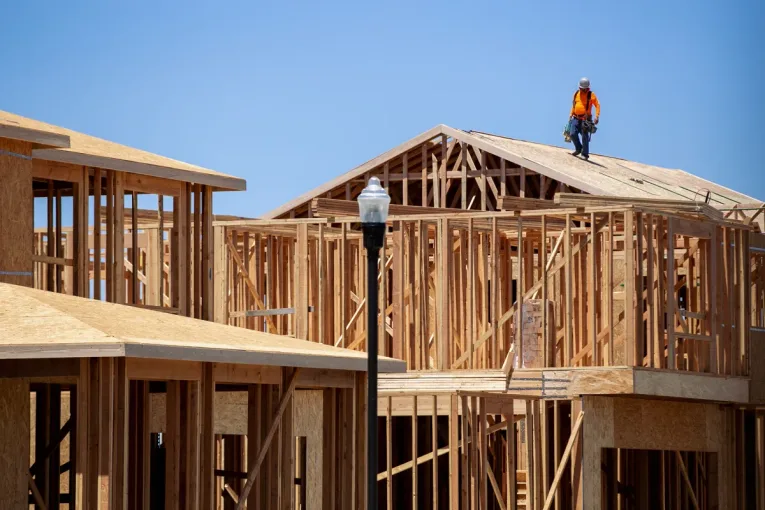
Federal immigration crackdown threatens California’s historic housing reforms
By Nils Gilman, Special for CalMatters
This commentary was originally published by CalMatters. Sign up for their newsletters.
California has finally made real progress on one of its most stubborn problems: the housing crisis. After decades of paralysis, the state has begun to unwind the bureaucratic thicket that made it almost impossible to build new homes in cities. This should be a moment for cautious optimism.
Yet a new and very different problem looms — one that threatens to undermine these hard-won reforms before a single unit is built: a growing national effort to crack down on the very workers California needs to build its future.
This summer, Gov. Gavin Newsom pushed through a pair of bills — Assembly Bill 130 and Senate Bill 131 — that amount to the most significant overhaul of California’s development rules in more than 50 years. In particular, the reforms are massively curtailing the California Environmental Quality Act, which for decades has allowed opponents to block urban housing with endless lawsuits and reviews.
Urban infill projects near transit are now largely exempt from CEQA litigation. Developers are, for the first time in a generation, preparing to build at scale.
But just as California removes the red tape, it may find itself caught in another bind: a lack of construction workers. And this time, the cause isn’t homegrown.
More than 40% of California’s construction workforce is foreign-born, according to the National Association of Homebuilders. That includes more than half a million immigrants, many of them undocumented, who work as framers, drywallers, roofers and laborers.
These are physically demanding jobs, often shunned by native-born workers. Without them, the math of housing development simply doesn’t work.
Yet the national political winds are blowing in the opposite direction. The Trump-aligned right has completely changed the conversation about immigration. Their focus is on deporting not just criminals, but all undocumented migrants. Mass deportation, as recently as last year considered a fringe idea, is now the openly stated policy objective.
The implications for industries that rely heavily on immigrants are as dire as they are obvious. Heightened enforcement, even without sweeping raids, creates fear and uncertainty. Some workers leave preemptively. Others move into the shadows.
The result? Just as building permits get faster, the labor force that builds will get scarcer. Construction firms already report difficulty assembling full crews. Wages are rising. Projects are being delayed — not by paperwork, but by a shortage of hands.
If this trend continues, California risks an awkward outcome: a flood of new housing approvals but not enough workers to actually build them. The “abundance agenda” could turn into a shelf full of blueprints.
In the worst case, we end up with a hollow boom — developments greenlit but never started, or started but never finished.
As construction lags, pressure will mount on Sacramento to push back against federal immigration policy. California has clashed with Washington before — on climate, guns, and abortion. Housing could be next. Newsom, perhaps eyeing national office, may argue that federal immigration enforcement is sabotaging state-led economic reform.
This will be a high-stakes confrontation. The federal government controls immigration. California controls land use. The two are now on a collision course.
The deeper irony is hard to miss. For years, the consensus was that California’s housing problems were self-inflicted — caused by too much regulation and not enough political courage. Now that the state is finally addressing those issues, it’s being undermined by a different kind of politics: a national campaign against the very people who build homes.
If California wants to realize its new housing vision, it will need not just faster permits but also enough skilled workers to turn blueprints into homes. That means protecting the workforce it has — even when doing so puts it at odds with Washington.
Otherwise, we will be left with the worst of both worlds: new rules, no results and a housing crisis that continues to degrade the quality of life for far too many Californians.
This article was originally published on CalMatters and was republished under the Creative Commons Attribution-NonCommercial-NoDerivatives license.

The irony in regard to housing activists discouraging a livable wage for construction workers . . .
The irony in regard to those who claim to be advocating for immigrants, but want to pay them slave wages . . .
But hey, when you want someone else to pay for your housing, I guess your values go out the window. (The window that was installed via slave wages.)
The youngest generation (“Z”) is, however, increasingly seeking out careers in the trades. But they’re going to have to get paid for that to continue.
Of course, this isn’t particularly good news for those who want to grow the size of college towns.
https://www.cnbc.com/2025/04/24/gen-z-workers-opt-out-of-college-and-go-into-trades.html
“What if my ideology IS to not build anything?” – Ron Oertel, 7/15/25
You think that I won’t stand behind that (though it was a joke)?
I do generally support redevelopment – I can think of some examples of buildings in Davis that should be knocked down and replaced with something denser. (The entire block that houses Kim’s market, for example – really ugly buildings in the first place. Of course, that could cause Kim’s market to leave.)
Another example – the buildings adjacent to Co-Op (but again, could cause the bike shop to leave).
But yeah, I think we’ve had plenty of sprawl (statewide and beyond), already. I would have put a stop to it decades ago, if I was “king”.
Then again, I’m not sure why the housing activists think that density leads to cheap prices, when the exact opposite is true. (That’s why the allegation regarding NIMBYs “protecting” their property values is simply not supported by facts.) NIMBYs fight density for “quality of life” reasons. Everything is more of a hassle (including trips to the grocery store) when cities become more dense.
I’d like to provide an example of the “hassle” difference:
Compare Nugget on Covell Blvd, vs. Bel Air in Woodland.
Nugget is a beautiful, stunning grocery store (with high prices, narrow aisles that become blocked by even a single shopper, crowded, etc.). Parking is a challenge, and the spots are narrow (possibly leading to door dings). The clientele is obviously upper-middle class (as are a lot of the young workers, who are only there temporarily).
Bel Air is nowhere near as beautiful, but prices are cheaper, the aisles are wider, and it’s less crowded. Parking is not a problem, and I believe the spaces are plenty-wide. The customers and workers are decidedly different than those at Nugget.
Selection seems about the same (though Nugget has better take-out food options).
So, I guess there’s give-and-take. If you want an expensive, but exclusive experience – density is for you. Of course, when it’s truly dense (e.g., San Francisco), there also seems to be more homeless people around.
And as density further increases, hardware and grocery stores, for example start disappearing entirely (as do lumber yards – e.g., Hibbert’s). But that’s o.k., since the population of the city itself starts changing – and people no longer know how to do anything around their own houses. At which point, they rely on blue-collar businesses from Woodland.
The same type of thing has been occurring in San Francisco for decades.
I have not seen a single example where density results in lower prices for housing, cost of living, etc.
Ron O.: “Compare Nugget on Covell Blvd, vs. Bel Air in Woodland.”
You can’t really isolate Nugget Markets on Covell from that kind of discussion without acknowledging what other grocery stores are in Davis. I think Nugget that you highlight is more significantly trying to distinguish itself from other grocery stores in Davis — 2 Safeways, Savemart, Trader Joe’s, the Davis Food Co-op, the Mercado (latest Westlake grocery store iteration), S. Davis Nugget, Grocery Outlet. It’s not practical to set up a grocery store that resembles Savemart or Safeway, because they wouldn’t be optimizing their potential sales. Nugget is a little more high end in its products and presentation because there’s market for it. Beyond your argument, I think it has a lot to do with what already existed in the grocery market. I don’t see UCD students shopping at the Covell Nugget nearly as much as I see them at Trader Joe’s, the newest grocery site in Davis, which has generally cheaper prices. Trader Joe’s is going for yet a different market.
I see it as more of a difference between the two cities, though there is a Nugget in Woodland (its original home base), as well. It does not have quite the same “upscale feel” as the one on Covell, but is not as crowded, feels more spacious, and has plenty of parking.
There’s a reason that Nugget moved its headquarters to Davis (from Woodland) not too long ago. I think most people (who don’t already know) would be surprised to learn that Nugget originated in Woodland, and not Davis.
There’s a reason for their billboard in Marin county (along Highway 37), as well.
Differences in communities. Davis is more-upscale, more dense, more of a hassle, etc. (And it’s increasingly becoming that way.)
But yeah, UCD students are a different market, which is also related to the reason it’s a hassle to patronize Trader Joe’s. In other words, density creating a more-difficult living situation, other than perhaps for those who can walk to a store (and don’t have a lot to carry back with them).
UCD students do, however, periodically patronize Costco (sometimes in small groups).
Ron O.: “I see it as more of a difference between the two cities, though there is a Nugget in Woodland (its original home base), as well. It does not have quite the same “upscale feel” as the one on Covell, but is not as crowded, feels more spacious, and has plenty of parking.”
There’s a second Nugget in south Davis, near El Macero, that also does not have quite the same “upscale feel” as the one on Covell. Maybe it’s similar to the one you mention in Woodland? By your thinking, would you suppose that part of Davis (El Macero) is less affluent and upscale than the neighborhood around the Covell Nugget?
You’re generally right about the Nugget near El Macero, I think. But still more-crowded than the one in Woodland.
But let me ask you (in general): Do you find that Davis is more dense, crowded, and expensive than Woodland? And that the population characteristics themselves are different? And that Davis is increasingly-becoming more crowded/dense? And that most people are still driving, rather than bicycling – even with the development of electric bicycles? Some of which are probably illegal to ride on the street in the first place? (It would be interesting to know how much traffic and congestion has increased over time, on various streets.)
As David sometimes says (regarding a somewhat similar issue), perhaps residents don’t notice such changes since they occur relatively slowly – similar to how a frog might not notice being inside an increasingly-hot pot of water.
Sort of like how we don’t necessarily notice climate change, either.
In any case – as cities become more dense, do you find that stores often get replaced by (or proposed for) housing? Such as the former ACE housewares store, Hibbert’s, etc.)?
In San Francisco, a neighborhood was recently fighting to try to keep a Safeway open. I recall an earlier time when another (more-upscale) grocery store was torn down and replaced (with housing above it), which then required customers to deal with parking in a garage underneath, using a driveway on an increasingly-busy street). I don’t believe I ever bothered with that place again. But they didn’t necessarily care about “me” in particular, perhaps because they had an entire new set of customers living above it. Of course, that left people like me with fewer reasonable options.
Just like how you can’t get lumber in Davis, anymore (outside of whatever they might sell at ACE). But that leads me back to the other thing that happens as cities become more dense: The populace seem to become even more white-collar focused, and no longer know how to fix a leaking faucet. (At which point, they rely upon a blue-collar business in Woodland to fix it.)
Ron, I’m quite surprised at your assessment of the two Davis Nugget Markets. I shop at both, as well as both Safeways, the SaveMart, Grocery Outlet and Trader Joe’s. I also occasionally shop at the Gibson Road Bel Air and CostCo. Parking at the South Davis Nugget and the SaveMart are the easiest. Never have to circle for a space. Next comes the Covell Nugget. Also quickly find a space and walk in. Both Safeways, especially the Marketplace one, are busy enough that finding a space is frequently a challenge, often having to park closer to Panda Express than to Safeway itself. Trader Joe’s has been the worst, but now that the construction is nearing an end that might change. Costco is as bad as Trader Joe’s. I’ve never found Bel Air any easier to park at than the Covell Nugget.
Your aisle width comment is equally bewildering. The only time I have any reason to pause is if a shopper is selecting the same thing I came for, and that happens everywhere.
I think you are seeing demons where none exist.
My experience with pricing has been that Woodland and Davis and Vacaville and West Sac Nuggets have the same prices.
The real problem is that you’re trying to make the “everything bagel” argument here. There is a tradeoff between building housing that people can actually afford and paying people what they need to make in order to live. Of course building housing that is more affordable helps to alleviate that real world tension. But the reality is that real world policies come with tradeoffs unless of course your actual goal is as you say – to build nothing.
What you’re advocating for is exactly what I said – rely upon illegal immigrants to “pay for” housing that will be occupied by others. Slave labor.
Maybe you’ll start advocating for prisoners to do so, as well? (Actually, you could probably get them to do so at an even cheaper rate than illegal immigrants.)
But I notice that you’re not actually addressing the fact that as cities become denser, they become more expensive. Again, this lays bare the lie that’s being told regarding the motivation of NIMBYs. (Their concern is not related to property values, which actually INCREASE as cities pursue density.)
It’s probably not the density itself which increases the cost of living – it’s the fact that increasing the size of the population in an exclusive area allows businesses, such as the tech industry, to continue expanding (while simultaneously displacing the “rif-raff” middle class who used to occupy those locales). (The lower class was the first to be displaced.)
I’m not advocating anything, I’m pointing out the flaw in your logic. Will you or will you not, acknowledge that there is a tradeoff here and it’s not as simple as you have allowed to date?
A tradeoff for what? (Also, you are CONSTANTLY advocating for more housing – including on the backs of immigrants in this article.)
“My” solution would be to take a shot at greed, itself. (That is, the greed of communities when pursuing businesses that will ultimately displace residents.)
Also – truth be told, anyone concerned about high prices could simply sell or rent their property at below-market rate to someone less-fortunate than they are – especially if they don’t “need” to be in a particular locale. (Or, their heirs can wait until the owners die, and do the same thing.) There is no “law” requiring owners to establish a minimum price. So until these people who claim to be concerned about that actually do so, I’m probably not going to take them very seriously.
Same thing with the organizations opposed to rent control.
Same thing with any local religious organization which claims to be concerned about such things, but simultaneously holds onto large parcels of property (that they don’t pay taxes on in the first place). (These folks might be the most-hypocritical of the bunch.)
What do you mean a trade off for what? Have you not followed this discussion? We’ll come back to this in a few days.
I am disgusted by Trump’s treatment of immigrants and I find Stephen Miller to be one of the most loathsome characters in American History. I am further sickened by those who support what is going on with the Gestapo tactics of Ice and Homeland Security. However training young people in the building trades is completely doable and doesn’t take too long. These are usually living wage jobs so the association between immigration and labor availability isn’t the same as in low paid areas like farm labor.
Those figures are for a 1500 square foot home
$25/hour is not a living wage, though there’s (also) a lot more than just “carpenters” required to build a house.
You can earn (by law) $20/hour to start, at any fast food restaurant.
Carpenters are skilled workers, and usually have a shorter career than white-collar workers (for obvious reasons).
Truth be told, these careers also require some innate skill, that not everyone has (or can even be successfully trained for). Just like any other skilled field (e.g., artists, musicians, technology workers, etc.).
If we all had the inborn skill, we’d all be working on artificial intelligence at this point.
But if you want Americans to start working at these jobs, you have to pay them.
Also, paying a reasonable wage might encourage an entire generation of men (who have been dropping out of the workforce) to seek work, again.
https://www.cnbc.com/2024/09/21/why-more-men-are-dropping-out-of-the-workforce.html
What about plumber, painter, electrician, mason? People can learn these skills. There are training programs around too.
My point is that the competition for these jobs should be greater than the competition for lower wage work in ag or cleaning or casual labor.
My comment wasn’t in response to yours, but yes – they can learn those skills. Regarding competition for them, I’m not sure what you mean (but competition from an American worker’s point of view would be a lot less, if there weren’t illegal immigrants competing for those same jobs).
I used to think that blue-collar trades (such as plumbing and electrical work) were “overpaid”, but I no longer think so. (But my opinion hasn’t changed as a result of the fake housing shortage. Instead, it’s changed because I’ve realized that the skill and preparation provided by professionals has more value than I first realized. Plus, everything is expensive now (and those same professionals have to pay those costs, as well).
Very few people get rich by working (except perhaps for some – but not all, technology workers).
I find myself in an odd position – valuing the skill required for the trades (not to mention the skill/engineering that goes into creating housing developments), while simultaneously opposing most of them.
Then again, you have developers like the one who owned Chiles Ranch, who did nothing but purchase the property when it was relatively “cheap”, and then sell it years later at a significant profit (even after calculating costs, I believe).
I understand there’s a “bigger” developer who essentially did the same thing (but worse) regarding Natomas.