

Undocumented: Part Two of an investigative series covering California’s Court Reporter Crisis
By Susan Bassi, Fred Johnson, and Faith Strader
When an airplane crashes, investigators race to find the black box. Buried near the tail of the aircraft, it records everything: altitude, air speed, engine data, and every word spoken in the cockpit. Without it, there is no investigation — only wreckage, guesswork, and near-certainty it will happen again.
Court reporters are the black box of the courtroom.
A certified shorthand court reporter creates a word-for-word transcript of every legal proceeding: a judge’s rulings, an attorney’s arguments, witness testimony, even the moment a custody decision changes a child’s life. A transcript is the official verbatim legal record. Every appeal, every misconduct complaint, every enforcement action depends on it.
In California’s family courts, the black box is gone.
A lawsuit now before the California Supreme Court, Family Violence Appellate Project v. Superior Court, reveals that millions of the state’s divorces, child custody disputes, and domestic violence hearings and trials have taken place without a single court reporter in attendance. No transcript. No verbatim record. No meaningful appeal. No accountability.
Sworn declarations filed into the lawsuit by working court reporters across California tell a more disturbing story: the shortage was not an accident. It was built, step by step, by the very courts now asking the state’s highest court to approve electronic recording as a replacement.
There is not a shortage of certified court reporters. There is a temporary shortage of official reporters and that shortage was created by the court. — Diana Van Dyke, Los Angeles official reporter, 23 years
The Judge Who Cried Mayday
The picture in Santa Clara County’s family courts in the late 1990s was not pretty. Parents who couldn’t afford attorneys lined up in a system where more than two-thirds of litigants represented themselves.
In that system, a small professional network of attorneys, therapists, and privately paid “Special Masters” collected fees to represent children or resolve custody disputes outside of open court. And on Fridays, photographers caught judges leaving their courtrooms to play golf while cases sat unmanaged.
Parents had seen enough. For more than 30 days, they picketed courthouses and leafleted county buildings, claiming the local courts were fraught with cronyism, conflicts of interest and outright corrupt.
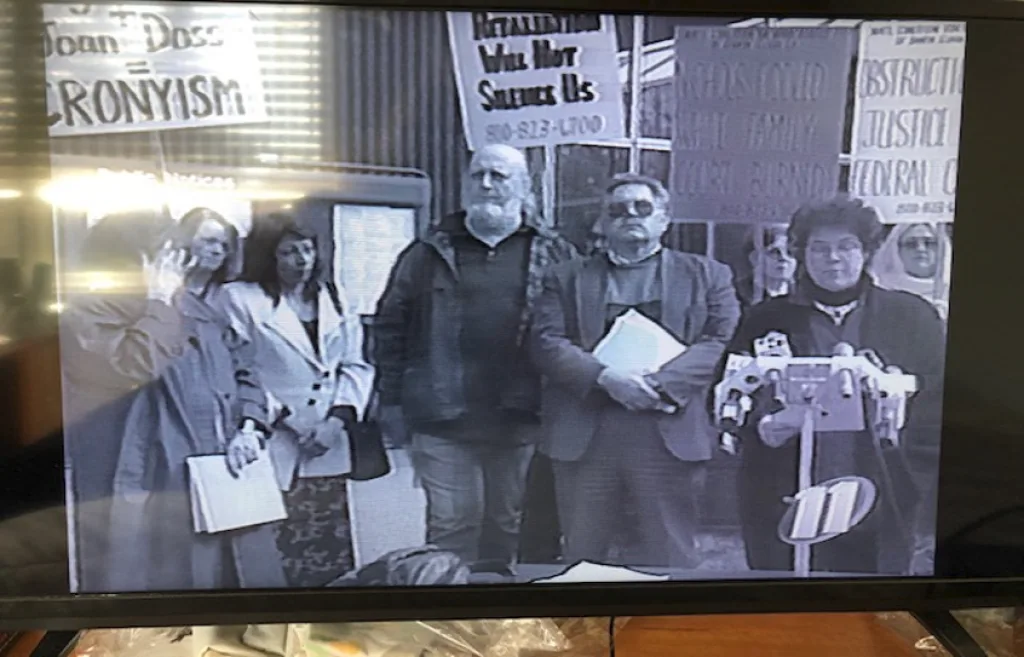
Jack Komar stepped into that chaos as the county’s new presiding judge. He barely had time to settle in before a firebombing at his San Jose Willow Glen home made him a crime victim and a local news story himself.
He didn’t slow down. Judge Komar formed a task force to address the family court crisis head-on, but the professionals whose livelihoods depended on the existing system pushed back fast.
Before the task force finished its work, 78 attorneys, therapists, and family law professionals signed a letter dismissing the protesting parents as “disgruntled litigants” whose picketing had grown “threatening,” “malicious,” and “patently false.”
Attorney James E. Towery was among them, complaining that the protests had left professionals “publicly humiliated.”
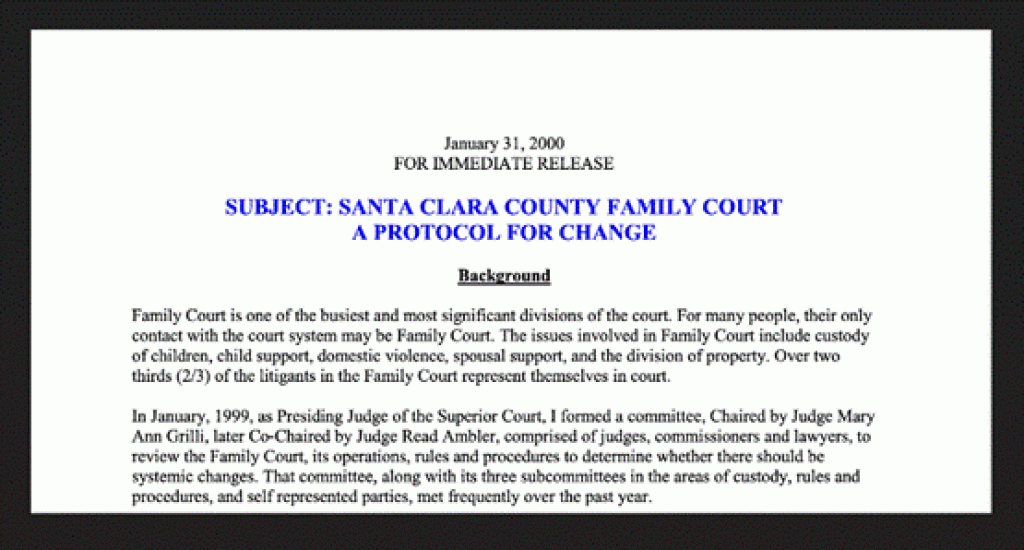
SANTA CLARA COUNTY “KOMAR REPORT” PUBLISHED JANUARY 31, 2000
Komar moved forward anyway.
His January 2000 report set strict limits on minors’ counsel appointments, capped attorney billing, reined in supervised visitation abuses, and placed hard restrictions on Special Masters.
Its finding was blunt.
Courts hold a “non-delegable duty” to decide child custody. That authority cannot be handed to paid third parties working outside of the court.
In the Komar era, court reporters produced transcripts that made accountability possible.
Then Komar retired, and the people he had tried to rein in got back to work.
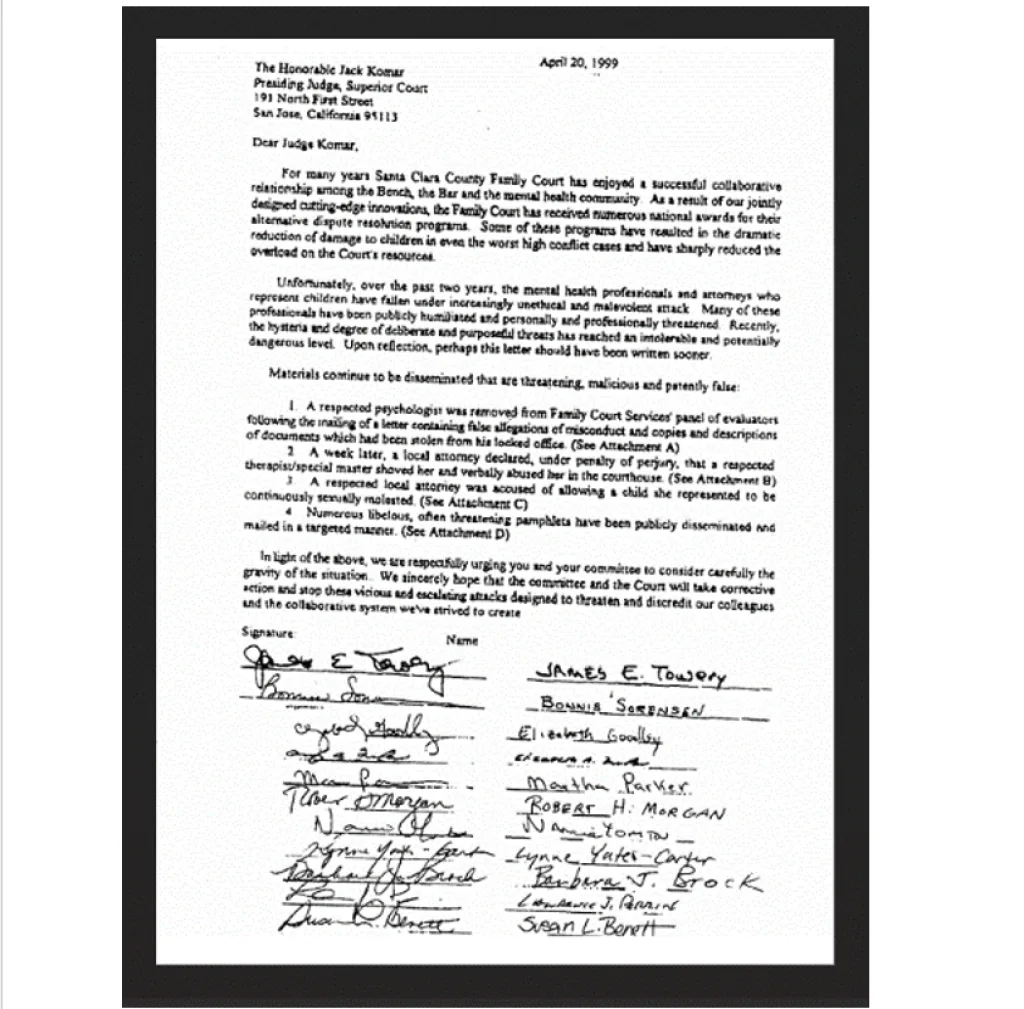
78 ATTORNEYS AND THERAPISTS OPPOSED FAMILY COURT REFORM EFFORTS
The Attorney Who Opposed Reform — Then Became the Judge
A decade after the Komar Report was published, James Towery — who had signed the letter calling protesting parents “dangerous” — was appointed to the Santa Clara County Superior Court and assigned to the family law division in 2012.
For most of Towery’s judicial career, families paid a $90 filing fee to schedule a hearing before a judge. Thirty dollars of that fee flowed into a pooled fund that guaranteed a court reporter would be in the courtroom. The court reporter assigned to Towery’s department was Kris Tresidder.
Records from the Court Reporters Board of California show Tresidder reported a hearing before Towery in 2015. The case involved a private judge’s fees and disclosures — exactly the kind of matter Komar had tried to regulate.
In 2023, the board found that Tresidder had provided written information to an outside party that did not appear in her official transcript.
She was cited for unprofessional conduct and fined $500.
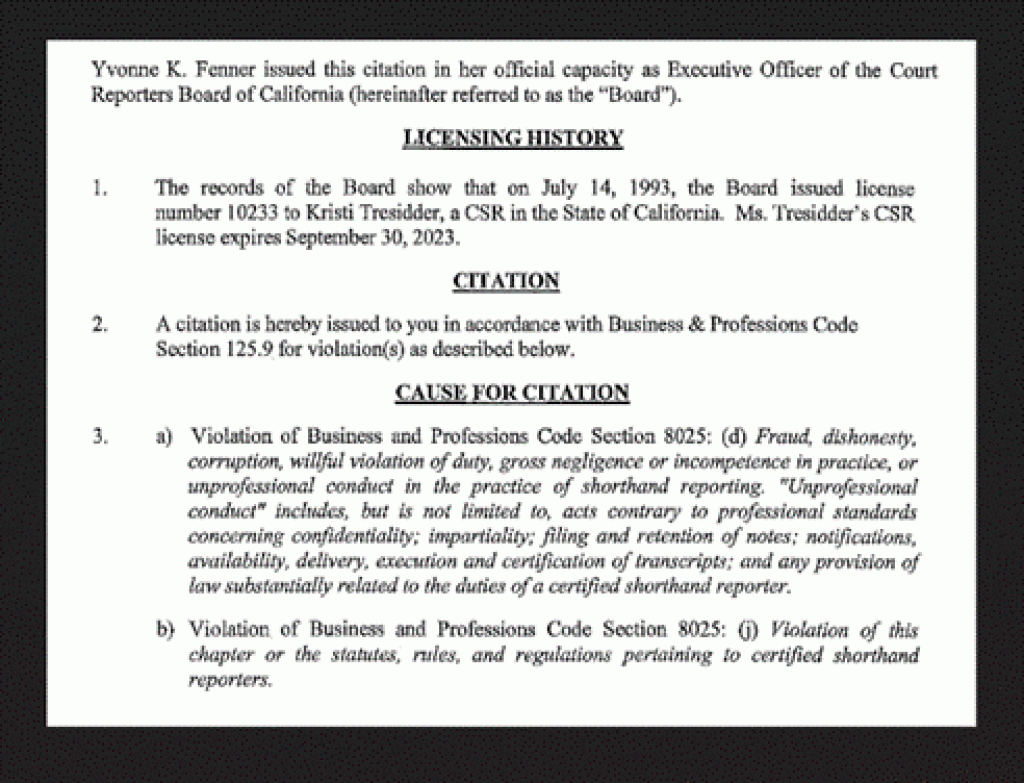
PUBLIC DISCIPLINE RECORD OF SANTA CLARA COUNTY COURT REPORTER KRIS TRESIDDER
No criminal charges were ever filed. But the case illustrated something critical: a competing record existed. The discipline was possible only because the transcript could be checked.
Public records show that over Towery’s judicial career, he appointed more attorneys as minors counsel, private judges and Special Masters rebranded as “parenting coordinators”, than any other judge in the court’s history.
By the time Towery retired from the bench, court reporters had vanished from every family law department in Santa Clara County.
No transcript. No appeal path. No mechanism to file a complaint against a judge, an attorney, a parenting coordinator, or a court reporter — because there was nothing left to review.
Private Judging Pulled Reporters Out of Public Courtrooms
Towery and his colleagues did not allow Judge Komar’s reforms to fade. They reversed them.
Attorneys and therapists who had worked as Special Masters rebranded themselves as parenting coordinators and private judges. Cases flowed to them precisely as Komar had tried to prevent.
When Santa Clara County first disclosed private judging cases, there were 47 active cases before six private judges.
Five years later, that number had climbed to approximately 1,080 — roughly 23-fold increase — with 44 attorneys and retired judges acting as privately paid adjudicators.
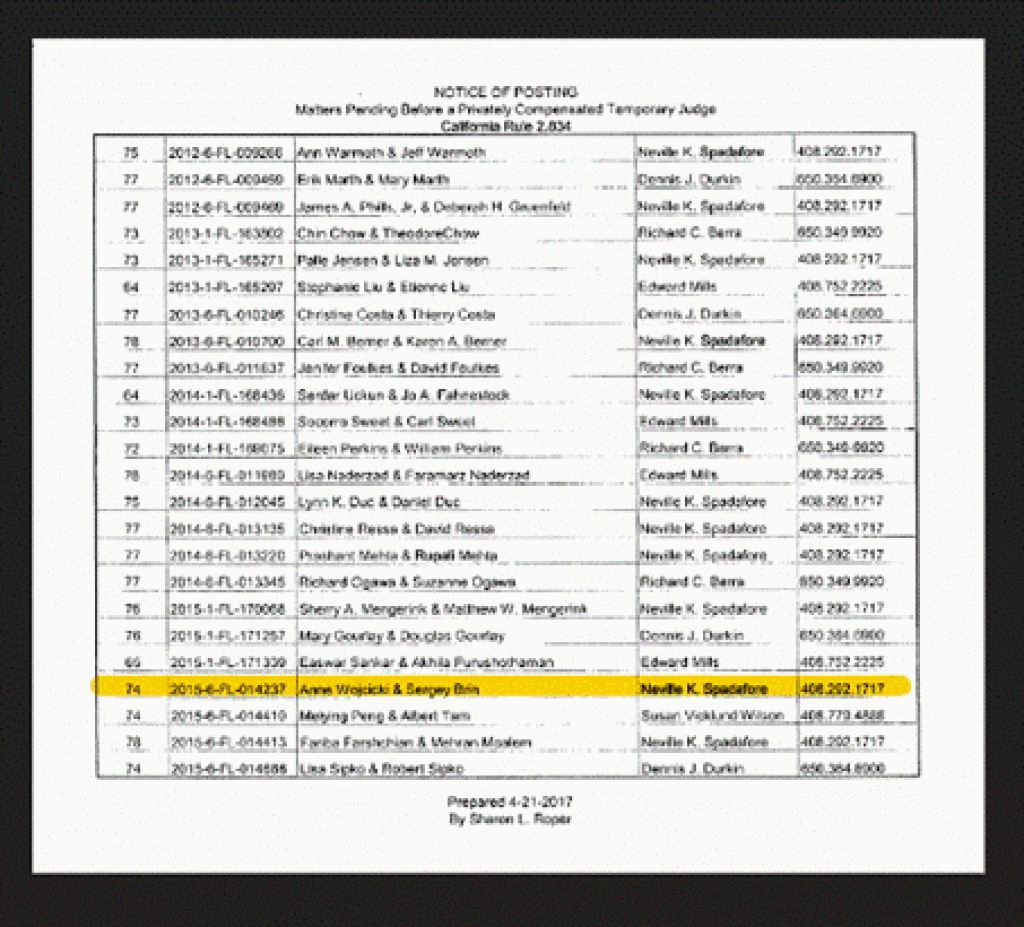
DIVORCE CASE OF GOOGLE FOUNDER SERGEY BRIN MOVED TO PRIVATE JUDGING
Private court reporters followed the money. A reporter who could earn five to ten times more covering a private custody hearing than a public family courtroom did not need much convincing.
Public court lost. The private market won.
A Vanguard investigation found that more than 1,000 private judge cases in Santa Clara County were never posted to the public disclosure list required by state law. No parenting coordinator cases appeared on the list, as the law requires.
Court attorney Sharon Roper told the Vanguard, she selectively removed entries, leaving the public with no record of where cases went — or whether any transcript was ever made of the proceedings.
Before the court created a market for private court reporters by failing to staff civil and family departments, there was essentially no such market. Now it is harder for the court to hire court reporters because the certified shorthand reporters in the area can earn more money working for civil litigants. — Kelly McCarthy, founder, Superior Court Reporters LLC
Whistleblowers Go on Record: Four Courts, One Playbook
Declarations sworn under penalty of perjury and filed with the California Supreme Court reveal that the four courts named in the court reporter lawsuit — Santa Clara, Los Angeles, San Diego, and Contra Costa — followed identical strategies to eliminate official court reporters from family courtrooms.
The tactics differed slightly. The outcome was the same.
SANTA CLARA: Paid reporters to leave, then stopped hiring.
Michelle Caldwell spent 22 years as an official Santa Clara County reporter and now serves as president of the California Court Reporters Association. She testified that the court offered financial incentives to reporters to retire voluntarily, then stopped hiring replacements.
The court turned away available pro tempore reporters who wanted full-time work. It capped salaries at $125,000 in a Silicon Valley market where neighboring San Francisco starts reporters at $133,007. It offered signing bonuses of only $7,500 — compared with $30,000 in San Francisco, Alameda, and Monterey.
“The court is not taking the necessary steps to recruit and hire more court reporters,” Caldwell said in her declaration. “For approximately the past decade, the court has not made serious efforts to recruit and hire qualified court reporters.”

JUDGE JAMES TOWERY(LEFT) AND KRIS TRESIDDER(CENTER)- SANTA CLARA COUNTY BAR ASSOCIATION HOLIDAY PARTY IN 2016. PHOTO BY STEPHEN JAMES
There is a harder number behind that failure.
The Legislature designated $866,029 in state grant money for Santa Clara County under SB 154, a law providing $30 million statewide to help courts recruit and retain court reporters. Santa Clara used only $456,839, about 53 percent, and returned the rest to the state. Then court administrators and judges told the public it could not find enough reporters to hire.
Kelly McCarthy, who retired from Santa Clara Superior Court in 2021 and co-founded Superior Court Reporters LLC, provided reporters to the court under a long-term contract worth $7.6 million. By 2024, her firm was providing up to 42 reporters per week.
When the court asked McCarthy’s firm to accept lower rates in October 2024, she offered to negotiate. The court never wrote back.
Instead, on Nov. 14, 2024, it issued a General Order authorizing electronic audio recording in proceedings where “no court reporter is available.” After that order, the court’s daily need for McCarthy’s firm dropped from as many as 10 reporters per day to one or two.
In her declaration, Caldwell described an even more striking incident: a Santa Clara official court reporter was present in a family law courtroom, providing real-time captioning for a hearing-impaired litigant. The judge announced the court would use electronic recording because “no court reporter was available.”
“This type of occurrence is commonplace,” Caldwell said. “Judges treat official court reporters as unavailable when they in fact are available.”
LOS ANGELES: Laid off 200, refused to hire back, let the private market take over.
Diana Van Dyke, a 23-year official reporter with the Los Angeles County Superior Court, put the math plainly: Los Angeles has 129 open official reporter positions and approximately 2,700 licensed reporters working in the county. That is not a shortage of certified professionals. It is a manufactured shortage of court employees.
“During the last economic downturn, the court laid off over 200 official reporters,” Van Dyke said in her declaration. “It then failed to adequately hire more reporters when economic conditions improved and mismanaged the court system in a way that allowed a private market for highly expensive private freelance court reporters to emerge and flourish.”
When the market for private reporters exploded, it became nearly impossible for the public court to compete.
Van Dyke said reporters could appear at a civil law and motion hearing that lasted 10 minutes and collect a half-day fee — every day, at all 36 Los Angeles County courthouse locations.
SAN DIEGO: Eliminated 41 positions, then turned it around.
San Diego County official reporter Charles Russell Walker described a court that repeatedly removed reporters from department after department when budgets tightened — eliminating 41 positions after the 2008 financial crisis alone, removing all family law reporters in 2017, and doing it again after COVID-19 in 2021.
Walker said the court was eventually forced to act after the California Supreme Court’s 2018 decision in Jameson v. Desta, which required courts to provide reporters to low-income litigants upon request.
“The limitation on the number of official reporters right now is the number of official reporter positions for which the court budgeted — not the outside labor market,” Walker said.
San Diego eventually reversed course: $30,000 signing bonuses, part-time positions, a mentorship program, and meetings between reporters and court financial officers every quarter.
Since 2023, the court has hired 25 new official reporters and filled every funded position and actively worked to train and recruit new court reporters.
CONTRA COSTA: Drove reporters out with hostile management, then called it a shortage.
Jennifer Burnett, an official reporter at Contra Costa County Superior Court since 2007, described a court that hired zero new reporters for 13 consecutive years. The court then adopted policies that pushed out the reporters it had — requiring them to sit in the courthouse until 5 p.m. even when no proceedings were scheduled, and docking pay when reporters arrived after 8 a.m., even if their assigned proceedings had not yet started. Between 2022 and 2024, the court lost 10 reporters. Most went to work as private freelance reporters.
“There was no court reporter shortage in Contra Costa County,” Burnett said in a 2023 letter to the court’s CEO and presiding judge, which she also included in her declaration. “Contra Costa was driving reporters away and struggling to hire new reporters because of its policies and management choices.”
After Burnett’s letter, the court reversed course, offering signing bonuses, part-time roles, and a paid internship program. It has since hired five new reporters with more expected.
Court reporting is not a dying profession. It is a profession the development of which has been ignored by the judiciary — even after the courts’ mass layoffs of official reporters altered the entire court reporting ecosystem in the state. — Stephanie Leslie, president, Deposition Reporters Association of California
Who Benefits From No Record
The question the lawsuit cannot answer is the one that matters most: Who benefits when family court hearings leave no transcript?
The answer is not hard to find.
Without a court reporter, a judge’s orders cannot be effectively appealed. The State Bar cannot verify an attorney’s conduct in court. A parenting coordinator’s recommendation may never become part of the official record. A minors’ counsel’s work cannot be reviewed by anyone — including the child they were paid to represent, after that child grows up.
In more than 300 cases examined by the Vanguard, no attorney representing a publicly funded child client filed the fee waiver available under Jameson v. Desta, which would have entitled that client to a court reporter at no cost. The attorneys collected their fees. They left no paper trail.
The private judge market makes the incentives clearest. Attorneys who once appeared in public court now refer cases to private judges who decide when to use a court reporter — and when not to.
By 2024, more than 1,080 Santa Clara County cases were before private judges, many of them the same attorneys and retired judges who had once worked as Special Masters and whom Komar tried to restrict.
The pending lawsuit seeks to obtain an order for courts to use electronic recordings, not video, in cases where the court does not provide a court reporter.
Los Angeles family law attorney Melissa B. Buchman described in her declaration what happens when electronic recording replaces a reporter. A client in a domestic violence case had 55 pages of testimony erased from her deposition transcript — a transcript that had been produced from audio clips sent to overseas transcriptionists who had never been in the room. The opposing attorney called the transcript “flawless” and certified. The judge believed him. The client lost her restraining order.
“Certified Shorthand Reporters are officers of the court and are held accountable for producing accurate and complete transcripts of legal proceedings,” Buchman wrote. “As guardians of the record, court reporters are the backbone of a functioning judicial system that gives everyone an equal shot at justice.”
The Presiding Judge Allowing the Planes to Crash
No presiding judge in Santa Clara County has confronted family court accountability the way Komar did in 2000. His successors watched the professional network that opposed his reforms grow larger, more lucrative, and more entrenched.
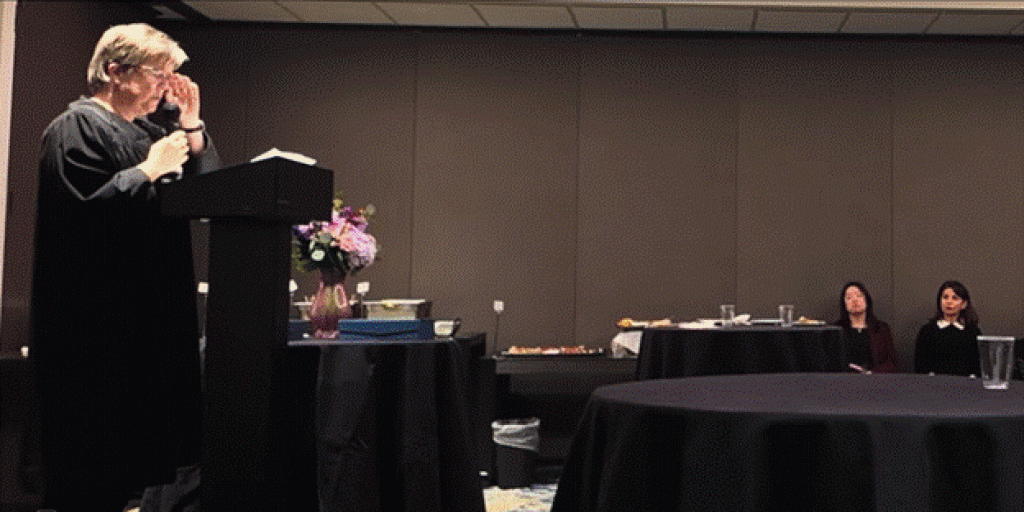
SANTA CLARA COUNTY PRESIDING JUDGE JULIE EMEDE (LEFT).
Judge Julie Emede serves today as supervising judge of the Santa Clara County family law division. Under her watch, minors’ counsel and parenting coordinator appointments have climbed, court reporters have disappeared, and the accountability infrastructure Komar built has been entirely dismantled.
During her tenure, Emede focused on legislation shielding minors’ counsel attorneys from public oversight — not on securing court reporters in every family courtroom she supervises.
Judge Komar built a paper trail on purpose. The professionals who opposed Komar understood it too — and spent 25 years taking it apart.
History Repeating Itself
The families who picketed outside Santa Clara County family court in 1999 are not so different from those posting on social media today. Their grievances are strikingly similar: minors’ counsel attorneys who stretch out cases for fees; parenting coordinators — the rebranded version of the Special Masters Komar tried to restrict — inserting themselves between parents and judges; a small, interconnected professional network making substantial money in a system with almost no public oversight.
The difference today is that when something goes wrong inside a family court hearing, there is no transcript. No black box. No record. Without a transcript, there is no appeal, no State Bar complaint grounded in evidence, and no way to show a minors’ counsel attorney actually did the work they were paid to do.
Stephanie Leslie, who as president of California’s largest freelance reporter association watched the courts dismantle their own reporting workforce and let private firms fill the gap, put it plainly in her declaration:
If there is a shortage of something, one should make a serious effort to try to increase the supply of that thing before trying to replace it with something that is both hugely expensive and of inferior quality. — Stephanie Leslie, president, Deposition Reporters Association of California
The California Supreme Court will decide whether electronic recordings can substitute for court reporters in cases where none are available. What the court cannot decide — and what no lawsuit can undo — is the harm already done.
The transcripts that were never made cannot be recovered. The custody hearings that took place without a reporter five years ago, have no record. The domestic violence survivor who needed an appeal and had no transcript to file it with has already lost.
The courthouse took the filing fees, closed the door, and switched off the recorder.
For families across California, there is no receipt for the legal work they paid for and the justice they were promised. The black box is gone. The pilots know it. The passengers have no choice but to fly on an airplane they know is doomed.
Follow the Vanguard on Social Media – X, Instagram and Facebook. Subscribe the Vanguard News letters. To make a tax-deductible donation, please visit davisvanguard.org/donate or give directly through ActBlue. Your support will ensure that the vital work of the Vanguard continues.

San Bernardino is just as bad. Went thru a nasty custody battle and we both had attorneys. Judge ordered ex to pay some back support due. Years later it went unpaid and when I asked the judge to enforce it She claimed there was no hearing however it went to trial and I was there. On the last day of our 4 year long hearing there was no reporter that day. And we were paying our attorneys big bucks for our trial. Contacted Council for Judical Performance and they thought i have a case but wanted the transcripts from my 2018 hearing but this reporter wants $1000 to give me a ½ day appearance transcript. I got over 5 long winded days of transcript from a different reporter for my earlier hearings and She charged me $200. Talk about corruption!