
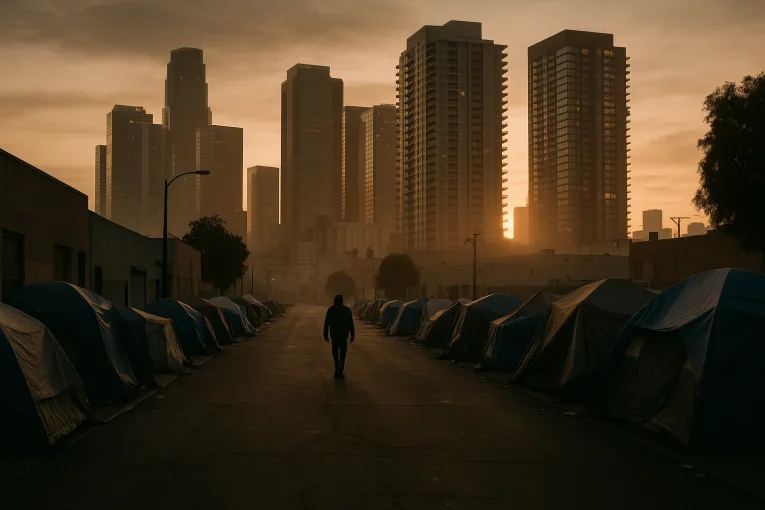
Key points:
- The city’s history of criminalizing poverty and disinvesting in housing has led to the crisis.
- Structural racism has shaped the crisis, excluding communities of color from housing.
- Mental illness and addiction are not primary causes of homelessness, but are driven by poverty.
Los Angeles is not alone in facing a devastating homelessness crisis, but its story may be the most instructive. A century of political choices—from racially exclusionary housing policy to disinvestment in public housing and mental health services—have created the conditions for mass homelessness in one of the wealthiest cities in the world. A sweeping new Los Angeles Times investigation lays out in exhaustive detail how this crisis was made. It is a history not just of L.A., but of America’s policy failures.
The most important lesson is this: homelessness is not inevitable. It is not a natural feature of urban life like traffic or weather. It is a man-made disaster, driven above all by a catastrophic lack of affordable housing. Every city has people experiencing poverty, mental illness, and substance use. But not every city has tens of thousands of people sleeping on sidewalks, in tents, and in cars. Los Angeles does because it has repeatedly chosen to limit the production of affordable housing while displacing its poorest residents and turning policing into the default response to social need.
As the Times shows, L.A.’s history of homelessness reaches back to the 19th century, when the city routinely jailed people for “vagrancy” and built work camps for so-called “tramps.” In the 1930s, Hoovervilles dotted the city as the Great Depression and the Dust Bowl pushed desperate families west. But even then, street homelessness remained a relatively contained phenomenon. The city responded, in part, with a 152-acre “poor farm” in Downey and a massive public works program that created modest housing and job opportunities.
What changed in the postwar decades was the city’s political and economic approach to growth. As the city boomed, Los Angeles built housing at a historic pace, including public housing developments like Jordan Downs and Estrada Courts. But during the Cold War, public housing came under fierce attack from anti-communist forces. In 1952, voters killed a proposal for 10,000 new units. In 1953, the city canceled the Chavez Ravine public housing project and cleared the land to build Dodger Stadium instead. That moment, more than any other, signaled the city’s retreat from public responsibility for housing.
By the 1970s, L.A. faced another turning point. A powerful slow-growth movement, driven by affluent homeowners and environmental advocates, pushed to downzone the city. As the Times explains, this slashed the city’s residential capacity from a projected 10 million to just over 4 million. The timing could not have been worse. Manufacturing jobs were disappearing. Union strength was waning. And more people were arriving—immigrants, young workers, and the formerly incarcerated—seeking housing that no longer existed.
Instead of building, Los Angeles criminalized. In 1968, the city passed an anti-camping ordinance banning sitting, lying, or sleeping in public spaces. By 1975, public drunkenness had become the most common reason for arrest in the city. In the 1980s, Police Chief Daryl Gates launched the “Safer Cities Initiative,” flooding Skid Row with officers and arresting people for jaywalking, loitering, or dropping cigarette butts. A federal court would later rule these practices unconstitutional in the absence of available shelter beds, but the damage was done: policing had become the city’s de facto homelessness policy.
Meanwhile, the housing market spiraled. Home prices skyrocketed from $25,000 in the 1970s to more than $1 million today. Rent surged as well. In 1970, the median rent in L.A. was the equivalent of about $900 today. Now it’s over $2,800. And throughout this time, the federal government—starting with the Reagan administration—slashed funding for public housing, rent subsidies, and social services. Los Angeles lost thousands of units of low-cost SRO (single-room occupancy) hotels, replaced by upscale lofts and unaffordable apartments. When homelessness surged in the 1980s, it was portrayed as a result of individual dysfunction. But as the Times investigation reveals, it was a predictable response to a collapsing housing market and gutted safety net.
Racial inequality has shaped every stage of the crisis. Redlining, racially restrictive covenants, and freeway construction displaced generations of Black and Latino Angelenos. Even during the housing boom, federal rules barred integrated developments. Today, Black residents make up roughly 8% of L.A. County’s population but more than 30% of its homeless population. These numbers reflect not only discrimination in housing and employment, but decades of disinvestment in communities of color and the criminalization of poverty.
Mental illness and substance use remain part of the picture—but they are not the drivers of the crisis. As multiple studies cited by the Times show, only a minority of unhoused individuals suffer from serious mental illness, and many begin using drugs or experiencing psychological distress after becoming homeless. Homelessness is traumatic. Living on the streets, in shelters, or in cars compounds pre-existing health problems, exposes people to violence, and makes recovery far more difficult.
What Los Angeles has tried in recent years—such as Housing First policies, Proposition HHH, and Measure H—reflects both ambition and frustration. Billions have been spent. Thousands of units are under construction or already built. Yet the crisis persists. Why? Because housing production remains slow and costly, because services are fragmented, and because more people are being pushed into homelessness than are being pulled out.
The COVID-19 pandemic briefly showed what’s possible. With state and federal support, L.A. launched Project Roomkey, using empty hotels to provide immediate shelter. It proved faster and cheaper than traditional construction. But it was always a temporary solution—and now, many of those people are back on the street.
In June 2024, the U.S. Supreme Court dealt another blow, ruling that cities can penalize unhoused people for sleeping in public even when no shelter is available. That decision reaffirmed the central role of law enforcement in managing homelessness—without addressing the root causes.
If there is a silver lining in the Los Angeles Times reporting, it is that the problem is not intractable. Every city in America that struggles with homelessness has made some version of these same mistakes. But cities can also choose differently. They can build abundant affordable housing. They can rezone exclusionary neighborhoods. They can fund mental health care and addiction treatment. They can decriminalize survival and redirect police budgets into housing and services.
Los Angeles is not cursed. It is not broken. It is the product of a long series of decisions—some made in ignorance, others in bad faith. What it offers the rest of the country is not just a cautionary tale, but a blueprint for change.
As the Times notes, “What those cities don’t have: this many people without homes.” The difference lies not in the people, but in the policies. We must have the courage to learn that lesson—and act on it.
Here are some of the key takeaways:
1. Homelessness is not inevitable—it is policy-driven.
Los Angeles’ crisis didn’t emerge from thin air. It was created through a century of decisions: criminalizing poverty, dismantling mental health institutions without replacing them with community care, blocking public housing under anti-socialist hysteria, and embracing restrictive zoning that slashed the city’s residential capacity just as demand was surging.
2. The biggest driver is the lack of affordable housing.
The article makes clear that the single greatest factor behind mass homelessness is the disappearance of low-income housing. When Skid Row lost half of its 15,000 SRO units by the 1970s and Bunker Hill was razed, thousands were pushed onto the streets. L.A. once built housing at astonishing speed; now, it builds at a fraction of that pace, and often only at luxury prices.
3. Structural racism shaped—and still shapes—the crisis.
From redlining and racially restrictive covenants to freeway construction through Black and Latino neighborhoods, housing policy in Los Angeles systematically excluded communities of color. Black Angelenos, once a small minority, now represent a vastly disproportionate share of the unhoused population, a result of both historical displacement and the collapse of unionized, middle-class jobs.
4. Mental illness and addiction are real—but not primary.
As multiple studies show, only a minority of unhoused individuals suffer from serious mental illness. Many more begin using drugs or develop mental health issues after becoming homeless. Trauma, poverty, and survival on the streets drive these conditions—not the other way around.
5. Law enforcement has been the default solution for over a century.
From “tramp stockades” in the 1800s to “broken windows” policing in the 2000s, L.A. has consistently turned to the police to manage its poorest residents. Yet criminalizing homelessness has never solved the crisis—it has only added criminal records to people already facing overwhelming barriers to housing and employment.
6. The limits of Housing First and the challenge of scale.
Housing First remains a proven model, but in Los Angeles, the housing itself is scarce, expensive, and slow to build. The high cost of supportive housing, the bottlenecks in the development pipeline, and the rising tide of economic precarity have undermined the policy’s promise.
7. The crisis is not just about the unhoused—it’s about the housed at risk.
The Times points to overcrowded garages, moving vans doubling as homes, and renters spending more than half their income on shelter. These are people one crisis—one illness, eviction, or job loss—away from homelessness.
8. L.A. is a warning, not an outlier.
What happened in Los Angeles is happening elsewhere. Cities like San Francisco, Seattle, and New York face similar housing shortages, rising rents, and punitive approaches. Meanwhile, places with ample housing supply and lower costs—like Houston—have seen homelessness fall.
9. Progress is possible—but fragile.
Proposition HHH and Measure H are helping build housing and fund services. Recent counts suggest a slight decline in the unhoused population. But with 67,000 still homeless in the county and housing construction still lagging behind demand, the scale of the crisis remains immense.
10. We have the tools—we just need the will.
The final, quiet lesson is one of political courage. At every juncture—whether it was expanding public housing, protecting rent control, reforming land use, or rejecting mass displacement—Los Angeles made choices. And those choices can be unmade.

I don’t know what planet you’re living on, but Los Angeles is the poster child for uncontrolled growth.
All of the claims you make here fall into the category of “unsupported” at best.
Los Angeles (perhaps more than any other California city) has a wide range of neighborhoods (some of which I wouldn’t want to find myself in – even during the daytime)
For example, I’d suggest staying away from the one were Reginald Denny got dragged out of his truck and had his head bashed in (in a rather celebratory manner), on video no less. It would be interesting to know if those who advocate teaching about diversity view that as a racist attack.
Maybe you should read more carefully: ” A sweeping new Los Angeles Times investigation lays out in exhaustive detail how this crisis was made. It is a history not just of L.A., but of America’s policy failures.”
I did read it – all of it is unsupported at best.
The Los Angeles Times itself is no longer a credible news organization – they write from an activist point of view (as does The Chronicle).
This is different than how they used to be. (I haven’t changed – they have.)
But again, the slow-growthers (discussed in the article) weren’t responsible for the sprawling mess that Los Angeles is. In fact, Los Angeles IS an argument for slow/controlled growth. There aren’t any better examples of the reason for the negative reaction against sprawl than Los Angeles already provides. (Not to mention climate-changing greenhouse gasses, as a result of that sprawl.)
Los Angeles is also essentially an argument in support of requiring residents to be legally in this country, to remain in the first place.
Ok. Not worth continuing.
O.K. – but I don’t think you (or the Los Angeles Times) is actually convincing anyone of anything, at this point.
They’ve already made up their minds based on their own “lived experience” and observations, one way or another.
Part of that division in the country you recently referred to (e.g., “no middle”).
But yeah, what a mess Los Angeles would be if it had 10 million people, rather than 4 million (that you attribute to the slow-growthers).
And from my own “lived experience” (coming from a much denser city than Davis), density makes life worse, not better.
(See the recent article in The Chronicle, regarding residents getting ticketed in their own driveways because they hang over a foot or so onto the sidewalk – and someone complained for no reason.)
Racking up hundreds of thousands of dollars in “nonsense tickets”, which impacts the cost of living in that “great city”.
And of course, sprawl is even worse (though the reason for its existence ultimately comes down to the hassles and expense of living in dense cities).
I suspect they’ll win a pulitizer for that piece.
If so, that would say something about the “Pulitzer committee”.
But one thing that opposition to sprawl or overly-dense housing isn’t about: racism. The reason being that no one actually cares what skin color you have, and no one – other than lunatics – is actually concerned about that. I’m pretty sure that most of us with “lived experience” aren’t always “fans” of individuals who share our own skin color, and ultimately don’t even factor that into any kind of equation or judgement.
They care about how they (and their family) interact with you, and they care about the environment (including man-made environment) in which they live.
Part of the problem is you are using a narrow, outdated understanding of racism, one that sees it only as explicit, conscious animus based on skin color. This definition doesn’t align with how most contemporary scholars, legal theorists, and civil rights advocates understand racism today. That makes it difficult for you to evaluate claims of this sort.
Moreover, I think you are misreading the Times article. It isn’t about people’s personal feelings toward race; it’s a historical investigation into how policy choices over decades — including zoning laws, redlining, freeway construction, and NIMBYism — created a segregated, sprawling city where homelessness exploded at the margins. The article shows that sprawl wasn’t just an aesthetic or lifestyle preference, but often a vehicle for exclusion.
You are wrong, again (regarding my view, at least).
But I don’t need “modern interpretations” to see that there’s still a problem (regarding black people in particular) being left behind.
I’ve come across plenty of individual black people to know that’s not always true (and perhaps some progress on average has been made).
All other groups seem to be advancing. And white people are becoming less of a majority (which I couldn’t care less about). As far as I’m personally concerned, I’m going to be “replaced” within a few decades at most – regardless. And I don’t care what skin color replaces me.
Though I do hope that they value the natural environment. And frankly, I kind of hope (that) whomever they are – they share some concerns with what you label as NIMBYs.
Personally, I like walking through Tiburon once-in-awhile.
Besides, how is redlining not about racism?
Regarding “redlining”, it sounds more like a business decision (ultimately as a result of what you call “systemic racism”). And it’s largely in the past.
But in my opinion, black people would do well to get out of black neighborhoods, for the most part. (Mostly, because of other black people who don’t care if they take advantage of someone who shares their skin color – just like ALL other skin colors.)
And they can do so (leave) these days, at least.
Green is the only color that lenders care about. That motivation is also why the cruise ship industry has been catering to black people, by lowering its prices. That’s why particular cigarette/booze companies do so (target black communities), as well.