
Federal Judge Blocks Santa Rosa from Penalizing Homeowner Who Feeds Unhoused Neighbors
By David M. Greenwald SANTA ROSA, Calif. — A federal judge has temporarily barred the city of…

By David M. Greenwald SANTA ROSA, Calif. — A federal judge has temporarily barred the city of…

Julius Jackson, Chief Executive Officer of Life House Reentry, asserts that Sacramento community organizations must prioritize collaborative efforts and accountability mechanisms through initiatives such as the newly formed Results Table coalition to effectively address pervasive issues including homelessness and recidivism.

A 124-unit affordable housing development, Rivo, has commenced operations in North Sacramento, providing income-restricted apartments and supportive services adjacent to significant public transportation infrastructure.

The California Association of Alcohol and Drug Program Executives (CAADPE) cautioned cities that restricting substance use disorder treatment facilities through zoning or permitting could violate federal civil rights protections, specifically the Americans with Disabilities Act.
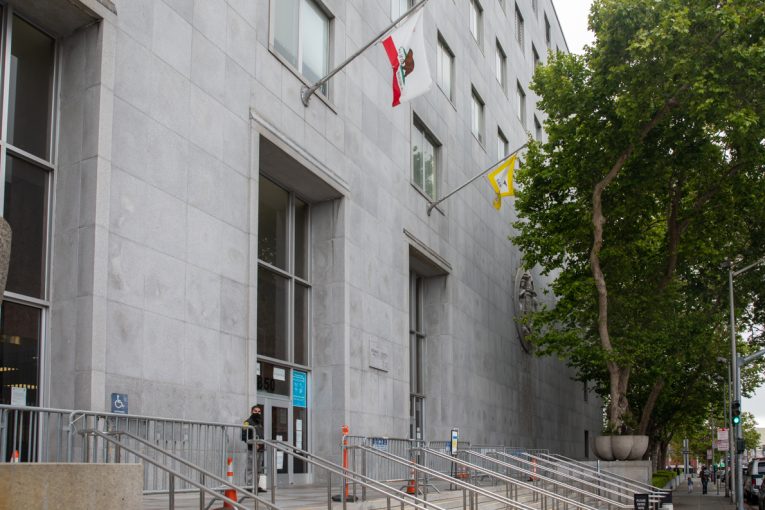
A San Francisco Superior Court judge reduced bail from $10,000 to $1,000 for an individual facing multiple felony vandalism charges, following arguments by the public defender that the existing amount was financially unattainable given the accused’s documented homelessness, addiction, and mental health struggles.

A federal judge set aside the Trump administration’s 2026 Notice of Funding Opportunity, which sought to overhaul federal homelessness funding, ruling that the Department of Housing and Urban Development violated the Administrative Procedure Act by failing to conduct required public notice-and-comment procedures.

An increasing demographic of older adults in the United States confronts a significant housing affordability crisis, characterized by escalating rental costs, substandard living environments, and an elevated risk of homelessness during their retirement years.
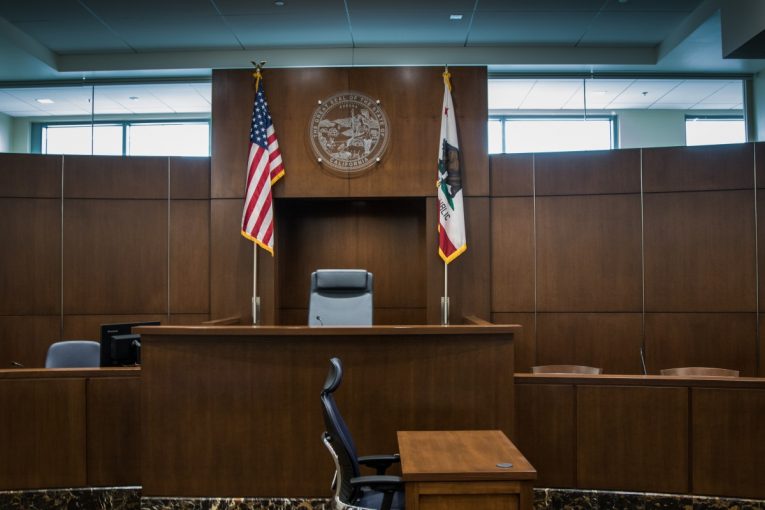
Yolo County Superior Court Judge Paul Richardson revoked the supervised own recognizance (SOR) release of an accused individual and set bail at $10,000 after a missed court appearance. The judicial action, which occurred during a pretrial conference, has drawn attention to the implications of monetary bail for defendants with limited financial resources. This development underscores ongoing concerns regarding the intersection of poverty and the pretrial justice system, particularly in light of California’s *In re Humphrey* decision.

Governor Gavin Newsom announced new agreements with the cities of Ontario, San Bernardino, and San Diego to expand the state’s highway encampment cleanup program, even as he defended his administration’s broader record on homelessness reduction and housing production.

A study conducted by the California Policy Lab, published in the Journal of Urban Economics, found that Rapid Re-Housing programs in Los Angeles County substantially reduced long-term homelessness. The research, based on linked administrative records, indicated that short-term rental assistance continued to benefit participants, particularly families, years after subsidies concluded, while also improving health outcomes and reducing criminal justice involvement for many families.

One year following the implementation of President Donald Trump’s executive order on homelessness, a policy debate persists between advocates for housing-first strategies and proponents of enforcement. The discussion centers on whether federal policy should prioritize punitive measures and public camping prohibitions or evidence-based approaches to address homelessness.

Journalist Martin LeFevre documented the environmental degradation of a local ecosystem, observing the decline of a sycamore tree and the proliferation of refuse from homeless encampments along an adjacent creek, while also articulating philosophical insights on the role of meditative stillness in confronting environmental and societal challenges.
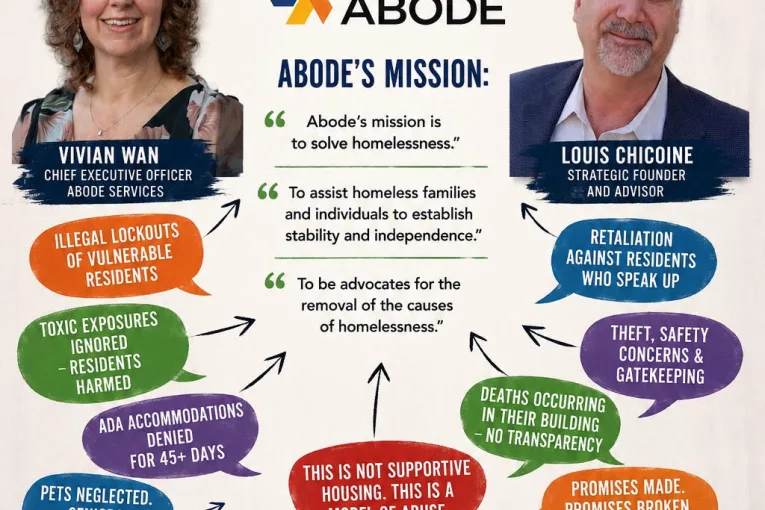
Rebecca “Becky” Wolf, in a column published by The Vanguard, issued a call for heightened accountability within supportive housing, specifically urging Abode Services leadership to prioritize resident safety and dignity over ceremonial public relations.
The Sacramento Homeless Union filed a federal civil rights lawsuit in the U.S. District Court for the Eastern District of California. The complaint alleges the City of Sacramento unlawfully terminated its Motel Shelter Program, resulting in the mass displacement of vulnerable residents, including families with children, seniors, veterans, and individuals with disabilities, on June 1.

Governor Gavin Newsom signed Assembly Bill 179, enacting sweeping changes to California’s affordable housing finance system that state officials contend will reduce construction costs, accelerate housing production, and extend funding for homelessness programs, while also establishing a new California Housing and Homelessness Agency to consolidate housing initiatives and enhance inter-agency coordination.

New York State is facing legal action from non-profit organizations asserting its current shelter allowance program fails to fulfill constitutional mandates for resident housing assistance. The lawsuit contends the state’s welfare allowance does not adequately cover the cost of modest private housing across New York.
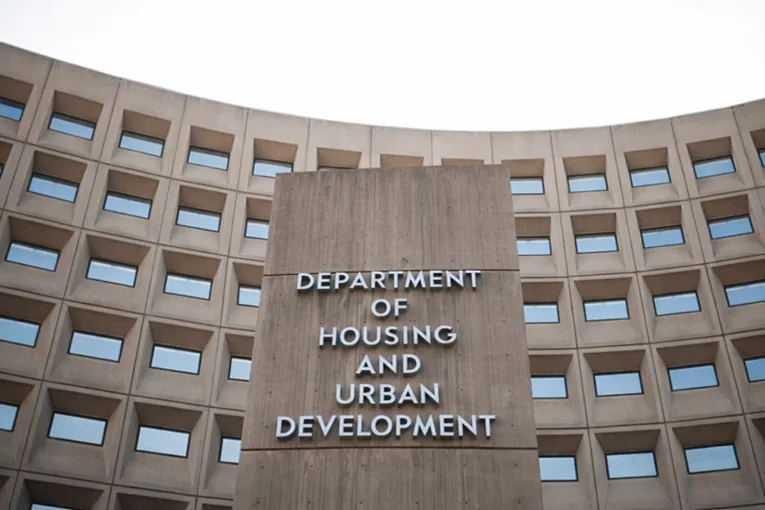
California Attorney General Rob Bonta, in conjunction with a coalition of 21 attorneys general and two governors, initiated legal proceedings challenging the Trump administration’s directive to reallocate federal funding designated for housing initiatives. The complaint asserts that this action risks displacing thousands of individuals and exacerbating homelessness.
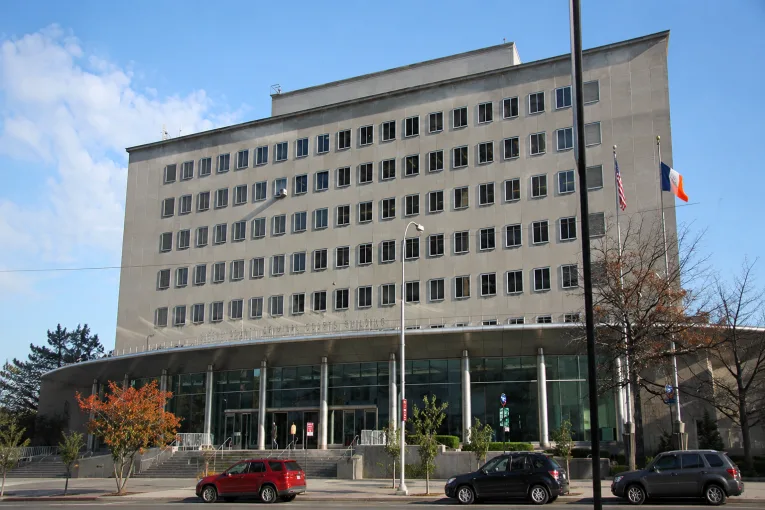
A Queens defendant, who had identified as homeless, pleaded guilty to second-degree menacing in Queens Criminal Court after a communication breakdown with his attorney delayed the proceedings. The court subsequently imposed a two-year full order of protection, a 15-day alternative sentence, and a civil judgment.
Yolo County Superior Court ordered a transient individual to remain in custody Monday following an arraignment for alleged felony parole violation, where Deputy District Attorney Alvina Tzang moved to terminate parole. The violation stemmed from the depletion of power in the individual’s GPS ankle monitor, marking the third reported instance of alleged device neglect or tampering, despite judicial acknowledgment of the individual’s transient status.
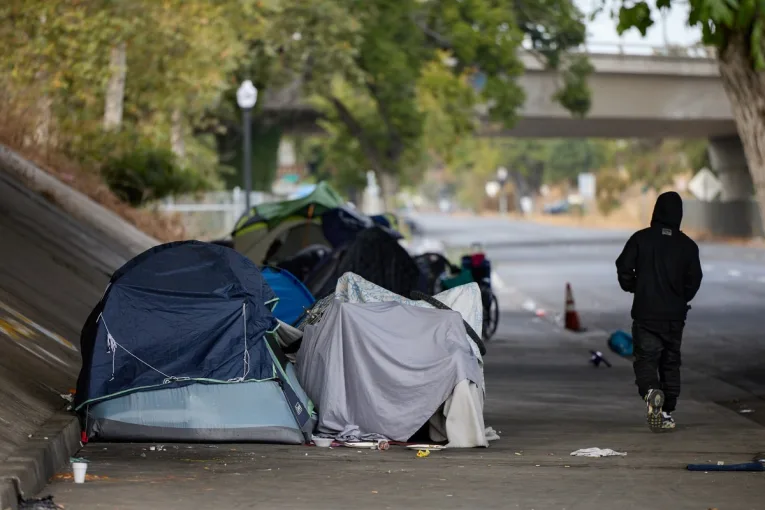
Housing advocates contend that the criminalization of homelessness has accelerated nationwide since the U.S. Supreme Court’s Johnson v. Grants Pass decision. This development has resulted in hundreds of cities and states implementing statutes that penalize individuals for sleeping outdoors, even in circumstances where alternative shelter options are unavailable.