
Key points:
- The United States is missing 15 million homes due to lack of housing supply.
- Homebuilding has slowed in suburban areas, despite abundant land, due to zoning regulations.
- Local land use regulations, including minimum lot sizes, limit housing supply and exclude working families.
According to a major new study released this spring by economists Edward Glaeser and Joseph Gyourko, the United States is missing 15 million homes. Had the housing stock continued growing from 2000 to 2020 at the same pace as it did between 1980 and 2000, we’d be in a very different place today—one with less rent burden, less displacement, fewer tent encampments, and more pathways to middle-class stability.
But that didn’t happen.
Instead, homebuilding slowed to a crawl—even in the sprawling suburbs of Sun Belt metros like Phoenix, Miami, Dallas, and Atlanta, long considered the nation’s “building superstars.” This slowdown is not confined to coastal enclaves with tight land constraints or famously anti-growth politics. It’s happening in the very places that once exemplified housing abundance. And in a strange twist, it’s happening most in areas with open land, where building should be easiest.
The new study—titled America’s Housing Supply Problem: The Closing of the Suburban Frontier?—offers a sobering and urgent diagnosis: America’s housing markets no longer respond to demand. And the biggest culprit isn’t lack of land or even lack of capital. It’s regulation. Zoning codes, permitting delays, and political resistance have functionally closed off the suburban growth engine that built America’s middle class in the 20th century.
This marks a dramatic reversal. From 1950 to 1980, U.S. metropolitan areas added over 50 million homes. Builders responded to rising prices by adding new supply. Sprawling suburbs, aided by interstate highways and permissive zoning, absorbed millions of families. When housing demand surged, construction followed. That’s how America used to work.
But sometime after the year 2000, that dynamic broke down. Glaeser and Gyourko’s data show that the annual housing growth rate across major metro areas declined and converged—meaning that diverse markets with wildly different geographies, demographics, and economies began building homes at the same sluggish pace. In the 2010s, Sun Belt metros like Phoenix, Dallas, Miami, and Atlanta all hovered around an anemic 1.2% annual growth rate.
That kind of uniformity is not what you’d expect from a functioning market. It signals the presence of systemic barriers overriding local variation and consumer demand. And the data suggest that these barriers are strongest in the very places where building should be easiest: low-density, land-rich suburbs.
Back in the 1970s, a doubling of home prices in a Dallas suburb would have triggered a 72% increase in construction. By the 2010s, the same price spike yielded just a 7% increase. In Phoenix, supply elasticity fell from 65% to 10%. In other words, prices can go through the roof and builders still won’t—or can’t—respond. That’s a broken feedback loop, and it helps explain why the cost of housing is now one of the biggest threats to economic stability in the U.S.
Critically, this decline in housing production isn’t about running out of space. If that were true, we’d expect dense urban cores to stop growing while suburban and exurban areas picked up the slack. But the opposite is happening. Glaeser and Gyourko show that by the 2010s, dense neighborhoods were seeing more new housing relative to their land area than the suburbs. In the 1970s, 44% of new Miami housing was built in low-density areas. By the 2010s, that number had dropped to 12%. The suburban frontier—once vast and open—is functionally closed.
Why?
The researchers point to the rise of land use regulation, particularly in affluent suburban jurisdictions. These include minimum lot sizes, maximum height limits, discretionary review processes, and environmental or historic preservation rules that make building new homes slow, expensive, or impossible. These policies are often justified in the name of community character or environmental protection, but they have the effect—whether intentional or not—of excluding working families, people of color, renters, and anyone not already lucky enough to own property.
The Wharton Land Use Restriction Index, which measures the intensity of local regulatory constraints, correlates strongly with the breakdown of housing market responsiveness. Cities with higher Wharton Index scores see far less building when demand increases. That’s not just an academic finding—it’s an indictment of the political choices made by local governments.
And it’s not just a blue-state or California problem. This pattern of regulated stagnation is visible in red-state suburbs, Sun Belt cities, and across the country. The deeper truth is that local control—when exercised without accountability—has allowed well-organized, often wealthier residents to veto housing growth that would benefit the broader region.
The consequences are massive. Young people priced out of homeownership. Teachers and service workers forced into multi-hour commutes. Seniors trapped in homes they can’t afford to maintain because there’s nowhere else to go. Homelessness creeping into every corner of American life. And deepening inequality as wealth accrues to those lucky enough to own while everyone else pays the price.
California YIMBY, the pro-housing advocacy group, highlighted these findings in a recent blog post. They point out that the solution isn’t just to build more homes—it’s to rebuild the mechanisms that once allowed our society to respond to housing needs. That means zoning reform. It means enforcing fair housing laws. It means aligning infrastructure investment with infill and density. And, most of all, it means confronting the political economy of scarcity that too many local jurisdictions have embraced.
The federal government has a role to play here. Just as the postwar housing boom was aided by federal highways, GI Bill loans, and mortgage finance reform, we now need federal leadership to incentivize housing abundance. That could mean tying transportation funding to zoning reform, penalizing exclusionary practices, or simply setting stronger national standards for housing equity.
But state governments, too, must act. California, Oregon, and Washington have all passed laws in recent years to allow more duplexes, triplexes, and accessory dwelling units by right. That’s a start. But more is needed—particularly in suburbs and unincorporated areas where anti-growth policies go unchecked.
We need a political view that sees housing not just as shelter but as infrastructure—as essential to our economy and democracy as roads, schools, or clean water. Because right now, the American dream is being rationed by ZIP code, and the ladder of opportunity is missing too many rungs.
Fifteen million missing homes. That’s the cost of two lost decades and a policy regime that prioritized preservation over people, wealth protection over inclusion, stasis over growth.
It’s time to reverse that trend. Not just in California. Not just in coastal cities. But everywhere.
Let’s reopen the suburban frontier—not by paving over every field, but by allowing our neighborhoods to evolve, welcome new people, and build the homes our future demands.

Your conclusion that regulation is the culprit for a housing shortage is at least less-than-complete.
First, from the Wharton Index you cite: “Markets around the national average (WRLURI2018 index values within one-tenth of a standard deviation from zero) include Houston, TX, Columbus, OH, San Antonio, TX, and Pittsburgh, PA”
Note that Houston is “average.” Just a reminder: Houston has no zoning at all. None! Yet it’s “average”! If zoning and regulation were the big factors responsible for a housing shortfall, how did it only achieve “average”? Why isn’t it the top of the list?
As for whether zoning is dumb…of course! Houston has absolutely none and yet looks almost identical to Sacramento (both are inland ports, and have allowed auto-centric sprawl to dominate the landscape).
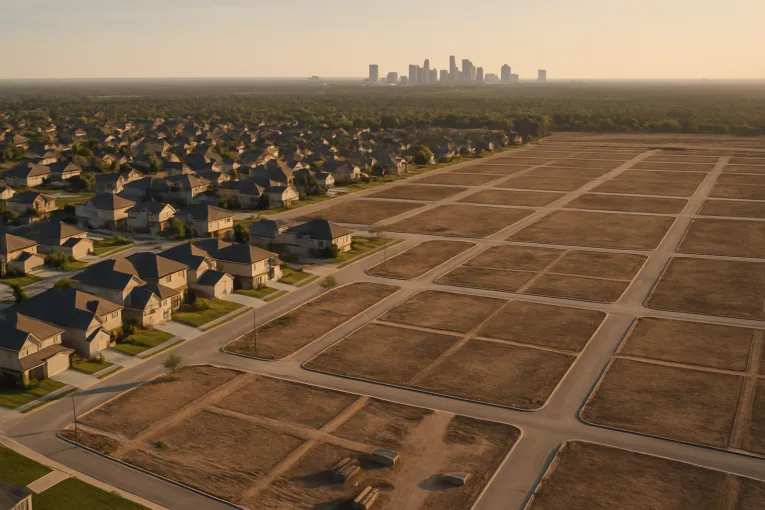
One interesting note (to me): your illustration is a New Urbanist low-density neighborhood. The streets are a grid, the sidewalks are set back, and the curb radius at the corners is small and pedestrian-friendly. That’s not sprawl. Sprawl has spaghetti streets that twist and turn, disorienting the inhabitants (and terminating otherwise unpleasant views), sidewalks that put pedestrians in peril as they walk next to traffic, and massive curb radii that make pedestrian crossings at corners even more perilous. Thank goodness California has adopted “complete streets” for all new development…although Newsom turned down retrofitting the sprawl with better pedestrian amenities.
Meanwhile, you ignore something that powerfully influences the current housing “shortage.” (Quotes because there are still more vacant homes than the US homeless population.) After the New Deal, the federal government built affordable housing until Nixon put a stop to it. Then, the Reagan administration cut HUD’s affordable housing budget 75% as it reduced taxes on the wealthy by roughly half, and with Bush 41, raised payroll taxes eightfold. After the New Deal, there was no significant homeless population until the ’80s. Surely that deserves a mention!
Sprawl is “conspicuous consumption” of land, eliminating the “missing middle” (medium densities) of housing that might make land costs less onerous in housing, and imposing perhaps the most regressive tax possible. It requires all driving age inhabitants to own an automobile. We desperately need pedestrian-friendly mixed-use neighborhoods that allow people to conduct their business without auto commuting. Nevertheless, we’re building sprawl after sprawl after sprawl.
Incidentally, if you want to cut per-unit costs in half, just build duplexes rather than single-family homes. Of course that would mean providing services (parks, security, public health) and we can’t have that! De-funding the public realm is the current agenda.
One other nice way to influence what’s built: Change FNMA/FHLMC property standards for new development. You may believe (with Frank Lloyd Wright) that “form follows function,” but in today’s economy, it’s really “form follows finance.” We’d stop building sprawl in five minutes if those loan underwriting standards changed to support something other than sprawl–really a racist “white flight” invention.
Finally, you omit mentioning the land speculation that’s at the root of many of our current problems. Land speculation is an “industry” in California’s Central Valley, and the foundation of several large fortunes. It’s one reason land is expensive. We’ve got to pay those speculators!
One example: North Natomas was once vacant farmland, and was 20′ under water floodplain surrounded by weak levees. It was deemed so unsuitable for development that a federal grant to increase regional sewer capacity specified a $6 million penalty if that capacity served North Natomas.
The speculators weren’t bothered; they went to then-vice-president George H.W. Bush and got the $6 million penalty pay-as-you-develop rather than a prohibitive up-front fee. At the same time, they got $43 million in levee improvement grants to bring the weak levees up to pre-Katrina standards.
Long story short, they sold land they optioned at $2,000/acre to builders, once they got Sacramento City’s approval, for as much as $200K/acre. That profit margin is called the “unearned increment,” and it’s 10,000%, gross(!) The current occupants of that neighborhood are now on the hook for all the post-Katrina levee improvements, but what matters is our land speculators have walked away with an enormous payday.
Naturally, the speculators exchanged out of the sale to income-producing real estate, so they deferred even income tax indefinitely.
In contrast, in Germany, the developers have to sell the outlying land they propose to develop to the local government at the agricultural land price, then purchase it back from that government at the buildable-land price. All that unearned increment inures to the benefit of the public, not lining some speculator’s pocket. And Germans have nice infrastructure, free college tuition and the arts budget for the city of Berlin exceeds the National Endowment for the Arts for the USA.
Incidentally, there’s a reason Sacramento’s main public library has no free meeting room as most other public libraries do. Instead it has the “Tsakopoulos Galleria.” Why? Because we gave all the money to Mr. Tsakopoulos.
Omitting these things and relentlessly celebrating the rollback of development regulation, as indefensibly stupid as it often is, just makes the Vanguard one more public voice calling for less intelligence in building our so-called civilization. (“Western civilization would be a nice idea” – Gandhi)
This Atlantic article builds on the study you write about and delves into some issues more deeply: https://www.theatlantic.com/economy/archive/2025/06/zoning-sun-belt-housing-shortage/683352/
In Texas, the rule used to impede development is the “valid petition” that gives 20% of the nearby population a veto. There are other examples there as well.
This article in the Atlantic highlights how the nation has lost the mobility that has been key to both our cohesion despite our differing ethnicities and our dynamic prosperity: https://www.theatlantic.com/magazine/archive/2025/03/american-geographic-social-mobility/681439/
While the Germany approach has its appeal, the Constitution stands as an insurmountable barrier. We need to change other laws on property and income taxation to change the incentives for speculation. Even so, as these articles show, it’s not property values that are causing problems. If development was opened up, the increased supply would reduce the value of speculation. (There’s other studies I’ve posted recently showing that the housing market acts like most other markets.)
All of that said, our group the Davis Citizens Planning Group has proposed an alternative for Village Farms that increases the availability of missing middle market housing on less land by reducing the amount of detached single family housing.
First, let me congratulate you on actually examining the land use planning in Davis. Davis’ planning is orders of magnitude better than Sacramento (County) already. But as one former supervisor (Grantland Johnson) said: “It’s widely acknowledged throughout the state that the Sacramento region’s governments are the most influenced by developers.” (Developers = land speculators)
The German solution would easily be mimicked by taxing the unearned increment. There is **NO** “insurmountable barrier,” unless you have decided to worship at the altar of “pure market capitalism.” In which case, you’re excused on religious grounds.
If, as you say, speculation was so marginal, it wouldn’t be so commonplace (and the alternative so actively suppressed). Folsom introduced an initiative requiring a popular vote on major planning changes like “South of 50” (which is building right now). The developers hired a gaggle of attorneys and successfully got the court to suppress it. One of the attorneys was Bob Holderness, the Folsom Mayor. I literally witnessed Holderness at a local political club (Folsom Dems) out shilling for the project. I’d bet he was billing the developers for appearing at that meeting too. If there’s anything more crooked than the revolving door of a public official out selling a project he was supposed to regulate, I don’t know what it would be.
Remember “If it weren’t for lies, there wouldn’t be any politics.” – Will Rogers
“If there’s anything more crooked than the revolving door of a public official out selling a project he was supposed to regulate, I don’t know what it would be.”
As I recall, there was a local politician who recently did this as well. But since it’s Davis, it didn’t go well for him or the proposal.
I guess we’ll see if that works for, or against the attempt to undermine Measure J. In other words, turning over decisions like that to a guy like that – ASSUMING that the electorate thinks that whatever parcels proposed for sprawl are deserving of that in the first place.
Have to say that it seems pretty absurd to be suggesting a “housing shortage” in the same places where housing prices are taking an enormous dive.
Regardless – it must be those “regulations”, per the logic put forth on here. “I see NIMBYs” (rather than dead people).
I’m thinking of going on a NIMBY hunt, myself – sort of like hunting for jackalopes.
Or perhaps the claim isn’t that individuals are necessarily NIMBYs – it’s more like “Systemic Nimbyism” (so they can avoid naming anyone). Just an elusive “system” that somehow possesses a bias. (I honestly want to meet some of these YIMBY-lopes in person at some point, so I can really tell them what I think of them.)
From article: “In the 2010s, Sun Belt metros like Phoenix, Dallas, Miami, and Atlanta all hovered around an anemic 1.2% annual growth rate.”
That rate FAR EXCEEDS the population growth rate of the country, at this point.