
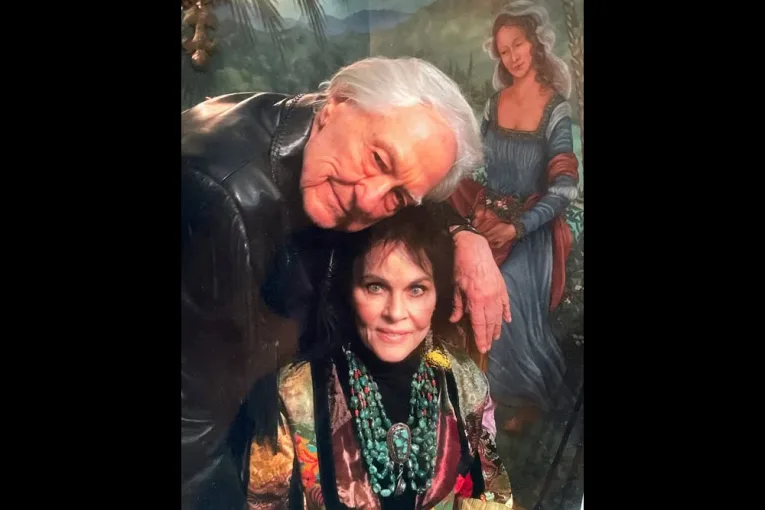
Special to the Vanguard
MONTECITO, CA — Gerry Spence, the celebrated “country lawyer” from Wyoming whose folksy eloquence and ferocious advocacy won him an unbroken string of high-profile courtroom victories over more than five decades, died Wednesday at his home in Montecito, Calif. He was 96.
“He was one of the greatest humanitarians that this country has ever produced,” said Joseph H. Low IV, Vice-President and Chief Instructor at the Gerry Spence Method school, which trains litigators to slay giants in the Spence manner. “He dedicated his life fighting for the rights and freedom of ordinary people. He gave thousands of hours of his life training and teaching lawyers how to stand up against the enormous power of government and corporations. No lawyer has done as much to free the people of this country from the slavery of its new corporate masters.”
Spence became nationally known not just for his signature buckskins and Western drawl, but for never losing a criminal jury trial and for remaining unbeaten in civil cases from 1969 until his retirement in 2010. His courtroom victories were as varied as they were high-profile, taking him from small-town Wyoming courthouses to some of the nation’s most closely watched legal battlegrounds.
In 1979, he won a landmark $10.5 million verdict for the family of Karen Silkwood against the Kerr-McGee Corporation, exposing corporate wrongdoing in the nuclear industry. Silkwood was portrayed by Meryl Streep in the 1983 Mike Nichols film, “Silkwood.” Co-stars included Kurt Russell and Cher.
That same year, Spence secured a $26.5 million libel judgment for former Miss Wyoming against Penthouse magazine. In 1982, he represented a local ice cream maker in a breach of contract battle against McDonald’s that resulted in a $52 million verdict.
“Gerry Spence’s verdicts were the original nuclear verdicts,” Low said. “No one had ever seen eight-figure verdicts before Spence and few can produce them even now 40 years later. His verdicts were so large for the time that the judges, many of whom were appointed by the corporations’ influence, would set them aside claiming that the jury was too emotional. Spence would argue that the jury has spoken so who are you to take their voice from them?”
Other high-profile cases included defending former Philippine First Lady Imelda Marcos on federal racketeering and fraud charges, winning a full acquittal in a trial followed worldwide. He defended Randy Weaver after the deadly Ruby Ridge standoff, winning an acquittal without calling a single defense witness. In Rock Springs, Wyoming, he successfully defended police chief Ed Cantrell against a widely publicized murder charge, the jury acquitting him after just three hours of deliberation.
Spence also won the acquittal of attorney Geoffrey Fieger on federal campaign finance charges in Michigan, and, in Portland, Oregon, represented attorney Brandon Mayfield in a case that struck down part of the Patriot Act. Even in the realm of televised “mock trials,” he made headlines — notably in Dallas, Texas, where he defended Lee Harvey Oswald in a 1986 mock trial broadcast nationally.
Born January 8, 1929, in Laramie, Wyoming, Gerald Leonard Spence spent his earliest years in Peoria, Illinois, before his family returned to Wyoming, settling in Sheridan and other small towns across the state. Spence graduated from the University of Wyoming and its College of Law, then began practicing in Riverton, where he also served as prosecuting attorney of Fremont County. Later in life, he made his home in Jackson Hole, maintained a residence in Dubois, Wyoming, and spent time in Santa Barbara, California, with his wife, Imaging.
In the 1990s, he became a familiar face on CNBC as a legal commentator, offering candid, plainspoken analysis of trials such as the O.J. Simpson murder case.
In 1994, Spence founded the Trial Lawyers College outside Dubois, Wyoming, training attorneys to represent “the poor, the injured, the forgotten, the damned.” He authored more than a dozen books, including The Making of a Country Lawyer and How to Argue and Win Every Time, blending memoir with practical advocacy advice.
“I was so gifted when Gerry became my mentor because I was guided by a soul who loved people, the kind of people we are told are just average people, or worthless people,” Low said. “I was shown by example the meaning of true humanity and the love he had for those who had no love in their lives. He could see and hear what could not be seen or heard in others. He shared with me how to listen and what to listen for. How to crawl inside the hides of others and how to actually feel what they are feeling.”
A Legacy of Storytelling and Justice
From the windswept streets of Riverton to federal courtrooms in New York and Los Angeles, Spence carried his Wyoming roots with him, weaving stories that connected jurors to the human truths at the heart of each case. His legacy endures in the countless lawyers he mentored and in the precedent-setting victories that reshaped how Americans view the courtroom.
Spence died surrounded by close friends and family, including Low. Before his death Spence also lived in Jackson Hole, Wyoming, for many years and sold the home about four years ago.
“At 9:05 p.m., I held his hand as he took his last breaths as his warrior spirit found peace for the first time,” said Low. “He will be greatly missed but his spirit lives on at Thunderhead Ranch, where lawyers train to become warriors.”
Spence is survived by his wife of 57 years, LaNelle “Imaging” Spence; his children Kip Spence, Kerry Spence, Kent Spence, Katy Spence, Brent Hawks and Christopher Hawks; 13 grandchildren; and one great-grandchild. His life’s work — and undefeated record — remain a testament to the power of preparation, principle, and the belief that every client deserves a champion.
