
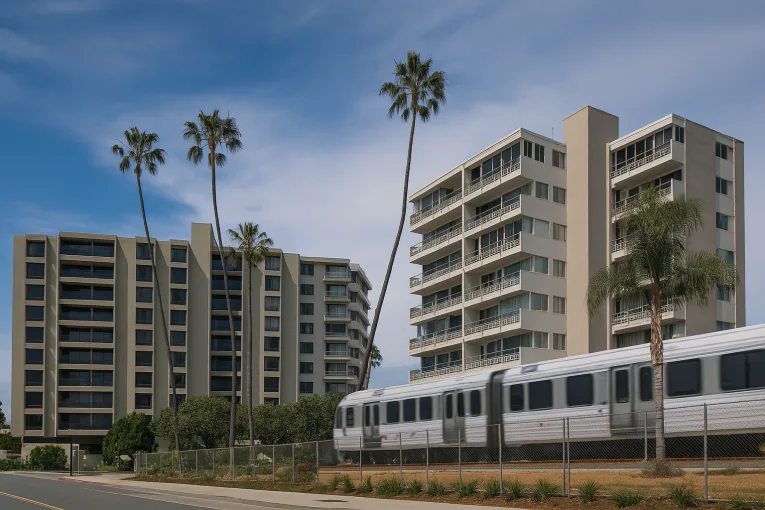
- “SB 79 is neither radical nor extreme, but rather ‘the most basic, evidence-based reform necessary to ease California’s housing shortage while also slowing biodiversity loss, slashing carbon emissions, and tackling climate change.'” – Chris Tokita
By Vanguard Staff
SANTA MONICA — Two California legislators who built their reputations as environmental champions are under fire for opposing a housing reform bill that advocates say is essential to fighting climate change.
Senator Ben Allen and Assemblymember Rick Zbur, both environmental lawyers with long track records in climate and conservation policy, have come out against Senate Bill 79. The bill, authored by Sen. Scott Wiener, D-San Francisco, would allow modest mid-rise apartments within a half mile of major transit stops.
Environmental advocates say the measure is critical. It is designed to ease California’s housing shortage, cut carbon emissions, and limit sprawl into fragile ecosystems. Housing experts argue that building denser, transit-adjacent neighborhoods would provide alternatives to car dependence, while allowing working families to live closer to jobs and schools.
Chris Tokita, an ecologist and data scientist who lives in West Los Angeles, published a blistering op-ed in Santa Monica Next accusing the lawmakers of bowing to wealthy homeowners opposed to change. “Both Senator Ben Allen and Assemblymember Rick Zbur have traded their environmental credentials for political cowardice in the face of wealthy NIMBYs,” he wrote.
Tokita argued that SB 79 is neither radical nor extreme, but rather “the most basic, evidence-based reform necessary to ease California’s housing shortage while also slowing biodiversity loss, slashing carbon emissions, and tackling climate change.” He cited research showing that California cannot reach carbon neutrality by 2045 without significant increases in dense, transit-adjacent housing.
The issue strikes at the core of the state’s climate strategy. “Where and how we build housing is profoundly important for the environment,” Tokita wrote. “It dictates how much we drive, how much untouched habitat we pave over, and how much energy we consume.” He said that infill housing near jobs and transit is among the most effective ways to cut emissions and protect landscapes.
Allen, who has chaired the Senate Environmental Quality Committee and led the Legislative Environmental Caucus, has long been recognized as a climate-focused legislator. But when SB 79 reached the Senate floor, he declined to support it. Allen gave a speech mentioning unspecified “concerns” before registering a “No Vote Recorded,” a procedural move that in effect counted as opposition.
Zbur, who built his career leading California Environmental Voters and making climate justice central to his public image, has also opposed the bill ahead of the Assembly’s vote. He argued that SB 79 could lead to “a six or seven-story building in the middle of a single-family neighborhood” and said it “doesn’t respect the land use patterns in Southern California.”
Tokita said those very patterns — exclusionary zoning, car-centric design, and sprawling subdivisions — are the reason California faces both a housing crisis and mounting environmental costs. He pointed to the loss of wildlife habitats and the displacement of families to high-fire-risk areas as consequences of decades of restrictive zoning.
He invoked the death of Los Angeles mountain lion P-22, who became trapped in an isolated section of the Santa Monica Mountains due to development pressures. “The tragic death of LA’s most loved mountain lion, P-22, was the predictable outcome of sprawl that trapped him in a lonely corner of the Santa Monica Mountains,” Tokita wrote. “To defend these patterns is to defend the status quo of climate inaction, habitat destruction, and unaffordable housing.”
The criticism also spotlighted what Tokita called contradictions in Zbur’s political messaging. Zbur’s campaign website pledges to address the housing and climate crises through “urgent action to invest in…sustainable and affordable housing near transportation and work hubs.” Tokita argued that by opposing SB 79, Zbur is undermining his own platform.
For both Allen and Zbur, Tokita warned, the consequences will extend beyond the immediate debate. “Voting no against the most important housing and climate reform our state has seen in a decade will tarnish both Allen and Zbur in the annals of history,” he wrote. “No other accomplishment will outweigh a retreat from necessary and effective climate action.”
Tokita also suggested that political calculation played a role, with both lawmakers worried about upsetting affluent constituents opposed to zoning changes. But he argued that such a stance reveals a misunderstanding of political capital. “Perhaps both legislators feel too politically vulnerable to risk a potentially unpopular vote,” he wrote. “But that misunderstands the point of political capital: it exists to be spent on the votes that matter most.”
The stakes, he said, extend far beyond political reputation. “Opposing SB 79 is not environmental stewardship but abdication of leadership,” Tokita wrote. He urged both Allen and Zbur to reconsider, noting that the bill will return to the Senate after amendments and will soon face a vote in the Assembly.
“History will not remember the careful, nuanced speeches hedging against SB 79,” Tokita wrote. “It will remember whether California’s so-called environmental leaders had the courage to act when the decision was in their hands.”
Tokita closed his piece by appealing to both legislators’ sense of legacy and responsibility. “Assemblymember Zbur and Senator Allen: if you will not support SB 79 for the sake of your own legacy, then do it for our children who must live with the world you leave behind.”
The Assembly is expected to consider the bill later this year, with another Senate vote possible depending on the scope of amendments. The outcome could shape California’s housing and climate future for decades to come.
Follow the Vanguard on Social Media – X, Instagram and Facebook. Subscribe the Vanguard News letters. To make a tax-deductible donation, please visit davisvanguard.org/donate or give directly through ActBlue. Your support will ensure that the vital work of the Vanguard continues.
