
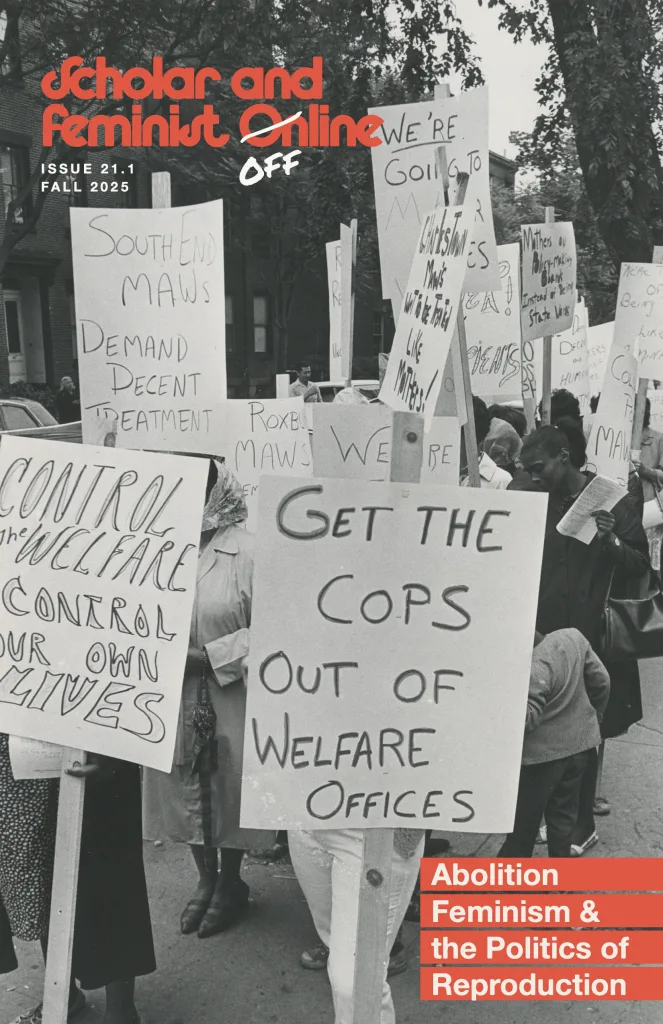
Edited by Sarah Haley and Emily Thuma, the Fall/2025 issue of Scholar and Feminist Online, “Abolition Feminism and the Politics of Reproduction” curates contributions that examine how “gendered, racialized, and classed forms of life are both sustained and constrained by carceral systems, and how abolition praxis reimagines and rebuilds the reproduction of the social otherwise.” Produced by the Barnard Center for Research on Women (BCRW), the issue was made available in print to free for captive residents of the punishment sector in collaboration with Haymarket’s Books Not Bars program (https://tinyurl.com/SFO-in-print). That outreach made it possible for me to gather a group of readers inside Valley State Prison, allowing us to convene around the issue’s centering of “a refusal of state violence with a commitment to building alternative infrastructures of care, safety, and survival.”
The care work this volume contains is reflected in the protective outer shell that holds the contents together; the book’s cover, itself, embodies the very reproductive maternal duty of care that knowledge production requires. Sleeved by a sturdy rubberized cover (the sort of binding that superbly protects the book’s 175 pages from the bodily oils and liquid elements that routinely penetrate and warp the cheap paper covers of most prison-zines), the quality of this printed version of S&F Online’s product construction is objectively impressive, and deserving of a mention. It surpasses the flimsy paper-print architecture of the annualized PEN America anthologies the Mellon Foundation routinely funds the printing and distribution of in partnership with Haymarket; those covers rarely survive a few months of what hand-to-hand reading combat does to books that move through prison. By contrast, the S&F Online issue is durably built to survive the rigors of being read, passed on, and reread continuously.
The material features contributions from a dynamic array of thought-leaders, scholars, and captives, whose ideas and experiences are placed in conversion with one another (itself an insurgent praxis that honors those on the inside who are engaged in active struggle work), including Kwaneta Harris, Stevie Wilson, and Orisanmi Burton, among others. Haley and Thuma deliver a tightly-packed and informative framing of the “emergent intersection” of not just abolition feminism and social reproduction, but themes of “collective resistance, policing, mass incarceration, decarceration, genocidal violence, and reproductive injustice,” that are generative of the “kinship-making, self-defense, and collective survival” work that resists the proto-genocidal aims of carceral reproduction.
S&F Online’s editors Sandra Moyano-Ariza and Beck Jordan-Young have given readers an essential resource that lucidly distills the dynamic subject of reproduction, while blueprinting for publishers the futurity of insurgent pedagogic praxis. With an eye towards connecting confined people with the scarce survival knowledge that serves to nourish the human flowers wilting in the otherwise barren dark garden, by placing its messaging directly in the hands of captives, this work does what so few other journals do: it valorizes the confined person as being worthy of reading the work the journal generates.
Affirming the need for abolitionist scholars to be more “intentional about relationship building with people who are on the inside, with imprisoned people,” Wilson, whose organizing and publishing exploits with the abolitionist study collective 9971, Critical Resistance, and In The Belly are prolific, points to a void in the very sort of collaborative work this book heralds. If the books you publish, the papers you write, and the talks you give on the campus circuit concerning the plight of incarcerated people never reach the captives whose circumstances you get paid to think, teach, write, and talk about, are you really in solidarity with us?
Have you co-published a paper alongside a captive intellectual yet? Have you used your agency as an academic to be more than extractive, but collaborative, in the making of work that allows the subject matter to climb into the realm of primary source? Have you presented a living captive’s perspective to your students by bringing that personified perspective into your classroom via phone or video call? Have you walked a prison yard, shared in-circle space with a group of lifers, or taught an in-prison college course?
Critical questions abound.
Haley and Thuma introduce the special issue of S&F Online to readers as one that centers “scholarship and organizing,” using long and short-form essays, interviews, and a roundtable conversation to “examine the workings of carceral power and modes of abolitionist struggle through the prism of social reproduction.” Building upon Tithi Bhattacharya’s interrogation of “the complex network of social processes and human relations that produces the conditions of existence,” which Aren Aizura writes “have instrumentalized reproduction in both social and biological forms to concretize racial, gender, and sexual order,” a core consideration of the project is “the imprint of theorists of racial capitalism, especially Black feminist theorists of captivity, the domestic, and reproduction,” as Haley and Thuma write.
Haley, Burton, Tiffany Lethabo King, Judah Schept, and Rosie Stockton open the issue with a discussion described by residents at Valley State Prison (VSP) who read the book as a collective within the Barz Behind Bars: Healing Through Verse literary workshop as an inspiring peek into the academy’s treatment of how social reproduction informs their PIC abolitionist work.
Chase Doulphus, a graphic novelist youth offender attending Merced College, and co-parenting a mixed-race son from prison, said “I connected with Burton’s framing of social reproduction as a prison technique, which our cohort relates back to Foucault’s theorization, as a projection of carceral power intended to—as Burton said—’interrupt the intergenerational transmission of Black radical knowledge,’ which of course, is what our Carceral Studies Journalism Guild’s (CSJG) partnership with the Justice For Everybody movement (J4EM) at the Yale Institute on Incarceration and Public Safety (YIIPS) is actively working to resist, by building out the Inside Knowledge portal on Edovo. The Black masculine care work he talks about is what we are engaged in here, and the capture/coopt threat is one we avoid via our autonomy.”
Dominick Porter, a former gang-leader who taught himself to read after the age of 30, earned a GED, and then became an honor society college student, public speaker, and journalist, described King’s conversation as most illuminating. “Within our Barz community,” Porter noted, “we have a well-read understanding of how and why we, as captive scholars, owe our intellectual fidelity and bodily solidarity to the Black radical feminist tradition—the work of Angela, Erica, Ruthie, and Joy—the thought leaders whose work we have come to identify by their first name. King’s words echoed Diana Paton’s 2022 piece in American Historical Review, ‘Gender History, Global History, and Atlantic Slavery,’ which I credit for teaching our group about the school of social reproduction feminism, whereby Federici, Mies, and James noted women’s reproductive labor as one foundation of capitalism.”
Porter described how “historicizing reproductive labor from the era of Atlantic slavery, gives us two threads to pull on: the one where slaves in the Americas are born to African women; and the one where captives held in the Caribbean, Cuba, Brazil, and the United States—after the Atlantic slave trade was abolished–were carried and cared for by African women.”
“The high fertility rates of enslaved women in the United States put Black women at the center of the conversation once slavers could perpetuate their workforce from within. Tracing how production, as a concept, morphs from that reproductive barbarity, to how carceral power produces the social conditions that constrict liberty, is mind-blowing,” Porter added. “Mapping how prison criminalizes our faintest expressions of liberty, leads us to how women’s bodies have, again, in the carceral context, become another terrain of state violence, like a sick feedback loop. The story of women teaches us everything we need to know about the ills of capitalistic power. We need more books like this.”
Sara Matthiesen’s essay — “‘We Aren’t Locking Up!’ Making Life on the Inside” — described a 1975 riot at the California Institute for Women that kicked off over the cancellation of an annualized family holiday party, which triggered a cataloging by our group of all the things VSP has taken from us since it became a men’s facility over a decade ago. When the group noticed that most of the programs that promoted pro-social community connections, or forged life-affirming solidarity among the captives were the ones discontinued, they were able to see a pattern rooted in one objective: fracturing community.
While the counterinsurgent methods of separation, disconnection, and anti-family policies deployed against captives form a familiar braid of prison technique, our reading group was silenced (a rare thing for prison performance poets), when I suggested to them that the family visiting prohibition our brothers in Connecticut face—a state with the nation’s highest racial disparity between the percentage of Black people that make up the state’s prison population, versus their representation within the state’s overall population (see “Liberation Live!” for more on this)—reflects a carceral form of eugenics, designed to curtail the reproduction of undesirables.
I asked the group: “If you wanted to prevent the so-called worst people from reproducing, what more effective policy could you enact concerning prisons?”
It took a minute for the implications to sink in, owing to how normalized family visiting is here in California. Two of the six men sitting in the circle were conceived during family visits at a prison. Thought experimenting requires an empathic capacity to do what critical resistance demands: reimagine what is, and conceive of what could be. In this case, imagining not having what they did have, led to a solidarity whiplash that spurred a conversation about all the ways prisons activate to obstruct family reunification, which led to a new appreciation for the “kinship making” Stevie Wilson described as the “antidote” to the carceral state in his essay for the issue.
In “Carceral Collusions with ‘the Community’: An Examination of Community-Based Juvenile Justice Reforms,” Kayla Martensen expertly explores the so-called progressive reforms of juvenile justice. She thus presents how carcerality itself is reproduced through the carceral cooptation of the very programs created within marginalized communities in order to present alternatives to incarceration. What Martensen describes as a “carceral service industry” is what our group has long-since called a “nonprofit industrial complex” of hydra entities that deliver services both within the prison, and during parole. Increasingly, law enforcement professionals become the wardens of these so-called services.
Harris, a fellow journalist whose writings we devour, echoes the “continuities of control” our sisters who are housed across the street at Central California Women’s Facility know firsthand in her essay, titled “Our Bodies, Their Currency: Parenthood and Survival in Texas’s Carceral System.” Bayan Abusneineh’s essay — “Reproductive Genocide, Disabling Futures, and Carcerality in Gaza” — lenses reproductive violence via the Israeli occupation of Gaza, connecting carcerality with genocide, which pushed our group to think about what resilience looks like while enduring the worst forms of pressurized struggle. Alisa Bierria, who gives us a liberatory essay about surviving the capture that follows self-defense, presented what our group found to be the most expansive topic. This took our conversation to the many iterations of conflict and power that invariably lead to the dilemma of avoiding death, and seeking safety.
The best part of having heteronormative men interrogate something like “Defending Self-Defense” is what comes after they relate to feeling threatened, endangered, and unsafe—after they uniformly agree with one’s right to use violence to defend against violence—when the underside of domestic violence demands its own reckoning for men who bring aggression into their interpersonal relationships. What begins as a sort of stand-your-ground resistance to state violence, evolves into a more nuanced reflection upon how we contribute to the violence that survivors defend themselves against.
There are “freedom-making” lessons here, for everyone.
There are very few books of this caliber, convening these types of esteemed scholars, that center the work of credible self-activating stakeholders, in service of a coherent survival ethos grounded in community, safety, and the principles of abolition, that can be had by the people who need it most, for free. Placing members of the academy in conversation with those most pressurized by the carceral state of being, is precisely the sort of brain food publishers need to be curating. More like it need to be published with the captive reader front of mind, not as an afterthought.
This nifty little reader may appear to some of you in the free world to be nothing more than a quick-print version of a special issue of S&F Online; however, for those of us who actively strategize ways to claim space, create meaning in those spaces, and politicize our community into the very state of self-awareness the container deems a contraband thought crime, we view it as a would-be textbook in a forthcoming Gender Studies class. You see, despite Ethnic Studies being a state-mandated subject matter graduation requirement for both high school, and California State University students, neither African American/Black Studies, nor Gender/Feminist Studies courses of any kind are offered here, via any of the multiple college degree programs made available to the more than 7,000 captives collectively residing at VSP and Central California Women’s Facility (CCWF).
Not a single abolitionist in the state (or the nation, for that matter), in five years, has answered the recruiting calls to either travel in to teach these subjects in-person, or do so virtually via Canvas.
Where are the teachers?
—Ghostwrite Mike appears in the American Prison Writing Archive’s forthcoming anthology Harm and Punishment: Incarcerated Writers on Violence and the American Prison, edited by Elizabeth Hinton and Elsa Julien Lora, available from Haymarket Books in August 2026. Read his Migrant Worker Sexual Exploitation and Black Radical Feminisms. Contact him at ghostinsideknowledge@gmail.com.
Haymarket’s Books Not Bars program furnishes free copies of select book titles to incarcerated readers by mail, upon request.
