
Key points:
- Government reliance on court fines and fees is financially unstable and unjust.
- Fines and fees act as a hidden tax on the poor, disproportionately affecting low-income communities.
- Researchers found a lack of transparency in tracking and reporting court fines and fees.
A new report from the Fines and Fees Justice Center warns that government reliance on court fines and fees is both unjust and financially unstable, creating lasting harm for individuals while undermining public budgets.
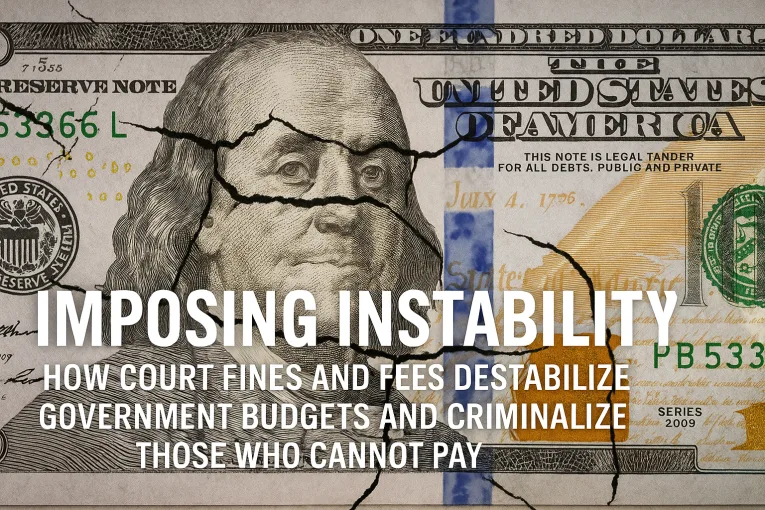
The report, Imposing Instability: How Court Fines and Fees Destabilize Government Budgets and Criminalize Those Who Cannot Pay, is based on two years of research across 24 states. It concludes that fines and fees are a hidden tax on the poor that fail to deliver meaningful accountability, destabilize state and local finances, and expose vulnerable communities to lifelong cycles of debt and punishment.
“If you’re someone who owes fines and fees and can’t pay for it, they can pile up very quickly, be incredibly difficult to pay down and lead to really long trajectory harmful consequences, including losing your driver’s license, including potentially being incarcerated,” said Lillian Patil, senior analyst of state and local budgets at the Fines and Fees Justice Center.
The organization’s research shows that fines and fees are imposed at virtually every stage of the criminal legal system — from traffic tickets and probation fees to surcharges on public defenders. Governments, Patil said, make themselves dependent on these revenues, which disproportionately fall on low-income communities.
“This ends up being a system that’s not only inequitable but also inefficient for governments,” Patil said. “It’s essentially a hidden tax on this really specific population that we know already disproportionately tends to be from low income communities.”
Billions Imposed, Few Dollars Collected
Between 2018 and 2022, courts in 24 states imposed nearly $14 billion in fines and fees, according to the report. Yet collections fell sharply. Revenue from these sources declined by 33 percent over five years, even as the amount imposed increased by 3 percent.
Senior research analyst Tanisha Pierrette said the numbers only reflect a partial picture because many states refused to provide data. “We were very surprised when we saw how much money courts were imposing on people,” she said. “We only had data from 24 states, so only 12 of the states provided us with complete data. Twenty-seven didn’t provide us imposition data at all. So if we had the full national landscape … we believe this number would be more than double.”
Courts are raising fines and fees per case in an attempt to make up for declining caseloads and collections. “There’s less cases, but we’re imposing more money,” Pierrette said. “It’s because courts are imposing a larger financial burden on individual cases trying to make up for that loss of collections and revenue.”
Patil noted that collection rates are often abysmal. Some Florida clerks reported that in certain case types they could only expect to collect 9 percent of imposed fines and fees. In North Dakota, the expectation was 25 percent.
Governments, she said, are sometimes spending more than they collect. “There were studies of some counties in New Mexico that even found that governments were spending more than a dollar to even bring in a dollar,” Patil said.
A System of Collateral Consequences
For individuals, the consequences are devastating. “When someone can’t afford to pay, then they are subject to a bunch of penalties that are very hard to bounce back from,” Pierrette said.
Those penalties include loss of a driver’s license, the imposition of interest and late fees, damaged credit scores, and arrest warrants. “If they’re on parole or probation, they might be sent back to jail because they didn’t have the ability to pay their court fines and fees,” Pierrette said.
The report found that in just 13 states between 2018 and 2022, more than 2.5 million bench warrants were issued for failure to pay or appear in court.
Patil emphasized that these practices entrench poverty. “If you’re someone who owes fines and fees and can’t pay for it, they can pile up very quickly, be incredibly difficult to pay down and lead to really long trajectory harmful consequences, including losing your driver’s license, including potentially being incarcerated,” she said.
National surveys confirm the impact. Studies show that people burdened with fines and fees often report difficulties paying rent, affording food, or covering childcare. “If you have to divert what income you have to be able to try and pay down your fines and fees … you’re really hurting people’s ability to access the very basic needs they need in their life,” Patil said.
Destabilizing Government Budgets
The practice also creates financial instability for states and cities that rely on fines and fees. Patil explained that because collections remain low, governments risk budget shortfalls that jeopardize essential public services.
“If you were depending on a certain amount of money … and you’re now only getting half, that means you’ve got a budget gap and you’re putting whatever service or program you were used to funding at risk,” Patil said.
She noted that revenues from fines and fees did not rebound after the COVID-19 pandemic, unlike other revenue streams. “That makes total sense because … it’s disproportionately a burden that’s placed on low-income communities,” she said. “And then COVID comes around, tons of people are furloughed, lose their jobs, have greater income instability. And the fact that we then made it through that fiscal peak impact of COVID doesn’t necessarily change people’s lower inability to pay.”
Calls for Reform
Both Patil and Pierrette argue that fines and fees are not about accountability but about raising revenue. Pierrette pointed to states like Idaho and Pennsylvania, where 70 percent of the amounts imposed are fees rather than fines. “That is not about accountability, it’s about raising revenue,” she said.
Patil added that reform would benefit both individuals and governments. “Looking at the reform of these fines and fees … it’s a win-win for people, for communities, but also for governments and budgets,” she said.
The report calls for eliminating justice system fees, ending government dependence on fines and fees for revenue, limiting bench warrants to public safety threats, discharging old and uncollectible debt, and mandating better data collection.
California has already made some changes, including ending license suspensions for unpaid fines and discharging certain categories of old debt. “That relieves a huge burden off the people who owe that debt,” Patil said. “And it often costs the government nothing because they weren’t going to collect that debt and be able to use it for revenue in the first place.”
Transparency Barriers
One of the central challenges, the researchers said, is the lack of transparency. Many courts and budget offices either do not track or refuse to share data.
Pierrette singled out Texas, which once provided court debt data but has since stopped. “That’s one super harmful — and also why you were tracking it before, now we can actually see how much debt exists. They stop tracking it, so now we can no longer hold them accountable,” she said.
Patil said that fines and fees are often buried in budget documents under vague categories such as “other revenues,” making it nearly impossible to trace how much is being collected or how it is spent. “When you do pull that out, it paints such an illustrative and important picture,” she said.
A Regressive Tax
The broader effect, the report warns, is the creation of a regressive tax that punishes those least able to pay while failing to deliver reliable funding.
“We conclude that using fines and fees as a revenue generating mechanism is bad for people, bad for budgets and requires bold reform nationwide,” Pierrette said.
Patil argued that the system entrenches poverty and undermines justice. “You’re doing great harm that sort of pushes people further into cycles of poverty and potentially into deeper interaction with the criminal legal system or incarceration. And that can have really harmful long-term lifelong consequences,” she said.
The Fines and Fees Justice Center has published its full report along with a blog series aimed at helping advocates and policymakers use the data to push for reforms in their own communities.
“We have spent the better part of two years doing deep dive research across the country into fines and fees systems and how they work in state and local governments,” Patil said. “What we know is that dependence on these systems ends up being bad for people and also bad for budgets.”
The full report is available on the Fines and Fees Justice Center website.
Follow the Vanguard on Social Media – X, Instagram and Facebook. To learn make a tax-deductible donation, please visit davisvanguard.org/donate or give directly through ActBlue. Your support will ensure that the vital work of the Vanguard continues.
