
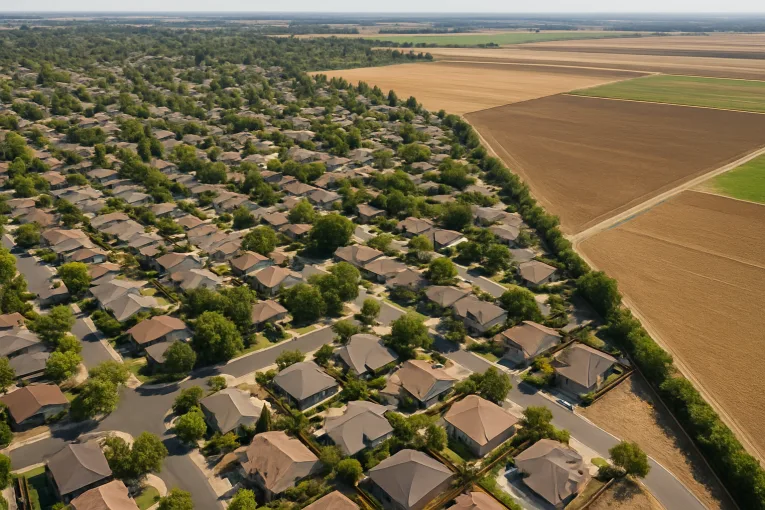
Key points:
- Davis city officials roll out General Plan update process.
- City’s approved housing element protects it from state intervention for now.
- Davis faces a potential state intervention if Measure J hinders housing progress.
On Wednesday, the city rolled out its General Plan update process. While there were some legitimate technical complaints about the size of the room, the meeting seemed like a good start and a reminder that Davis is finally confronting questions it has been avoiding for a long time.
After the meeting, someone asked me why I am so pro-housing and why I believe the state will eventually come for Davis. That’s the point I want to address here.
I will provide a more detailed breakdown of the General Plan workshop later, but I think it’s important right now to step back and look at the bigger picture — both where Davis stands and how the state is increasingly approaching housing.
The first point to make is that this isn’t something that happens overnight. The state isn’t going to swoop in today or tomorrow. Davis has an approved housing element for the sixth cycle, and that protects us for now. The city can make some progress under this plan. The real danger, though, will come in the seventh cycle, when Davis itself has acknowledged it doesn’t have enough readily available infill sites left to meet state housing targets.
As Eric Yurkovich pointed out this week, “Nearly 97% of the city is built out with only really a handful of vacant areas or sites within the city. So that means we’re going to need to be creative in how we problem solve, to figure out where we need our housing, jobs, needs in the future.”
That reality puts Davis in a difficult position. Too often I hear people say that the state will eventually force the city to expand outward. That is not what I am arguing. The state doesn’t operate that way, and it is not going to dictate where Davis builds. But the state does have a clear interest in making sure that communities meet their RHNA numbers, and it will step in when local restrictions make compliance impossible.
Measure J is the obvious example. In previous pieces, I have highlighted correspondence between the city and HCD that raises concerns — from both sides — that Measure J is a constraint on housing. If it becomes apparent that Davis cannot meet its housing obligations under Measure J, that is when I believe the state will intervene.
And intervention wouldn’t mean the state tells Davis where to put housing. What it would mean is that the courts could remove or modify Measure J. That alone would change the landscape. Davis could still decide to do very dense infill instead of peripheral projects, and as long as the RHNA requirements were met, the state wouldn’t stand in the way.
So, will the state take Davis to court? That’s not a short-term scenario. It would likely require several things happening first: the defeat of upcoming Measure J projects, a lack of real progress on housing, and non-compliance in the seventh cycle. That’s probably at least five years away. But it’s not an abstract risk — it’s a very real possibility, and one the city needs to take into account as it makes decisions today.
This is one reason I’ve been watching Sacramento so closely this past year. The state is no longer sitting back and hoping cities comply. It is increasingly aggressive in forcing the issue.
Assemblymember Chris Ward laid out the broader picture in San Diego, noting that since 2020 “monthly payments on a mid-tier home have soared 82% while average hourly wages rose just 24%.” The Legislature, he wrote, is responding with “renewed urgency and unprecedented coordination” to accelerate project approvals and expand supply (Union-Tribune).
That package includes bills like AB 253, which would allow applicants to hire independent reviewers if a city drags its feet on housing permits. The point is not that Sacramento wants to dictate local outcomes, but that it is stripping away excuses and delays that cities have long used to keep projects tied up.
And if the Legislature is taking away procedural roadblocks, HCD is showing it is willing to directly challenge cities that defy state law. Cupertino is a prime example. Earlier this summer, HCD accused Cupertino of violating housing law after the city claimed developers had missed deadlines and invalidated projects filed under the builder’s remedy. YIMBY Law and the California Housing Defense Fund have already sued, and HCD has warned the case could be referred to Attorney General Rob Bonta (Mercury News).
The Cupertino case illustrates the new reality: the state is not afraid to use lawsuits, penalties, and legal tools to push cities into compliance. If Cupertino can be challenged for how it interprets deadlines, then Davis certainly isn’t immune from scrutiny over something as sweeping as Measure J.
I understand some people want to believe Davis is in a relatively safe position.
Compared to nearby communities, our housing numbers are smaller — West Sacramento is expected to generate 9,000 units, while Davis is only on the hook for around 2,000. That’s true.
But smaller numbers don’t erase the fact that Davis has one of the most restrictive growth control measures in the state. And if we keep stalling on housing, eventually that’s going to collide with Sacramento’s growing impatience.
That is why I keep hammering on this point: Davis cannot treat this as business as usual. The city cannot assume it can continue to put off hard decisions, reject projects, and delay planning. That may have worked in the past. It will not work going forward.
The state doesn’t need Davis to be the biggest producer of housing in California. But it does need Davis to meet its share. And if Measure J gets in the way of that, the state will step in. The courts are already being tested in Cupertino. Davis should not assume it will be spared the same kind of challenge.
The question for us is not whether we can keep the state at bay. The question is whether we can get ahead of the problem by planning smartly, acknowledging our limitations, and finding real solutions now — before Sacramento decides it has to do it for us.

David says: “As Eric Yurkovich pointed out this week, “Nearly 97% of the city is built out with only really a handful of vacant areas or sites within the city. So that means we’re going to need to be creative in how we problem solve, to figure out where we need our housing, jobs, needs in the future.”
Not sure how many more times you’re going to put forth this same argument. Many cities are more dense than Davis is, and have very few vacant sites. Some of them can’t expand outward, and/or have chosen not to.
Not sure if you’re familiar with these things called “city boundaries”, but all cities have them. Most cities in major population areas are not expanding their boundaries, and haven’t done so for decades.
The way that they’ll address the next round of RHNA targets is to rezone existing sites. Of course, this won’t actually result in housing – but it will be a paper plan at least.
As noted yesterday, Bay Area cities have permitted less than 10% of CURRENT RHNA targets. What does THAT tell you about the viability of the state’s entire effort?
David says: “Too often I hear people say that the state will eventually force the city to expand outward. That is not what I am arguing.”
That’s exactly what you’re arguing. And the people you “hear” saying that consist of YOU.
Do you believe if you put forth this argument in a court of law it would dispositive?
Definition: “Dispositive is an adjective that describes something that has the power to determine the outcome of a legal dispute. In other words, it’s a case’s ultimate decision or resolution. It’s derived from the Latin word “dispositive,” which means “that which directs or determines.”
https://www.cdforrestlaw.com/blog/the-importance-of-dispositive#:~:text=Dispositive%20is%20an%20adjective%20that,that%20which%20directs%20or%20determines.%22
No, I don’t think a challenge would determine a case’s “ultimate decision or resolution”. But I believe the question is irrelevant in the first place. You’re a non-attorney asking a non-attorney to speculate on a challenge that doesn’t even exist, using laws that are both new and don’t force cities to expand outward. (I can’t imagine a more speculative exercise than that.) You’re also claiming that the fact that the state’s efforts are not viable have no impact regarding a challenge.
In other words, do you believe your arguments would be given weight in a court? If not, it’s largely irrelevant – which you seem to concede.
I said that your question is irrelevant.
The problem that you have is that you’re an advocate for a legal challenge. It’s not as if you’re writing this out of interest in the legal system.
The city has plenty of sites that can be rezoned – just like cities in the Bay Area will do.
If the state claims that rezoned sites are not viable, then the appropriate response is to (both) point out that no other city is meeting the targets, AND to ask the state which sites they think ARE viable.
Neither the city nor the consultant believes that the city has plenty of sites that can be rezoned. In fact, the city had trouble identifying sufficient sites for the last cycle and acknowledged it will be difficult.
That’s backed up by the consultant this week: As Eric Yurkovich pointed out this week, “Nearly 97% of the city is built out with only really a handful of vacant areas or sites within the city. So that means we’re going to need to be creative in how we problem solve, to figure out where we need our housing, jobs, needs in the future.”
And btw, my personal preference is that we approve the housing and avoid any legal entanglements.
The city is putting out purposefully-incorrect information. It is not the first time they’ve done so, and they will likely do so again.
Again, the entire city could be rezoned (and can be rezoned more than once, indefinitely). There is no limit to the number of rezonings a city can do. In fact, this is exactly what the state EXPECTS cities to do.
This is exactly how cities in the Bay Area will handle this.
But it also points out the absurdity and lack of viability of the state’s new housing targets – which are ALREADY a complete and total failure.
That’s false. HCD has to deem the sites to be viable (I’m not going to look up the exact wording but you can find it).
So again, if HCD claims that the sites aren’t viable, then the appropriate response from the city is to ask them which sites (or type of sites) would satisfy their requirements. And it’s a question that the state will have to deal with from a majority of cities in places like the Bay Area.
But the fact that existing sites are already developed does not mean that the state will view them as not viable. If the state took that position, the entire Bay Area would literally have no way of meeting their own targets.
In fact, the state’s efforts are DESIGNED to rezone sites with existing buildings on them. The state’s efforts are DESIGNED to encourage demolition and rebuilding in a more-dense manner. It’s essentially the entire point of the new laws.
There are LOTS of sites in Davis that can be demolished (on paper) and rebuilt in a more-dense manner. (There might even be a strong-enough market to make that happen, on some of the sites.)
I can probably name some of the sites/areas myself, if you’d like.
In order for that exercise to work, you would need to contact the property owner and ascertain whether they are interested in rezoning/ redeveloping their site. This is not a useful conversation at this point. The city and HCD have already done all of this.
That is also a false claim. Cities do not need “permission” from property owners to rezone sites.
And again, this is the ONLY way for cities in the Bay Area to address the next round of RHNA targets.
Neither the city nor the state are going to be going through neighborhoods, knocking on doors in hopes of gaining universal property owner approval (that they don’t need in the first place) to rezone sites.
What an absurd thing to suggest.
Show us the law which states that they need individual property owner approval to rezone entire sections of a city, for example.
You don’t know how this stuff works, so I will stop wasting my time.
I’m sorry that (when the conversation goes into a topic that you obviously don’t like), you shut down your participation. But this subject is key regarding how cities across the state are going to address the RHNA targets that you cite. Here’s what AI has to say about rezoning sites:
“In California, property owners are not necessarily required to give permission for their land to be rezoned, but the process is heavily regulated. Generally, a local government can rezone land without owner consent if the change is consistent with the General Plan and deemed to be in the public interest. However, there are specific procedures, including public hearings, that must be followed.”
(Seems like this is exactly what the city is doing, right now.)
Of course, city officials may not like dealing with this, due to the fear and anger it might create for some city residents.
But the city is not responsible for the new laws. It’s unfortunate that the electorate has been asleep at the wheel, so to speak, regarding the people they elect to represent them in state government.
Of course, a lot of that is also “by design”, in regard to the political system itself. (No actual choice, by the time that the ballots are sent out.)
Ron O
“Cities do not need “permission” from property owners to rezone sites.”
You’re missing the point. To meet development targets the rezoning is only effective if the property is controlled by someone who is interested in redevelopment. In the Bay Area, there are many sites where developers and property owners who are prepared to densify their parcels if rezoned from single family. We see those proposals everyday in the Bay Area media. But rezoning all of Davis to eliminate SF-only will have no real effect because home owners generally are not interested in maximizing their commercial value. HCD requires that a city identify specific parcels where development will occur, and that step does require permission from the property owner. (Note several owners of parcels initially identified asked that they be withdrawn, shrinking the potential pool.) Rezoning is only a necessary but not sufficient step in this process.
Richard says: “You’re missing the point. To meet development targets the rezoning is only effective if the property is controlled by someone who is interested in redevelopment. In the Bay Area, there are many sites where developers and property owners who are prepared to densify their parcels if rezoned from single family.”
Prove it, and prove that there’s no property owner in Davis interested in doing so.
Richard says: “We see those proposals everyday in the Bay Area media.”
No, you don’t.
Richard says: “But rezoning all of Davis to eliminate SF-only will have no real effect because home owners generally are not interested in maximizing their commercial value.”
They’re not interested in doing so ANYWHERE, in general. That’s why the state’s “mandates” are failing.
Richard says: “HCD requires that a city identify specific parcels where development will occur, and that step does require permission from the property owner.”
No, it doesn’t. I listed a source which shows you’re wrong.
But more-important, all of this is the reason that cities in the Bay Area have permitted less than 10% of their current RHNA “requirements”. “Requirements” that can’t be met.
Ron O
David is not the only person asking this question, including many who are much more experienced in the state’s land use planning and laws. That’s why this issue is getting so much attention in the broader media. You ignore the fact that you are in a tiny minority, like climate change deniers, who try to push back against the overwhelming tide of well-informed expertise on an issue.
One of the more-interesting aspects of rezoning sites within cities is that it likely creates the same type of unrealized “profit”, as it does when it occurs outside of cities.
If a homeowner, for example, is suddenly able to build a much-denser building (or additional buildings, such as ADUs), this INCREASES the value of their property. The YIMBY claim that NIMBY homeowners are “protecting their home values” by rejecting density is demonstrably false.
Homeowners reject density for quality-of-life reasons; not to protect home values. Again, allowing for increased density INCREASES the value of a property. So for that reason alone, some homeowners might welcome density (e.g., they or their heirs might want to “cash in”), themselves. Pack it up, and call it a day so to speak. Especially if it actually starts occurring in a given neighborhood – at which point the original owners may become increasingly-scarce.
Of course, the increase in value of properties (resulting from rezoning) isn’t going to make housing “cheaper”, when the sites themselves are made more valuable by rezoning (and the costs associated with demolition, rebuilding, etc.). This is yet another problem resulting from the state’s ill-conceived effort.
How much of Davis’ required building under the current directive is going to get built? Not much. Nishi is stalled because they gave up access to pass a vote. Village Farms efforts to get to the polls has been stalled because the City Council dragged its feet for the first two years of Vaitla’s term while NIMBY opposition continues to be fierce. Downtown is not redeveloping because of interest rates. The only things that seem to be moving forward are DJUSD’s efforts to build workforce housing, the old Horse farm on Eighth St recently changed hands and seems to be advancing, Wildhorse Ranch is moving forward because it fell under the builders exemption and WDAAC is under construction. I doubt the City meets its requirements under the current directive unless measure J votes start passing. Forget about the next cycle we can’t even get it together to meet the current mandate.
Ron G.,
Village Farms is “stalled” because it is a horrendous project on a seriously handicapped parcel with a terribly flawed Draft EIR. The Village Farms project has far too many unresolved and un-resolvable problems including but not limited to:
1) A 200-acre flood plain – it is ridiculous to try to build on an enormous flood plain of this size which would just bring significant flood risks and liability to the City.
2) Toxics including PFAS “forever chemicals” in the Village Farms groundwater from the adjacent UNLINED Old City Landfill and Sewage Treatment Plant.
3) Soil toxics including high arsenic levels (exceeding maximum concentration levels) that they want to use to try to fill in the 200-ascre flood plain and then to build houses on? How many people want to pay $800,000 to over $1 million for a house built on high-arsenic content soil? That can’t be good for anyone’s health including families with young kids.
4) Unsafe access across Covell Blvd. (south) and no access from F St. due to the railroad tracks (to the west) and from the Old City Dump leaking toxics to the north. And who knows if the Pole Line under-crossing is really “feasible” or not, per the Draft EIR’s uncertainty documented? Plus, the developer made clear in the Draft EIR that he did not want to pay for the undercrossing entirely. So, will the City (ie: we residents) be subsiding that multi-miillion dollar infrastructure costs? This same developer (John Whitcombe) is stalled for 7 years now on his approved Nishi project where he promised he would build the railroad over-crossing. Why on earth would the we give this same developer entitlements for this seriously handicapped Village Farms monstrosity project proposal with massive infrastructure costs and problems also?
5) Massive infrastructure costs including an unneeded additional Fire Station because 90% of the fire dept calls are medical not fire -related. Instead what make far more sense is an Emergency Medical Service which would cost a fraction of the cost and could go anywhere in East Davis instead o the multi-millions of dollars in costs into the future for another fire station station for salaries, equipment and operational costs.
6) Massive 1,800 housing units when the Covell Blvd. and Pole Line Road area has enormous traffic impacts. Traffic would be backed up even more for 15-20 years due to the additional construction traffic including 100,000 truck loads of soil that they need to move per the Draft EIR to try to fill the enormous 200-acre
floodplain.
7) Endangering the vernal pools by potentially flooding out of Channel A and the impacts from the construction and the massive amount of development planned surrounding them.
8) Affordable housing due to the projects huge infrastructure costs including trying to fill the 200-acre flood plain, trying to re-route Channel A (bringing flooding risks), the possible Pole Line Road undercrossing.
That’s just some of the many problems that the Village Farms project has and since its Draft EIR roughly 200-letters of opposition. Village Farms is a ridiculous proposal that needs to be rejected for many reasons including the need to protect the City from long term liability due to the toxics and flooding potential issues.
She’s got the talking points going…
That said, I think it’s inaccurate to say stalled. It was the city’s call and much of that was about staffing. That said, the longer this process takes, the more likely it is that the state will come in – and third parties may not wait for the state.
Let the third parties and the state do their thing. I already noted the reasons they won’t.
But even if they find some angle to do so, that’s the time to deal with it (as you yourself once noted).
There’s no reson to shoot yourself in the head, “just in case” someone tries to do so at some point.
But I’m absolutely certain that you’ll continue to spread misinformation as you have been doing for the past few years.
You’re not going to get people to approve Covel Village out of “fear” that Measure J will be taken-away.
“You’re not going to get people to approve Covel Village out of “fear” that Measure J will be taken-away.”
He wasn’t serious about that. He meant it as humor :-|
“You’re not going to get people to approve Covel Village out of “fear” that Measure J will be taken-away.”
I agree.
To clarify: If voting “yes” on a given proposal (or more than one proposal) is the only way to save Measure J, it’s not really of much use in the first place. (Not sure I initially worded it that clearly, or how you interpreted it.)
The implication being that the only alternative is to vote “yes for sprawl”, in order to prevent sprawl.
Reminds me of the saying (from back in the day) that you can get a Ford Model T in any color you want – as long as it’s black. (Makes me wonder if Ford had an order form for other color options – for internal/company amusement purposes only.) Then again, everything in life was in “black and white” in those days.
“While there were some legitimate technical complaints about the size of the room”
It was a pre-planned graphic metaphor to show there are too many people for the space provided :-|
“the meeting seemed like a good start and a reminder that Davis is finally confronting questions it has been avoiding for a long time.”
Pffft.
“After the meeting, someone asked me why I am so pro-housing and why I believe the state will eventually come for Davis.”
Talk about poking the bear.
“I will provide a more detailed breakdown of the General Plan workshop later”
I hope a report on boredom is more exciting than the boredom itself.
“The real danger, though, will come in the seventh cycle, when Davis itself has acknowledged it doesn’t have enough readily available infill sites left to meet state housing targets.”
By then so many people will have woken up and joined My Neighborhood Voices that the backlash will have destroyed the careers of Newsom, Bonta and Weiner.
Hey, a man can dream :-|
Y said, “So that means we’re going to need to be creative in how we problem solve.”
Mumbling code alert! It means we are going to rezone the areas around the CORE, whether the residents want it or not! Where is the federal opportunity zone (allowing tax breaks for developers): Old East Davis, Olive Drive, Davis Manor, etc. Did we get to vote on this? NO!!! City just DID it. Where is the Respite Center? Keeping prices down for scooping up adjacent properties and making Core living a living hell? In between Davis Manor and Old East Davis. Just watch people!!! They are coming to destroy our neighborhoods. Don’t say I didn’t warn you.