

By Vanguard Staff
SACRAMENTO – Communities across California are reporting measurable declines in homelessness, offering signs of progress in a state long at the center of the national housing and homelessness crisis. Early point-in-time counts conducted in January show reductions in both unsheltered and total homelessness across multiple regions.
While the final numbers will not be verified by the U.S. Department of Housing and Urban Development until December, state officials say the preliminary reports are encouraging.
Governor Gavin Newsom said that his administration has sought to address homelessness through long-term investments in housing, mental health care, and local accountability.
“I have been clear that I expect every community to address encampments and help get people off the streets and the support they need. My administration has provided unprecedented support. Addressing encampments means more than just sweeping them up, which is why California has developed a comprehensive and effective approach to end the mental health epidemic, create more shelter, and support our communities to get people into a safe home,” Newsom said.
Local governments are required each year to conduct point-in-time counts of individuals experiencing homelessness. These counts provide one of the most widely used measurements of trends in homelessness, though they are only a snapshot of a single night in January.
The early 2025 reports suggest that California is seeing progress in moving people out of encampments and into housing or services.
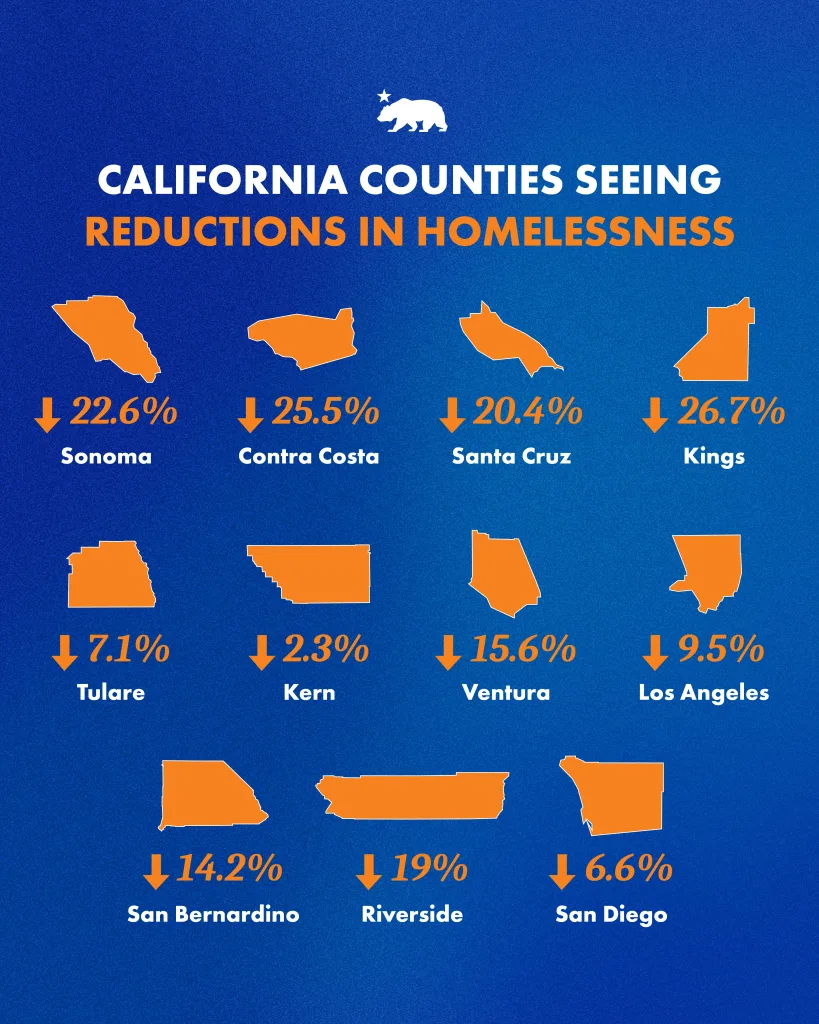
Los Angeles County reported a 9.5 percent decline in unsheltered homelessness, while the City of Los Angeles recorded a 7.9 percent decrease. San Diego County showed a 6.6 percent drop in total homelessness, and the City of San Diego reported a 13.5 percent decline. Riverside County reported a 19 percent decrease in unsheltered homelessness, while San Bernardino County saw a 14.2 percent drop. Sonoma reported a 22.6 percent reduction in total homelessness, Contra Costa reported a 25.5 percent decline, Ventura reported a 15.6 percent decline, and Watsonville/Santa Cruz reported a 20.4 percent decline. Other reductions include Bakersfield/Kern County at 2.3 percent, Kings County at 26.7 percent, and Tulare County at 7.1 percent.
State officials point to California’s investments in behavioral health, new housing, and supportive services as central to the progress. In 2024, voters approved Proposition 1, a $6.4 billion behavioral health bond that is funding new treatment settings and supportive housing for veterans and individuals experiencing homelessness. The measure also reformed the Behavioral Health Services Act to prioritize those with the most serious illnesses, expand services for substance use disorders, and increase housing supports.
The Newsom administration has also moved to modernize conservatorship laws for the first time in 50 years, expanding eligibility to include people unable to care for their own safety or medical needs due to severe substance use or serious mental illness. The state’s new CARE Court system provides court-ordered treatment and housing plans for people struggling with untreated mental illness, often compounded by substance use challenges.
In addition, California has enacted major reforms to speed up housing construction. Newsom signed into law a series of measures aimed at breaking down barriers to new housing development, including changes to the California Environmental Quality Act. For the first time, the state has made the creation of new housing a priority, embedding accountability measures for local governments that fail to meet their obligations.
The administration has also prioritized clearing encampments in ways it says are more humane and effective. After the Supreme Court affirmed local authority to remove encampments, Newsom filed an amicus brief in support and then issued an executive order directing state and local governments to clear encampments with notice and services attached. The state says this model ensures people are not simply displaced but connected to shelter and support.
Officials highlight that the early results mark a sharp contrast with national trends. In 2024, homelessness increased nationwide by more than 18 percent. California limited its increase to just 3 percent, a rate lower than in 40 other states. The state also kept the growth of unsheltered homelessness to less than half a percent, compared to a national increase of nearly 7 percent. Florida, Texas, New York, and Illinois all saw larger increases in both percentage and absolute numbers.
California also achieved the nation’s largest reduction in veteran homelessness last year and reported progress in reducing youth homelessness. Newsom’s office has argued that this shows California’s approach is not only stabilizing the crisis but beginning to reverse it.
The broader picture shows how decades of underinvestment and policy failures left California with the nation’s largest homeless population, particularly among unsheltered individuals. Between 2014 and 2019, before Newsom took office, unsheltered homelessness rose by approximately 37,000 people. Since then, California has slowed the growth significantly, even as other states have seen worsening trends.
The governor’s office has framed the contrast with federal policy as especially sharp under President Trump. As Trump has ordered National Guard members to conduct encampment sweeps without offering services, Newsom has pressed for a model that pairs encampment removal with shelter, treatment, and long-term housing. State leaders say the early numbers show that the latter approach is working.
With final HUD-verified data still months away, the early 2025 counts are not yet definitive. Still, for many local officials and advocates, the preliminary reports are a hopeful sign that California’s sustained investments in mental health, housing, and accountability are beginning to bend the curve of a decades-in-the-making crisis.
Follow the Vanguard on Social Media – X, Instagram and Facebook. To learn make a tax-deductible donation, please visit davisvanguard.org/donate or give directly through ActBlue. Your support will ensure that the vital work of the Vanguard continues.

“California’s Homelessness Rates Drop, Defying National Trend, Early Counts Show”
Because:
• Half the street people are in CA, so with so many easy to drop
• Cities are cleaning themselves up (SF cited 1100 people for illegal camping)
• Harm reduction is being seen as the sham that it is
• Police are acting again
Time for Davis to get with the times