
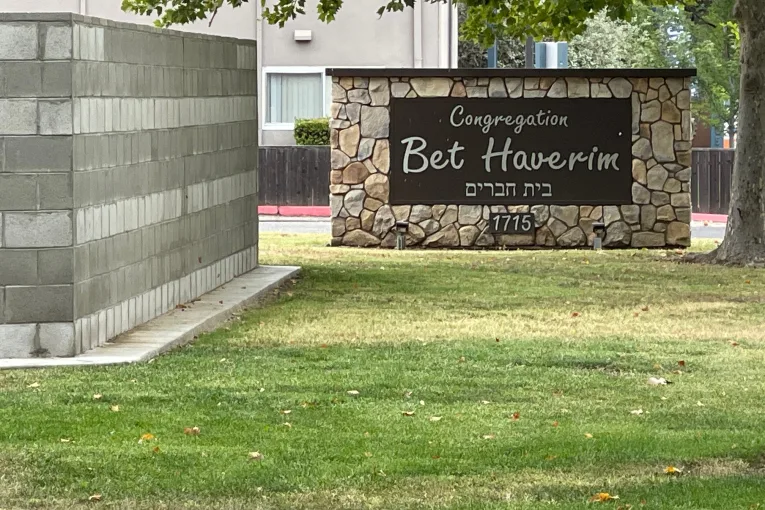
The “Days of Awe,” the Jewish High Holidays, begin Monday night, September 22. This ten-day period of introspection, repentance, and teshuva—a return to the authentic principles of mercy and goodness lost in day-to-day life—starts with Rosh Hashanah and ends with Yom Kippur, a fast day, on October 2.
Jewish redemption—release from the weight of past sins—has uniquely Jewish aspects:
We do not ask for a good afterlife in heaven, as Christians might, nor for release from the karmic cycle of suffering, as in Buddhism. Instead, we pray for sweetness here and now, in the new year. Our prayer is this-worldly: “Inscribe me in the Book of Life.”
Forgiveness is also communal. Jewish liturgy includes prayers where we each beat our chests and collectively confess to hundreds of sins, from adultery to slander to bribery. We ask forgiveness not only for our own wrongs, but also for those committed by other members of our community.
This collective dimension echoes the redemption of Passover, when God delivered the Israelites from slavery. We also recall God’s collective punishment in destroying the Holy Temple twice and sending us into exile. Today, the prayer for the State of Israel calls it the “first flowering of our redemption.”
But this year, Jews everywhere are struggling to spiritually metabolize media reports from Israel and to make sense of what it means to be Jewish after Gaza.
This year’s struggle with our collective Jewish responsibility marks a radical shift within a generation. According to polls, Jews in the U.S. were once considered the most respected religious group in America. In 2016, on the eve of Trump’s election, the Anti-Defamation League (ADL) reported the lowest levels of antisemitic belief in its history among a cross-selection of Americans, along with the fewest reported antisemitic incidents.
Now, two years into the Gaza war, it feels different to be Jewish. Jewish identity feels like it needs justifying, if not redeeming—especially for those who believe Zionism is integral to Judaism.
How do Jews metabolize reports of a humanitarian crisis in Gaza—where even former Israeli prime ministers and a former head of the World Zionist Organization have accused the IDF of war crimes, and multiple Israeli and international groups allege genocide?
For some, the dissonance is resolved by believing Prime Minister Netanyahu’s claim that media reports are fabrications driven by antisemitism. Even in Davis, a few Jewish leaders have argued that Hamas has a local network. This is the core of the film October 8th, promoted by local Jewish groups.
This global criticism of Israel aligns with a longstanding Jewish narrative: that antisemitism is the oldest, most enduring and widespread of bigotries. From this perspective, America in 2016—when antisemitism seemed at historic lows—was only an illusion. The world is now “returning to normal,” just as early Zionist thinkers from 1900 predicted. In their view, pluralistic democracies could never be truly safe havens for Jews. What better evidence than the international institutions created after the Holocaust to prevent genocide are now being turned against Israel.
And once you accept that mainstream media is pervasively printing “fake news” on a subject (Israeli war crimes) the internet is cunningly set up to help you curate your media diet to avoid upset.
Yet another spiritual response is emerging among mainstream rabbis and some Israeli leaders who are speaking out against the war. One of the earliest and most eloquent is Peter Beinart, an observant Jew who speak from within the tradition. As a former progressive Zionist, he writes:
“What Israel is doing in the name of the Jewish people is a desecration… The same principles that apply to them [pro-Palestinians] apply to us. If we’re going to question someone who says ‘globalize the intifada’ about their support for violence, we should also question the people who say ‘we stand with the IDF’ about their support for violence.”
A more ambivalent stance comes from a letter co-signed by my own Davis rabbi, Jeremy Simon, and written by leaders of Reform Judaism. This Zionist yet critical statement calls for Israel to take responsibility for humanitarian aid to Gaza, end settler violence against Palestinians in the West Bank, and halt Netanyahu’s annexation plans. It begins:
“The Jewish people face a grave moral crisis, threatening the very basis of Judaism as the ethical voice it has been since the age of Israel’s prophets. We cannot remain silent in confronting it.”
Meanwhile, Jews are fearful any public criticism of Israel could morph into antisemitism, particularly among those seeking simplistic black-and-white answers. They note many on the left lionize Arab culture, though much of the Arab world has struggled to create liberal democracies that protect human rights and diversity. Ironically, the political right is platforming a tiny group of left-wing anarchist accelerationists—people like UCD’s Cops Off Campus which portrays Israel as the ultimate symbol of the evil of Western Capitalism. It works for GOP, the right-wing media, and some Jewish defense groups to amplify this tiny fringe group. They spread fear and trauma among Jews—and then instrumentalizes this as a justification for the use of state power to defund the University and stifle free speech.
Most Jews will find themselves in the ambivalent middle—holding on to connection with Israel and its 7 million Jews even as they face the tragedy of Israel: its death as a source of pride and place of safety. This is what praying for Jewish redemption will mean for most during the Days of Awe.
Alan “Lorax” Hirsch can often be found handing out free “Love Your Neighbor” signs at the Davis Farmers Market on Saturdays. Alan is a member of Davis Congregation Bet Haverim but writes only for himself. He notes 81% of Bet Haverim partners express concern about Israel’s conduct of the war a survey by the Rabbis — a year ago,
Follow the Vanguard on Social Media – X, Instagram and Facebook. Subscribe the Vanguard News letters. To make a tax-deductible donation, please visit davisvanguard.org/donate or give directly through ActBlue. Your support will ensure that the vital work of the Vanguard continues.

I’ll have more to say on this later when I have time to unwind this twisted tale. But seriously, the photo should be changed. This implies visually that this is the the view of CBH, which it very much is not. That many Jews are critical of Israel or it’s government is not the same as supporting what is written in this op-ed. Please change the picture.
Alan Hirsch’s essay does not so much illuminate the meaning of the High Holidays as conscript them into a political argument. That is precisely the problem. The Days of Awe are not a stage for contemporary polemics about Israel and Gaza. They are a sacred period of self-examination, repentance, and renewal. To flatten them into a metaphor for one side of today’s political debate is to strip them of their depth and universal relevance.
Hirsch writes that “Jewish identity feels like it needs justifying, if not redeeming—especially for those who believe Zionism is integral to Judaism.” No, it does not. Jewish identity requires no justification. And Zionism is not an optional footnote to Judaism. Half the world’s Jews live in Israel. The State of Israel is inseparable from Jewish identity in the modern era, whether or not one supports every action of its government.
Even more troubling is the way Hirsch blurs fact and framing. He cites “a few Jewish leaders” in Davis who supposedly claimed that Hamas has “a local network.” That is a distortion. The reality is not that Hamas has some secret cell operating here, but that Hamas propaganda is being laundered through local organizations. That is true worldwide, but is an especially serious problem here in Davis with left-leaning politics mixed with the diverse student population all catalyzed by the extremely flawed campus leadership on this matter.
The misrepresentation extends to Hirsch’s description of the film October 8th, which he says is “the core” of this supposed narrative. In truth, the film was about how Jews felt after October 7, 2023—abandoned, demonized, and denied support by many in their own communities. To reduce it to a conspiracy theory about Hamas “networks” is false. If anything, it was Hamas-leaning propaganda that saturated Davis, as evidenced by three anti-Israel films shown at the very same theater that screened October 8th.
Hirsch also writes that “Jews in the U.S. were once considered the most respected religious group in America.” This framing itself is part of the problem. Jews are not simply members of a religion. Most Jews in America are not observant, and many are not religious at all. Judaism is a people, a civilization, a shared history and destiny. To keep reducing us to “a respected religious group” erases that reality and harms public understanding of who Jews are.
And finally, thanks (NOT!) for bull-horning Cops Off Campus by telling them they’re supposedly having a “fear and trauma” effect on local Jews. I doubt most Jews in Davis even know who they are. But you, not Mr. T, may have just emboldened the o’masked ones by inflating their relevance in your piece.
One can hold many views on Israel, and Jews certainly do. Some support the current government; some oppose it fiercely; many fall somewhere in between. But most share one basic conviction: Israel remains the home of half the world’s Jews and deserves to be treated with the same standard applied to any other state. To fold the holiest days of the Jewish calendar into a lecture about Israel’s supposed moral “death” is not only unfair, it distorts the very essence of the holidays. And it’s downright offensive.
If Hirsch wants to criticize Israeli policy, he is free to do so. But to dress that criticism in the language of repentance and redemption is to exploit the tradition rather than honor it. It’s as if Hirsch believes he has influence to guilt individual Jews worldwide into believing they should repent for what he himself believes is some collective Jewish sin that we are all responsible for. Not a chance! The Jewish calendar deserves better than to be reduced to a prop in a political op-ed.
This exchange happened in our local newspaper in response to my comments above:
AH say, “Mr Miller is usually first, and often only one commenting critically on what I submit to enterprise. The comments are negative even if authorship of document submitted under my signature is by a synagogue committee and the Rabbi approved its contents before publication. Please note, this piece is my own.”
ACM (me) say (note parts in quotes are quotes “” from AH above):
“Mr Miller is usually first, and often only one commenting critically on what I submit to enterprise.”
That incorrect attempt to paint me as the only one critical of your views dodges any attempt to address any of my points that address points in your article. I could also say “You are are often the first and only one to critically writing what you submit to the Enterprise.” These arguments lead nowhere.
“Please note, this piece is my own.”
Yes it is.
“The comments are negative . . . ”
My comments are critical of your article regarding what it is to be Jewish and the meaning of our High Holidays, and co-opting Judaism to fit your political agenda, which you clearly did. I could call your article negative as you called my comments negative . . . to what end? That does not further a conversation.
” . . . even if authorship of document submitted under my signature is by a synagogue committee and the Rabbi approved its contents before publication.”
There is nothing sacred about your congregation’s social justice committee nor in the signature a single rabbi. Jews revel in our diversity of thought yet our unity as a people (though I often wonder if antizionists share in the unity part). There are whole synagogues, worldwide, that would disagree with the opinion you presented. That doesn’t make it “right” or “wrong”. But stop trying to play false numbers and magic support games and just argue your points.