
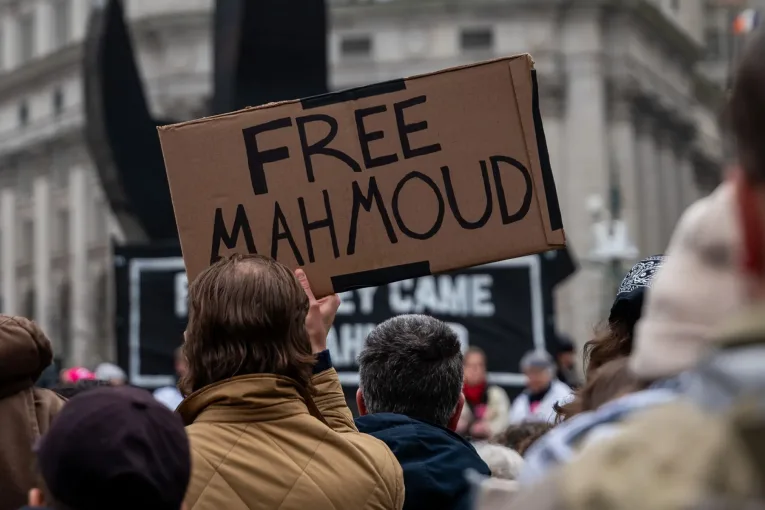
PHILADELPHIA, PA – The U.S. Court of Appeals for the Third Circuit heard arguments Oct. 21, 2025, in the case of Mahmoud Khalil, a Columbia University graduate and permanent resident who was detained by U.S. Immigration and Customs Enforcement for more than 100 days after publicly advocating for Palestinian rights. The case centers on whether federal officials unlawfully detained and attempted to deport him in retaliation for his political speech.
According to the American Civil Liberties Union, defense attorneys urged the appellate panel to uphold a lower court ruling that freed Khalil from custody and blocked future attempts to detain or remove him.
The government’s position relied on Secretary of State Marco Rubio’s statement claiming Khalil’s advocacy could “compromise a compelling U.S. foreign policy interest,” a justification that Khalil’s attorneys argue has no factual or legal basis.
“The Trump administration is still trying to bring me back to detention and block the federal court in New Jersey from reviewing my case,” Khalil said following the hearing. “They want to make an example of me to intimidate those speaking out for Palestine.”
Earlier this year, a federal judge issued a preliminary injunction preventing further detention, finding that Khalil would suffer “irreparable harm” if the government continued its efforts.
The court also found that Khalil was likely to succeed on constitutional grounds and determined he was neither a flight risk nor a danger to the community.
“Since day one, the Trump administration had no legitimate reason to detain Mahmoud Khalil—it was retaliatory and unconstitutional,” said Bobby Hodgson, assistant legal director at the New York Civil Liberties Union. “The law is on our side: in the United States, ideas are not illegal.”
Court records show Khalil was transferred to an ICE facility in Louisiana after his arrest, separated from his pregnant wife and attorney. He remained jailed for 104 days, during which his first child was born.
A magistrate judge has since eased restrictions on Khalil’s movements, now requiring only two days’ notice before he travels. The decision grants Khalil more flexibility as his case continues in federal court, but the larger question—whether the government can use immigration law to punish political advocacy—remains unresolved.
The Third Circuit’s ruling is expected to have implications beyond Khalil’s case, touching on free speech and due process rights for noncitizens nationwide.
Follow the Vanguard on Social Media – X, Instagram and Facebook. Subscribe the Vanguard News letters. To make a tax-deductible donation, please visit davisvanguard.org/donate or give directly through ActBlue. Your support will ensure that the vital work of the Vanguard continues.
