
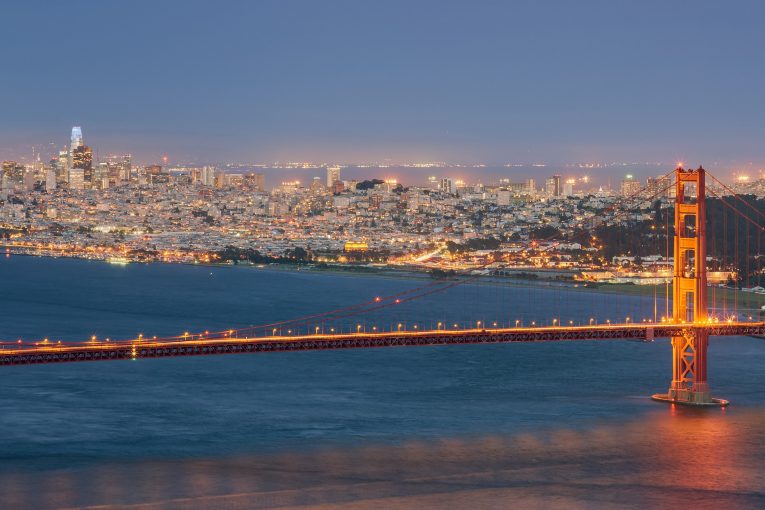
SAN FRANCISCO, CA – Dozens of community members joined the Golden Gate Bridge Board of Directors meeting last week, urging the board to withdraw its unprecedented $162,554 restitution claim against 26 Palestine solidarity protesters facing criminal charges for a Tax Day protest in 2024, according to a press release by the Golden Gate 26 Defense Committee.
The protesters, known as the “Golden Gate 26,” were arrested last April after allegedly blocking traffic on the Golden Gate Bridge to protest U.S. funding of Israel’s war in Gaza, according to the release.
San Francisco District Attorney Brooke Jenkins charged each protester with 44 counts, including conspiracy and false imprisonment, with seven of them facing felony conspiracy charges, the release said.
The Golden Gate Bridge District’s decision to seek restitution marks the first time in its history it has demanded financial compensation following a traffic disruption, the release added. The claim came after the San Francisco District Attorney’s Office and California Highway Patrol publicly urged commuters to file restitution claims following the protest.
According to the release, the restitution demand represents a dangerous escalation in the criminalization of protests, potentially setting a precedent for future charging decisions by the DA’s office in protest-related cases.
“It gives prosecutors undue leverage to turn charges that would typically be misdemeanors into felonies,” the release stated.
Supporters of the Golden Gate 26 have appeared at monthly board meetings since July 2024 to speak on the burden the restitution places on the defendants, the release said.
“These are incredible, caring community members who don’t deserve this financial hardship, especially right now, with massive cuts to federal programs,” said Lauren Sepin, as quoted by the release. Sepin further referenced growing economic strain, especially with the ongoing government shutdown and cuts to federal programs.
“This is a burden on us collectively, as we’re actively trying to make up for these cuts and other hardships that people are facing,” Sepin said. “Our communities are hurting right now, and it is not a time to put further financial burden on us.”
The release quoted another supporter, Angelo Wood, who said the restitution would devastate the defendants. “They’re already losing income, taking time off for court, sometimes multiple times a month. Dropping this restitution charge will allow the defendants to focus on holistic community building,” Wood said.
“The GG26 include some of the hardest-working people I’ve ever met. Within them are other educators—the kind students need—and they’re being withheld from their credentials due to these charges,” said middle school teacher and union vice president Opal Spencer, as cited in the release.
The release also highlighted labor voices who spoke in solidarity and were inspired by the Golden Gate 26’s actions last year.
Otis Nur, a third-generation San Franciscan and member of the Inlandboatmen’s Union, said his grandfather was a long-serving member of the bridge’s board. “When I heard the news of the action that the courageous demonstrators took on the bridge, and I heard the interviews with some of the folks who were in traffic being proud to be stuck in traffic for the cause of ending genocide in Gaza, that made my heart smile. Please drop the restitution,” Nur said, according to the release.
Jillian Tobin, a nurse and member of the National Union of Healthcare Workers, said the bridge district’s claim on the protesters is “inflated” and “directly fueling an excessive prosecution,” according to the release.
“As many people have pointed out, the money and the math do not line up,” Tobin said. “This was evidenced in the preliminary hearing when Judge Conroy stated that he could not reduce the charges because of this restitution. By insisting on this inflated restitution demand, you are forcing a full trial, which costs taxpayers far more than the claim itself,” Tobin added, as quoted by the release.
Following public comments, Director Amber Parrish directly addressed the crowd, acknowledging the hundreds who have spoken out in recent months, the release said.
“So many struggles for justice rely on civil disobedience to move this country forward. If we continue to criminalize that tradition, we risk silencing a generation of voices willing to stand up for what’s right,” Parrish said in the release.
“I hope that we respond in this moment with strength and a clear understanding that defending the rights of protest is a sacred responsibility that we all have,” she added.
The Golden Gate 26 are scheduled to appear in court on Nov. 7 at 9 a.m. for a restitution hearing that will determine how much, if any, the group must pay the bridge district, according to the release.
Follow the Vanguard on Social Media – X, Instagram and Facebook. Subscribe the Vanguard News letters. To make a tax-deductible donation, please visit davisvanguard.org/donate or give directly through ActBlue. Your support will ensure that the vital work of the Vanguard continues.

I love it that agitators are finally being held responsible for the damages they do.
This needs to happen more often.
Yes, I have no sympathy for those who choose to block transportation as a form of protest. I also have no respect for those not willing to take responsibility for the consequences they may suffer from protest that is not legal. There are plenty of forms of legal protest. If you choose to go beyond that, part of that must be that the cause is worth the consequences you must suffer. Today, lawyers argue the cause was righteous enough to allow the protestors to get off? What kind of BS is that?
I didn’t realize transportation was so sacrosanct. Effective protest almost always involves civil disobedience. MLK and Gandhi didn’t exactly stay within the law.
“I didn’t realize transportation was so sacrosanct.”
LOL, how d people get to their jobs and earn a living if their transportation is blocked?
How does an ambulance get to the hospital with a dying patient if some group blocks their way over some cause?
Yes it’s sacrosanct and those that block it should be held responsible.
DG says, “I didn’t realize transportation was so sacrosanct.”
It is. But the main point – being willing to take the consequences is more sacrosanct.
Not really. For example, when MLK led the Montgomery Boycott, there were legal ramifications for him. He didn’t sit back and accept them. That’s why we have the epic court case, ALabama v. MLK where Fred Gray earned his reputation defending him.
If a patient being transported in an ambulance were to die because they were stuck on the Golden Gate Bridge do to it being shut down by some protesters I think they should be charged with murder.
The thing about civil disobedience is the idea that you break a minor law and accept the consequences in order to highlight a greater injustice. While the monetary fines seem like an escalation compared to protest of the past I think the DA is sending a message that blocking traffic on the Golden Gate Bridge will no longer be tolerated as a simple protest. It will be interesting to see but my guess is that some attempt at issuing hefty fines will change the tactics of protesters going forward.
Exactly.
Except for this cause, because it is so righteous :-|
“The thing about civil disobedience is the idea that you break a minor law and accept the consequences in order to highlight a greater injustice”
The problem with this as written is that you seem to be using the term “accept” as a synonym for concede. As I said before, MLK never conceded legal sanctions – he fought them all the way through. He did accept legal risk, but not the outcome.
DG say, “The problem with this as written is that you seem to be using the term “accept” as a synonym for concede.”
I do not “accept” your conclusion.
DG, I just can’t agree with your normalizing the character of modern protestors to those of King. The difference between civil disobedience in the era of King and what we see today is the moral seriousness of those involved. King and his peers knew that defying the law meant arrest, trial, and punishment. They saw that acceptance not as surrender but as testimony to conviction. They risked prison, beatings, and worse to expose injustice, not to inconvenience commuters or demand immunity from consequence. The integrity of their protest was bound to their willingness to endure lawful penalty, not to evade it.
By contrast, modern activists confuse inconveniencing the public with making a causal impact on the public. Their righteous certainty erases any civic responsibility. They try to block highways, rail lines, and bridges with little regard for the public’s safety or freedom. Then they treat their arrest, when it happens, as proof of persecution rather than the result of their chosen protest means. That is not courage; that is entitlement. Their civil disobedience is a spectacle, not an act of conscience. Protest should be measured by a willingness of protesters to sacrifice, not by how loudly they can whine.
It’s not an equivalency, it’s a tactic.
” King and his peers knew that defying the law meant arrest, trial, and punishment.”
Not to mention violence and potential death. But they also didn’t concede any of it. One of the unsung heroes was Fred Gray, who defended King in the Albama v. MLK case. I don’t see that case as that different from some of the protest cases I’ve covered in court recently. There was a lot of prosecutorial overreach in the MLK case and there was in several of the recent cases.
At the end of the day, I think you just view this as different because of the issue which I get, but is not really the point.
From article: “Supporters of the Golden Gate 26 have appeared at monthly board meetings since July 2024 to speak on the burden the restitution places on the defendants, the release said.”
(My condolences to them – written in the same manner as if I was working for the Babylon Bee).
(I’d love to be on a jury regarding something like this – especially when I hear an “argument” like that one.)
From article: “The GG26 include some of the hardest-working people I’ve ever met. Within them are other educators—the kind students need—and they’re being withheld from their credentials due to these charges,” said middle school teacher and union vice president Opal Spencer, as cited in the release.
(Seems like they might need to get different careers anyway, to pay off their debt. Plus, are these the type of people you want teaching your kids?)
As I recall, these people chained themselves together (and to stopped vehicles) to make it that much harder and more-expensive to remove them.
They are essentially saying “fu” to the public.
How is it that when someone gets lost in the wilderness, they sometimes get charged for the cost of rescuing them. But the people who break the law ON PURPOSE don’t get charged with the cost of responding to the situation that they created?
Generally protesters are just dispersed and don’t face significant charges. Just for a local angle….
“In this 1972(?) Aggie article, [councilmember and later mayor Bob] Black is the most prominent member of a group of 50 Davisites arrested for protesting the Vietnam war. They shut down I-80 for 20 minutes, and when dispersed by the highway patrol they shut down the Southern Pacific Railway. The Aggie covered the events in good detail, and offered clear rationale for the protests to help general readers sympathize with the cause — “Remember, it’s everybody’s war when the bomb falls.””
https://localwiki.org/davis/Bob_Black
DG, “ . . . I think you just view this as different because of the issue . . . “
Honestly I forgot what the issue was. But I have alway viewed blocking transportation as an insanely stupid tactic — from the ***** who tried to block the SP tracks in Davis in the 60’s to protest Vietnam, to the guy run over
by a train at the weapons station east of Concord, to the ***** who tried to block Caltrain, to the woman killed in Oakland (I think?) protesting on the freeway and hit by a car, to the Davis students who spilled out an onramp onto I-80 and tried to stop cars and block the freeway.
I fully encourage all efforts to discourage blocking transportation as an ‘acceptable’ form of protest. To heck with the inconvenience factor, the blocked emergency vehicles is reason enough, but the fact that someone could be killed, especially as the blockade starts, is more than enough reason.
As to King, what I don’t think you may understand — because you weren’t alive at the time, and no matter how much you have read — is the depth of the intensity that we all felt in the 60’s. Yes I was a child, but I was very politically aware as my siblings were over a decade older than I and my entire family were highly concerned with the civil rights issue with some I’d call activists. This wasn’t about systemic and generational wealth issues, which I do agree are issues — I think you and I just highly vary on how those should be handled. Back then government laws themselves discriminated against the black population of the south. It was freaking dark to a level maybe today is hard to comprehend.
I hope the SF DA sticks to her guns and holds the protesters accountable.