
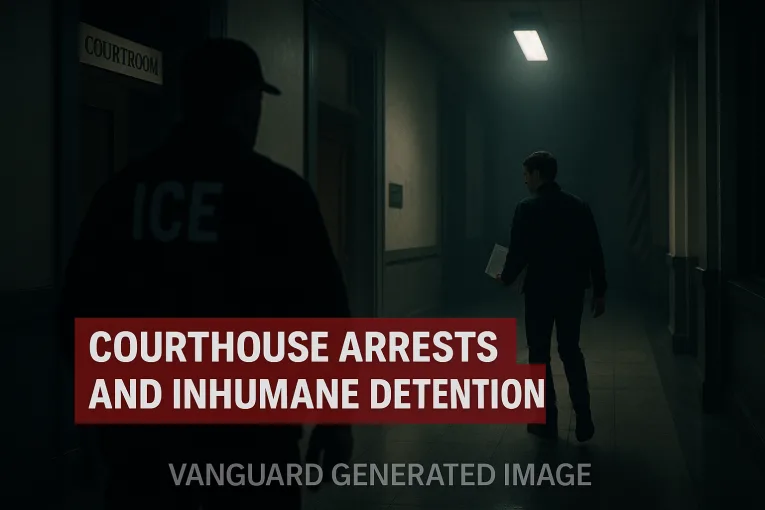
- “The administration is using courthouses as bait for immigrants seeking asylum and dragging them to a makeshift jail as punishment, despite them engaging in no wrongdoing whatsoever.” – Marissa Hatton, senior staff attorney at the Lawyers’ Committee for Civil Rights of the San Francisco Bay Area
SAN FRANCISCO — Immigrants’ rights legal organizations and their pro bono partners have filed two new motions in federal court, seeking to stop what they call the Trump administration’s unlawful and inhumane immigration enforcement tactics. The filings, part of a broader class-action lawsuit, challenge the administration’s recent reversal of policies that for decades protected immigrants from arrest while attending their own court hearings and from being held in unsafe detention conditions.
The first motion, filed Thursday, asks the court to stay a Trump administration directive that allows Immigration and Customs Enforcement officers to arrest people in and around immigration courthouses. The second, filed October 10, targets the agency’s decision to detain immigrants overnight in holding cells at its San Francisco Field Office, a facility at 630 Sansome Street that was never designed or approved for extended confinement.
Together, the motions argue that the administration’s actions violate both the Administrative Procedure Act and the Constitution’s guarantee of due process by abruptly reversing long-standing practices without public explanation, public comment, or consideration of the human impact.
For decades, federal immigration agencies had maintained a bipartisan practice of abstaining from civil arrests at courthouses, recognizing that courthouse arrests could deter people from appearing in court and undermine the justice system itself. That policy was formally codified in a 2021 Department of Homeland Security memorandum and an accompanying policy from the Executive Office for Immigration Review. Both were rescinded by the Trump administration in January 2025, shortly after the inauguration.
Within weeks, according to the plaintiffs, ICE officers began conducting courthouse arrests at an alarming rate, transforming immigration courts into what lawyers described as “traps” for those following lawful orders to appear.
In Northern California alone, declarations filed with the court report that at least 75 people have been arrested outside the San Francisco immigration court and another 39 outside the Sacramento court since May. Across the country, researchers estimate that ICE has made more than 2,300 courthouse arrests since the policy change took effect in the spring of 2025.
Many of those arrested, attorneys said, are asylum seekers or people previously released by immigration authorities on supervision, whom the government had already determined were not flight risks or public safety threats. According to the filings, ICE is now re-arresting those same individuals—often without notice, hearings, or any new evidence of risk—immediately after their scheduled court appearances.
The plaintiffs argue that the new policy forces noncitizens to choose between two unacceptable outcomes: appear in court as ordered and risk arrest, or stay home and face automatic deportation orders in absentia. The result, attorneys said, has been a sharp increase in absenteeism and chaos in immigration courts, undermining the very purpose of the system.
In San Francisco, one attorney reported that before the new policy, only a handful of people would typically fail to appear for hearings on any given docket of 20 to 30. Now, it is common for only one or two individuals to appear, with the rest ordered removed in their absence.
The October 10 motion focuses on what attorneys describe as “inhumane and unlawful” detention conditions at ICE’s 630 Sansome Street Field Office, where immigrants arrested at courthouses are routinely held for days. The facility, which was designed for brief 12-hour detentions, is being used to jail people for up to 72 hours or longer.
Court declarations describe conditions that include sleeping on cold metal benches or the floor near open toilets, exposure to bright lights kept on 24 hours a day, and being given only thin Mylar blankets for warmth in freezing temperatures. Detainees are denied access to showers, clean clothing, hygiene products, and adequate food. Medical care is virtually nonexistent. One plaintiff, Martin Hernandez Torres, reportedly suffered a hypertensive crisis and possible stroke after being deprived of his prescribed blood pressure medication.
The motion contends that these practices are arbitrary and punitive, violating the Fifth Amendment’s Due Process Clause and the Administrative Procedure Act. The plaintiffs say that ICE’s waiver of its own 12-hour detention limit was done without explanation, oversight, or any consideration of the foreseeable harm to those affected.
The case, Pablo Sequen et al. v. Albarran et al., filed in the U.S. District Court for the Northern District of California, is being brought on behalf of asylum seekers and others who were arrested after attending their immigration hearings and subjected to conditions at the San Francisco facility. The plaintiffs are seeking class certification to represent all similarly situated immigrants facing the same risks nationwide. A hearing on class certification is scheduled for Oct. 30 before a federal judge in San Jose.
Marissa Hatton, senior staff attorney at the Lawyers’ Committee for Civil Rights of the San Francisco Bay Area, said the administration’s policies weaponize the courthouse itself.
“The administration is using courthouses as bait for immigrants seeking asylum and dragging them to a makeshift jail as punishment, despite them engaging in no wrongdoing whatsoever,” Hatton said. “With these motions for preliminary injunction, we are asking the Court to stop ICE from using the courthouse as a trap and to immediately address the inhumane conditions inside the cells at 630 Sansome while our case moves forward.”
Lauren Davis, legal fellow at the ACLU of Northern California, said the administration is targeting people who have done everything the law requires of them.
“ICE is targeting immigrants who have followed the rules while they lawfully pursue an opportunity to stay in the country,” Davis said. “We are asking the court to end the administration’s illegal policy so that people can attend their mandatory court hearings without fear of being arrested and detained.”
Laura Sanchez, litigation director at the Central American Resource Center of Northern California, said the arrests are an affront to basic human dignity.
“Our clients followed the rules, appearing in court as the government ordered, only to be ambushed and then subjected to conditions that no human being should ever endure,” Sanchez said. “The law requires more than this. It requires basic human dignity, and we are confident the court will agree that these practices cannot continue.”
Mark Hejinian, a partner at Coblentz Patch Duffy & Bass LLP, which is serving as co-counsel in the case, commended the plaintiffs for their courage.
“The courage of our plaintiffs in the face of such calculated hardship is a beacon for all of us,” Hejinian said. “They are not just seeking relief for themselves, but for thousands of others. Their bravery is a powerful reminder that dignity is not a privilege but a right that cannot be waived by any government memo. We stand with them in demanding justice.”
The plaintiffs’ legal team argues that both ICE and the Executive Office for Immigration Review acted unlawfully in abandoning their prior policies. The motion notes that neither agency offered a reasoned explanation for the change or considered the widespread reliance interests of noncitizens who had trusted that they could safely appear in court.
Lawyers also pointed out that the policies directly contradict the government’s own mission statements. The Department of Justice, which oversees EOIR, previously stated that civil enforcement actions in courthouses risked “impairing the fair administration of justice.” Similarly, DHS had warned in its 2021 memorandum that courthouse arrests could “chill individuals’ access to courthouses” and “unnecessarily impinge upon the core principle of preserving access to justice.”
By discarding those findings, the plaintiffs contend, the administration not only ignored its own prior reasoning but violated administrative law requirements to engage in reasoned decision-making.
The motions request that the court immediately halt both the courthouse arrest policy and the detention practices at 630 Sansome Street while the case proceeds. They argue that without court intervention, countless immigrants will continue to face unlawful arrest, detention, and suffering for merely attending their required hearings.
If granted, the injunctions could restore decades of precedent protecting courthouse access for immigrants and require ICE to cease overnight detentions in temporary holding cells. The plaintiffs say these steps are essential to preserve due process and basic human rights.
The case is being led by the Lawyers’ Committee for Civil Rights of the San Francisco Bay Area, the Central American Resource Center of Northern California, the ACLU Foundation of Northern California, and the law firm Coblentz Patch Duffy & Bass LLP.
Follow the Vanguard on Social Media – X, Instagram and Facebook. Subscribe the Vanguard News letters. To make a tax-deductible donation, please visit davisvanguard.org/donate or give directly through ActBlue. Your support will ensure that the vital work of the Vanguard continues.
