
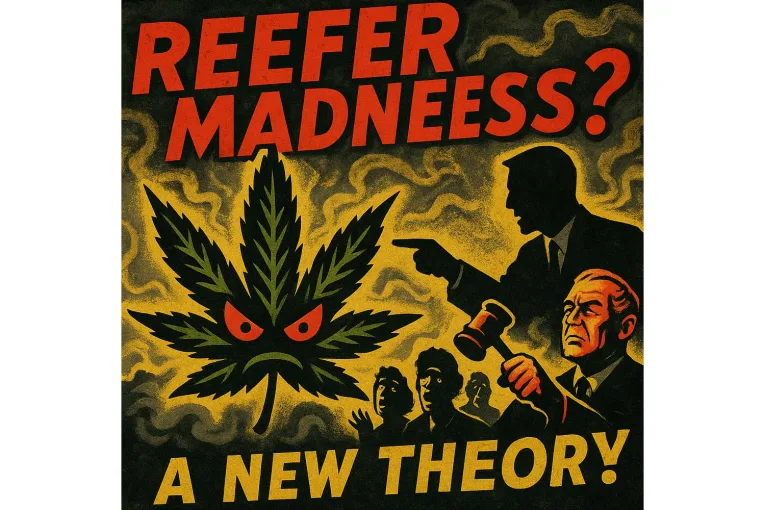
WOODLAND, Calif. — After more than a year of litigation, thousands of pages of psychiatric records, and a mistrial, the Yolo County District Attorney’s Office has rolled out a brand-new theory in the prosecution of Carlos Reales Dominguez — and it’s one that feels less grounded in science than in stigma and desperation.
At a Thursday hearing, prosecutors argued that Dominguez, accused of killing two people and seriously injuring another in Davis in April 2023, may have been suffering from cannabis-induced psychosis rather than schizophrenia. The theory was presented by Assistant Chief Deputy District Attorney David Wilson, who told the court, “The defendant was purchasing high THC value, meaning above 10% products, for months, if not years, prior to the events in question. Those high THC materials lead to psychosis.”
Judge Samuel McAdam immediately called attention to the abrupt pivot. “This is an entirely new theory for the people?” he asked.
That question lingers — loudly — because nothing from the first trial or the extensive psychiatric record suggests that cannabis played a meaningful role in Dominguez’s mental state. In fact, the defense reminded the court that the overwhelming weight of medical evidence points in another direction.
“No less than eight psychologists and psychiatrists have diagnosed Mr. Dominguez as suffering from schizophrenia,” attorney Dan Hutchinson said. “He still suffers from the negative symptoms of schizophrenia, which of course we saw throughout the trial, which he still suffers from to this day.”
Eight mental-health professionals. Independent exams. Court-ordered evaluations. Long-term treatment. Antipsychotic medication. And yet, more than a year into the case — after a mistrial — the prosecution is suddenly arguing marijuana as the driving factor?
The prosecution acknowledged reviewing more than 8,000 pages of discovery and admitted the theory was never meaningfully raised during the original proceedings. Wilson told the court, “In my review of the 8,000 pages of discovery and much of the reports… is that it was touched upon, but more or less ignored.” When pressed on why it was ignored, he said he didn’t know.
That admission matters, because at this stage, this doesn’t look like science — it looks like scrambling.
Cannabis-induced psychosis exists, but documented cases remain rare, typically acute, and short-lived. It is not a substitute diagnosis for schizophrenia and is not treated as a causal explanation for long-term psychotic disorders already confirmed by multiple clinical experts. And prosecutors are not pointing to a measurable psychiatric evaluation, a treating doctor, or new evidence — only receipts showing high-THC purchases and a theory.
Instead of persuading, the strategy reinforces a familiar trope: blame the drug, not the disease. The idea that cannabis — even strong cannabis — predictably triggers violent psychosis is not supported by current medical consensus. Yet it is politically convenient. It evokes fear. It avoids acknowledging the harder, uncomfortable truth: a severely mentally ill former student slipped through institutional cracks long before violence occurred.
Judge McAdam denied the motion, noting, “The defendant has been treated for schizophrenia for over two years. He’s been in custody, and he’s been on psychotropic medication as part of his treatment. His circumstances for an evaluation now are dramatically different.”
That ruling is grounded in reality. The new theory is not.
With jury selection approaching and public pressure mounting, the DA’s late-stage shift looks less like a breakthrough and more like an attempt to reframe a case they struggled to win the first time.
There is a difference between building a case and reinventing one.
The people of Davis deserve answers, not theatrics. The victims’ families deserve the truth, not shifting narratives. And the jury deserves a trial based on evidence — not recycled Reefer Madness mythology.
Tags:

“OPINION: ARE THESE GUYS INSANE? ”
In my OPINION your headline is classless and over the top.
Ok
Maybe tasteless but not unreasonable. Reisig has a long history of being anti-weed.
I don’t get what the point of this gambit was? What difference does it make for the upcoming re-trial?
They are trying to create a theory where there is no insanity defense, the problem they have is that eight psychologists have determined he has schizophrenia and that’s going to make their theory difficult to maintain, especially since they don’t yet have expert backing.
The judge ruled it out so isn’t it dead?
Unless they can produce an expert that can convince the judge it’s viable.
Honestly they should concede insanity and simply institutionalize him.
Honestly, I disagree. They should take a second bite at that apple.
So maybe “THESE GUYS” aren’t insane, I did a Google search and found this:
“Beyond the “high” associated with marijuana, many users report paranoia or hallucinations while under the influence. This is due to the active component, Tetrahydrocannabinol (THC). THC binds to receptors in the brain and triggers a series of reactions in brain cells. Typically, these effects fade after the high wears off, but in some cases, they may last longer, leading to what’s known as cannabis-induced psychosis.
In high-risk individuals, cannabis can disrupt brain development and lead to conditions like schizophrenia”
https://medicine.yale.edu/news-article/behind-the-smoke-unmasking-the-link-between-cannabis-and-schizophrenia/
That’s not the point, the point is that they have a theory with no evidence that they brought up two months before a retrial when they have eight medical experts saying its something else.
Isn’t it schizophrenia either way?
No. And it matters legally
Does it matter, though? Maybe, in regard to where he ends up.
It seems to me that almost all crime might have an element of mental illness. Maybe that’s what greed, hatred, envy, etc. – actually is. (Not a comment regarding this particular individual.)
Where are his parents in all of this, by the way? They had no idea that Johnny was having problems (adult, or not)?
Yes, it matters whether he ends up being a prison or a mental hospital. Legal insanity has a very specific definition, and it goes to the issue of culpability.
Truth be told, I think what matters more is how it impacts potential “stab-bees”, more than the “stab-ber”.
But (even on my worst days), I never felt like stabbing strangers with no provocation. So, I’m going to assume that I don’t have this guy’s particular affliction.
Again, where are his parents in all of this? They had no idea that their own son was nuts?
(See, that’s one of the areas where you and I differ. You think it’s society’s responsibility to address this, while I think the first line of “defense” so to speak are the kids’ own parents. At least, most of the time.) And that goes for semi-adult kids as well. Didn’t you say that young people’s brains don’t fully develop until their mid-20s?
The parents just sent this kid off to UCD, in hopes for the best?
Did they not keep in contact with him, while attending UCD?
It seems that there was an overall failure to recognize how far down the road of mental illness. He went before anyone intervened. You mentioned his parents, but his parents weren’t necessarily the closest people to him at that point.
That said, I think trying to situate yourself in this is not particularly helpful
If his parents weren’t (still?) close to him, that’s already indicative of a problem regarding the family.
Again, I think this (in general) shows a fundamental difference between how I view situations, vs. how you view them.
How old is this guy? (I haven’t looked it up.) His mental illness just “suddenly appeared” while at UCD?
Again, I’m not so sure there’s a difference between “run-of-the-mill” criminal activity, vs. formal mental illness. Both require sociopathic behavior, and a lack of empathy toward others.
He was an adult and not living at home, doesn’t seem reasonable to put an undue burden on them as opposed to the people that were actually interacting with him, including presumably professionals at the university. Regardless, this goes way a field from the issue in this article. It’s also not particularly relevant to the issue of whether or not he was insane at the time that he committed these crimes.
Again, a difference regarding how you view situations, vs. how I view them.
I went through my entire college experience without being “close to anyone” regarding university staff/faculty – or expecting anything of them other than providing me with an education, so to speak.
In fact, I viewed their role as being similar to that of a supervisor (e.g., can I “do the job”). Essentially, practice for the working world. (The purpose of the grading system itself.)
In contrast, my parents cared about me for as long as they were alive, and didn’t say “good riddance” when I left home. (Well, maybe they did sometimes, at least.)
But for sure, parents are usually the only ones who “permanently” care about their own kids – if they’re doing their “job” (probably human instinct). Even more so than spouses (given that half of marriages end in divorce).
For sure, my former professors never followed up with me (even while IN college) to see “how I was doing”.
Seems rather unreasonable to expect “society” to care more about someone, then their own parents (who brought them into the world in the first place). And if not unreasonable – certainly unrealistic.
What does this have to do with legal insanity, mental illness, and schizophrenia?
Regarding what it has to do with mental illness, parents are the first line of defense (for their own children, as well as society itself – regarding the individual that THEY brought into the world.)
At the very least, one might think that they’d at least know what’s going on with their own offspring (minor or adult).
And that’s true for ALL of the crimes that their own offspring inflict upon others, even if they’re able to “wash their hands” of legal responsibility at age 18. (Though truth be told, the parents of most criminals wash their hands of responsibility for the actions of their own kids starting on the day they’re born.)
But again I ask – this young man showed NO SIGN of mental illness before becoming (estranged?) from his own parents? Just woke up one day, and decided to start stabbing strangers?
Are his parents showing up in the courtroom, at least?
And why would “I” particularly care what happens to this individual, if his own parents don’t?