
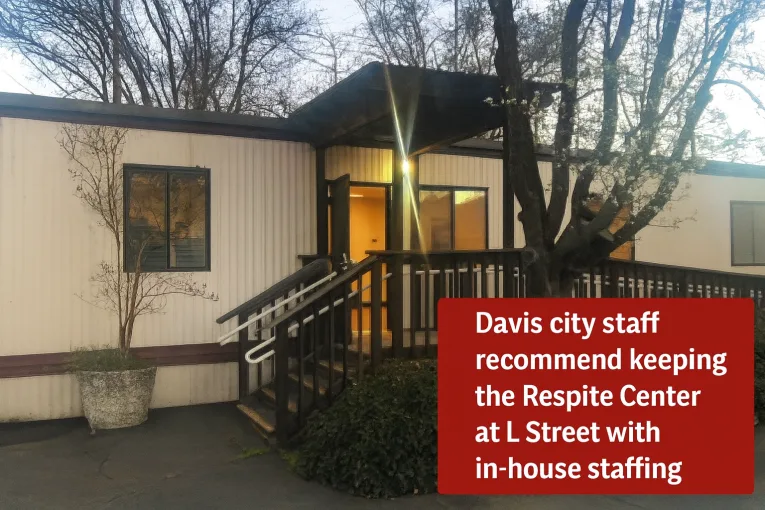
DAVIS, CA — City staff are recommending that the Daytime Respite Center continue operating at its current location on L Street and transition to an in-house staffing model rather than contracting with an outside provider, according to a comprehensive homelessness system update prepared for the Davis City Council.
The recommendation follows the sudden shutdown of Downtown Streets Team operations in October and weeks of testimony from service providers, housed residents, and unhoused individuals urging the city not to allow another service interruption.
The staff report details steps taken to keep the center open during the transition, including the temporary hiring of two former Downtown Streets Team employees to maintain daily operations and client access. The report states that the center is functioning with stable hours and consistent service during the interim period.
While the city evaluated several other potential sites for relocation, including facilities owned or managed by the city, the review concluded that each alternative presented greater operational, physical, or neighborhood impacts than remaining at 530 L Street. The report notes that relocating the program would likely result in a service gap, increased costs and additional challenges.
In addition to recommending the site remain unchanged, staff are urging the city to move away from the contractor model and instead establish two new permanent full-time city positions to run the center. The proposed in-house staffing structure is projected to cost $505,534 per year. Staff emphasize that the cost is already covered under the current budget allocated for homelessness services and write that the in-house option is the lowest-cost approach that maintains existing service levels.
During the September council meeting when the shutdown was first discussed publicly, several councilmembers expressed concern about the possibility of the center going dark.
Councilmember Josh Chapman said, “We can’t let this center close without a plan. This one is right in front of us. Other issues like detox and mental health take time, but the respite center is immediate and within our control.” His remarks reflected pointed frustration about both the suddenness of the closure and the lack of redundancy built into the city’s homelessness response structure.
Councilmember Gloria Partida focused on the fragility of relationships between the city and people experiencing homelessness.
“If we allow a gap in service, we will lose that trust, and rebuilding it will take years,” she said. Her comments underscored a theme echoed by many frontline service providers, who described consistent staffing as critical for outreach and case management to succeed.
Mayor Bapu Vaitla said the public response demonstrated the importance of the facility. “This is a lot. We heard directly from residents, from service providers, from case managers. The message is clear — this center matters, and we have to find a way forward,” he said.
Public testimony included comments from individuals who use the center regularly. One unhoused resident said the program served “40 to 70 people a day who rely on it for mail, medications, case management, showers and a safe place to be.” Another said the center was “one of the few places where people can get food, showers and clean clothes.”
After the meeting, the city issued a Request for Proposals seeking a new operator. Three organizations submitted qualifying proposals: Volunteers of America, The Gathering Inn and Yolo County Children’s Alliance. These proposals ranged from approximately $367,000 to nearly $880,000 in estimated annual operational costs. The wide cost range reflected differences in staffing models, programming structure and administrative frameworks.
Despite receiving multiple qualified bids, the staff analysis leans toward internal operations due to cost predictability, staffing stability and alignment with long-term goals.
The report states that bringing the program in-house “adds case management capacity directly to the City’s homelessness portfolio” and ensures consistent program culture, recordkeeping and service delivery over time.
While third-party operators may offer specialized expertise, staff noted that contract providers can exit suddenly, which is what occurred with Downtown Streets Team.
The staff report also rejects assigning the city’s Homeless Outreach Team to run the site. The report states that such a shift “would substantially reduce the City’s capacity to respond to community-based homelessness-related service calls” and would likely result in more responses handled by police or delayed service contact. Outreach workers spend the majority of their time in the field, working directly with individuals living outdoors or in vehicles.
The report says, “On average, it takes at least eight to ten field contacts before outreach workers garner enough of a person’s trust for them to be willing to accept services.” Removing the team from that role, staff argued, would undermine progress.
City records show 90 outreach contacts in September and 87 in October. Outreach staff offered referrals to behavioral health services, shelter placement, veteran services, public benefits, transportation, and medical support during those interactions. The report states that while the path from contact to engagement is not linear, proactive outreach prevents crises and reduces reliance on emergency and law enforcement responses.
The broader staff update outlines other homelessness programs funded by the city, including the temporary winter shelter motel voucher program, Paul’s Place emergency beds, peer navigation services and coordinated entry partnerships. The report highlights that the city’s homelessness investments attempt to balance short-term crisis response with longer-term stability efforts.
The report also warns that the funding landscape is shifting due to state and federal changes. Proposition 1 implementation will overhaul behavioral health funding and may reduce regional services tied to prevention and general community support.
At the federal level, proposed changes to housing voucher structures and time limits may affect long-term housing placement. The report notes that Yolo County may face a multimillion-dollar shortfall as a result of these reforms, which could reduce or eliminate services currently funded externally.
City staff conclude their report by reiterating the recommendation that the council maintain the current Respite Center location and adopt the in-house staffing model unless directed otherwise.
The report ends with the statement, “The concerted efforts of our local government, community organizations, and citizens are fundamental to creating a supportive environment for those in need.”
Follow the Vanguard on Social Media – X, Instagram and Facebook. Subscribe the Vanguard News letters. To make a tax-deductible donation, please visit davisvanguard.org/donate or give directly through ActBlue. Your support will ensure that the vital work of the Vanguard continues.

The City of Davis must be crushed underfoot like a stinkbug ¥€¥
Metaphorically speaking of course :-|