
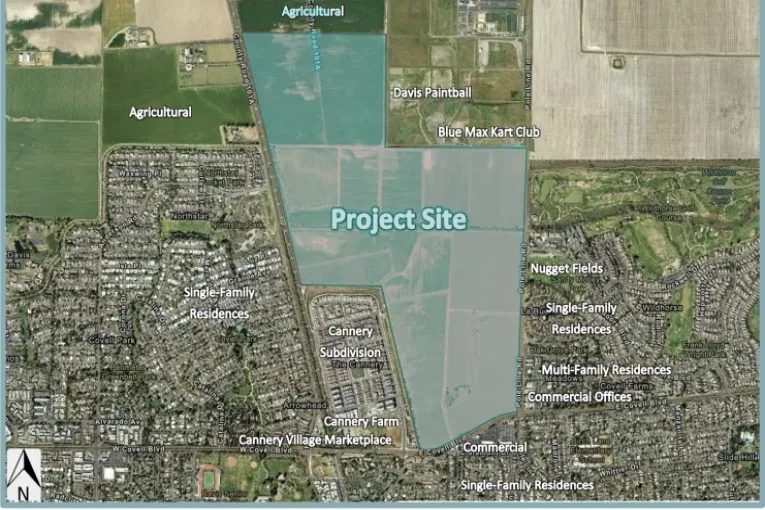
DAVIS, Calif. – In a meeting that stretched late into the night and featured hours of questioning, legal clarification, public testimony and commissioner debate, the Davis Planning Commission voted 5–2 to recommend the City Council certify the Village Farms Environmental Impact Report and move the proposed 1,800-unit development toward a June 2026 ballot measure.
Commissioners who supported the motion framed their votes through the lens of long-term housing needs and demographic concerns.
“We need housing. We’re about to close schools. We need housing. That’s the problem,” Catherine Brinkley said.
Commissioner Vince McLaughlin also described how his view shifted after reviewing mitigation efforts and hearing public comment, stating, “I hated it at first and now I like it… I’m satisfied that a lot of the environmental concerns that I had seemed to be mitigated adequately.”
The vote came after commissioners wrestled with an unusual procedural situation: they were asked to recommend certification without having reviewed a final EIR, baseline project features document or completed development agreement. The City Attorney told the commission state law allows a recommendation based on a draft document because the City Council, not the commission, is the body that certifies the EIR.
City Attorney Inder Khalsa said, “The legality of a planning commission recommending certification of an EIR based on a draft to me is not in doubt.”
She added, “It is the city council that certifies the EIR and planning commission is just making a recommendation.”
Khalsa also told commissioners that timing was a decisive factor. He explained that the ballot calendar limited the opportunity to return with a final EIR before the measure could be noticed for the June election.
“This is the very difficult mathematical exercise that your staff has been engaged in attempting to find, thread a needle here in which this project can make it to the June ballot. Bluntly, we do not have a lot of flexibility at this time,” she said.
The vote occurred after multiple motions, including an effort by Commissioner Catherine Brinkley to recommend that the City Council pursue the environmentally superior “higher number of units, same footprint” alternative identified in the EIR, which she noted would reduce per capita VMT and better align with long-term fiscal goals.
Brinkley referenced the EIR language stating that “for this project where the impact on per capita VMT is considered a priority issue, the environmentally superior alternative is the higher number of units, same footprint alternative,” and asked staff whether pursuing that alternative would trigger recirculation or additional CEQA analysis.
That motion was voted down.
Brinkley then offered an alternative motion to recommend a similar density with a smaller footprint, which also failed. She explained her rationale by arguing the commission should use the EIR to pursue stronger climate and fiscal outcomes.
“What I’m trying to do is use the EIR to make recommendations to city council that wouldn’t trigger recirculating the EIR, but would allow city council to negotiate with a developer for higher density,” she said.
Brinkley ultimately voted yes on recommending certification, she said, “This is the last chance for city council to negotiate with the applicants for a project that they think is going to be the strongest project to put in front of voters.”
Commissioner Greg Rowe cast the other dissenting vote, citing flood hazards, incomplete documents and concerns he argued could undermine public safety.
He said, “I am concerned that we don’t have a final baseline project features document to go over. Typically, in the eight years I’ve been on this commission, eight years as of this month, we’ve got those baseline features when it reaches us. This is a really unusual situation.”
Rowe argued that the project site in the northern portion of the parcel posed unacceptable risks. He referenced scientific literature and historical flooding. “I’m going to be voting against the EIR. I’m voting against the project because I just think it’s nuts to build, even remotely think about manipulating the landscape to this degree,” he said.
He concluded, “We’re putting the lives of too many people at risk,” citing the prospect of severe storm events intensified by climate change.
In contrast, commissioners who voted yes expressed discomfort but said the city’s housing needs outweighed procedural concerns. One commissioner said they would “vote to recommend this to city council as long as we make the appropriate caveats about not having final documents,” emphasizing the need to bring families and younger households back into the population mix.
Several commissioners said their votes reflected not project perfection, but ballot timing. The commission was told that a January meeting could jeopardize the June vote. That constraint fueled the majority’s view that voters, rather than commissioners, should have the final say.
Chair Michelle Weiss captured that sentiment when she stated that commissioners could vote yes or no based on their views of the draft documents, adding, “You either don’t like this project, which is fine. Then you say, no, I don’t like this project because it’s not meeting these goals.”
Public comment during the meeting and through voicemail was overwhelmingly in support of sending the project to voters.
One caller said, “Please keep the process on schedule. Recommend approvals to the city council and let the voters decide.”
Another said the project addresses affordability and long-standing supply shortages.
“The city has a significant housing supply problem… thousands of community members who work in Davis must drive in from other towns because of a lack of single family homes.”
Several public commenters described generational and affordability barriers.
One resident said, “I believe that many families will never be able to afford a house in Davis without a project like this.”
Others urged the commission to consider school enrollment. One commissioner echoed that perspective, noting declining trick-or-treaters as anecdotal evidence of shrinking family households. “We had one kid this year. We used to get 75,” he said.
Opposing commenters focused on timing and process. One caller requested delay, stating, “Mid-December is the worst time to ask people to study lengthy documents.” They added, “The EIR for this huge project must be final, must be fully complete and must reflect all possible traffic accurately.”
Developers addressed some questions directly. Rochelle Swanson told commissioners that attached housing product types were still flexible, saying, “It’s a good ballpark is half and half” referring to the halfplexes and townhouses.
Commissioners also discussed edible landscaping, bike and pedestrian connectivity, solar and floodplain mitigation. Those details produced several motions aimed at refining the project, though most failed.
Brinkley offered a motion to require edible landscaping, and Commissioner Georgina Valencia acknowledged the idea “has merit” but added, “not at this time,” before voting against it.
Throughout the meeting, frustration surfaced about what several commissioners called an atypical decision process.
Rowe said he had “never seen a situation where we get to this point where we don’t have a complete DA to look at.”
Khalsa responded, noting CEQA requirements differ depending on whether a body is advisory or decision-making.
She pointed commissioners to “CEQA guideline section 15025” and explained that “the law clearly allows the planning commission when you’re working in an advisory capacity to review a draft EIR.”
After the final motion passed, Weiss announced, “Okay. So it carries five to two.”
YES votes:
- Michelle Weiss
- Catherine Brinkley
- Georgina Valencia
- Vince McLaughlin
- Johannes Troost
NO votes:
- Greg Rowe
- Alan Bennett
The recommendation now moves to the City Council, which will decide whether to certify the EIR and place the project on the June 2026 ballot. The council has the authority to negotiate density, amend baseline project features and approve the development agreement.
Follow the Vanguard on Social Media –X, Instagram and Facebook. Subscribe the Vanguard News letters. To make a tax-deductible donation, please visitdavisvanguard.org/donateor give directly through ActBlue. Your support will ensure that the vital work of the Vanguard continues.

I see multiple references to prioritizing this for a June election.
Pretty sure that “election timing” does not appear anywhere in any EIR as a factor to consider regarding certification recommendations, let alone a draft EIR.
Measure J runs on a calendar
Irrelevant, regarding an EIR.
Here’s how it’s SUPPOSED to work: You certify an EIR (or not) based on the factors in the EIR (or that are supposed to be in an EIR) – not on election cycles (or how many trick-or-treaters you get).
Pretty sure that the process to consider certification of an EIR also does not include things like this, either:
“Others urged the commission to consider school enrollment. One commissioner echoed that perspective, noting declining trick-or-treaters as anecdotal evidence of shrinking family households. “We had one kid this year. We used to get 75,” he said.”
Yes Ron, that’s scientific evidence. #Cough #Cough
There’s an analysis of enrollment in the EIR
EIRs are disclosure documents, not intended to indicate support for (or against) a proposal in regard to the certification process.
Did the commissioners have any concerns regarding the accuracy of the EIR regarding enrollment or any other issue?
Seems like some of the commissioners don’t understand the purpose of an EIR, based on some of the comments quoted in this article.
One can recommend approval (or denial) of an EIR separately from their own preferences regarding the proposal itself. But it seems that some of them are indicating a bias that’s overriding what their role is supposed to be in regard to the EIR, and are viewing the EIR as a “formality” to be discounted if possible.
The Commission’s deliberations and decision underscore the fact that advisory commissions have little power to change anything. They advise the City Council, and often investigate and frame issues in ways that are helpful to the CC, but the latter is always free to ignore that advice. Commissions aren’t exactly rubber stamps, but they are largely toothless.
The city attorney explained that on projects like this, the Commission does not have legislative power. They are merely advisory. The council has the legislative power. The Planning Commission does have legislative powers for some project, of course it can be appealed to the council even then.
Yes- but- these public discussions are really important for the electroate to understand the process and what is at stake. We will vote on these projects with direct democracy (at least for those registered to vote and here in June).
You left out the most important comment of the night from Alan C. Miller: “I don’t care if this is built or not. And Davis is never going to be affordable. You all know that. So please just stop trying.” (paraphrased from my memory, such as it is.)
Unfortunately by rushing this to the ballot, the City is actually going to delay getting this project built. In its current configuration, the project is unlikely to get sufficient electoral support (especially in a June vote when students are the least likely to be paying attention), and many of the pro-housing proponents are going to either stand back or openly oppose because its giving us more of what we don’t need–single family housing aimed at wealthy commuters who have older or no children. The developers gave up on cultivating the groups that they need most. This project may come back in a different form but several years later than it could have been.
The rush to the ballot by both Village Farms and Willowgrove looks like attempts to get under the wire before the new General Plan Update guidelines are adopted. This behavior should not be rewarded by the voters.
Four years ago this project came forward. In what world does a project four years in the making constitute a rush to the ballot?
When the developers don’t listen to community input they create a rush at the end to try to pressure City officials. it’s a problem that they created themselves.
Sorry Richard, in 2023 when Bapu and Will decided they didn’t want any Measure J votes on the ballot in 2024 they jammed up the 2026 ballot. The inability of Bapu to get a Measure J amendment on the ballot in 2026 is karma.
Four years? Hell, I thought it was more like 20 years since the last time this proposal was voted down.
You’d think that would give them enough time to get the usual growth activists (other than Ron G.) on board.
Rushed?!?
“John Whitcombe, who is proposing to develop Village Farms Davis on the previous site of Covell Village, had urged the council to put his project on the November 2024 ballot, saying there was no reason to wait. However, last Tuesday, former Councilwoman Rochelle Swanson, who is working with Whitcombe and his partners, did thank the council for considering a special election in 2025 for a development project.”
— Davis Enterprise. April 25, 2023.
Glad to see the Planning Commission moving this forward. I would say the project developers are not going to make major changes at this point. It’s ready to go on the ballot. My personal opinion is that it will pass.
I also comment Greg, Jan and Catherine for standing up and voting against an EIR and plan that still doesn’t address the important issues that the City faces.
Richard, I did not vote against recommending certification to city council.
I did quote the EIR findings back and try to rally my fellow commissioners to make project recommendations based on the EIR findings and proposed mitigation measures.
“For this project, where the impact on per capita VMT is considered a priority issue, the environmentally superior alternative is the Higher Number of Units – Same Footprint Alternative.”
Ultimately, my motion failed to recommend that council push for the higher density alternative or a high density, reduced footprint.
My motion to include edible landscaping also failed.
My motions for a solar capacity study and optimization of roof area and slope for solar passed.
My motion for ADU ready lots passed.
“Public comment during the meeting and through voicemail was overwhelmingly in support of sending the project to voters. ”
Not true, at least for the in person comments. In person ran about two-thirds against certification. I didn’t stay for the 30 mins of call in. However, the call ins could have been orchestrated by the developers. Please correct your mischaracterization.
Taped call-ins must end. People need skin in the game, not 3 minutes of reading off a talking points list. Covid-19 hangover policy that is so 2021
Richard, I attended the meeting also and I completely agree with you. David conveniently leaves out of the article the large number of people (at least 18) who attended and testified their opposition the Village Farms Project, and far fewer (including some real estate people) who supported it. As you point out, the call ins were clearly orchestrated by the Village Farms developers.
In addition, the article selectively covers primarily the pro-Village Farms discussion and testimony when there was particularly by Commission Greg Rowe who explained in great detail the many reasons why he was voting against the project as well as opposing certification the EIR. Commissioner Jon Troost also explained why the Village Farms proposal was unacceptable.
David, for the record, this kind of misrepresentation really damages your credibility. It makes clear your bias in these Village Farms articles when you put your “thumb on the scale” and misrepresent the facts.
Please stop campaigning for Village Farms. By the way, have the Village Farms developer team been “contributing” to the Vanguard?
I did my best to be accurate, as you can see I messed up on the final vote as well – it took me seven hours to complete the piece.
“Please stop campaigning for Village Farms. By the way, have the Village Farms developer team been “contributing” to the Vanguard?”
No
“Developers addressed some questions directly. Rochelle Swanson told commissioners that attached housing product types were still flexible, saying, “It’s a good ballpark is half and half” referring to the halfplexes and townhouses.”
This conflicts with what the documents and presentation said. Of the 1100 mid market units, only 10% or 100 were shown at attached, the rest being detached. All of the larger homes were detached. This apparent conflict is at the heart of the problem with this proposal–the development team cannot give a consistent answer.
Yes, Village Farms is an ever moving target. So do not count on the getting correct or accurate information from the developers, particularly to the uncomfortable questions. This way no one knows what the project really is. But then Village Farms developers pitch their motto “But we need housing.” Meanwhile, what we do not need is Village Farms with 80% market rate houses that are unaffordable.
What Whitcombe clearly wants is for his “legacy” project Village Farms to be another expensive, upscale project, like his Northstar project, not affordable housing.
Recommending the Certification of a flawed and incomplete EIR is civic malfeasance by the Planning Commission. Regardless of how eager they are to see peripheral sprawl overturn the City’s Legacy of slow and responsible growth, the Commission Members should have delayed recommendations until all Environmental Concerns , including Waste Water Plant issues are evaluated,
Yes John, one would think anyway.
David. Thank you for covering this important topic- but please correct this statement. I voted to recommend certification – not against. I made my support clear throughout my comments and motions.
This sentence is incorrect: “Brinkley ultimately voted no on recommending certification, not because she opposed housing, but because she believed the commission missed an opportunity to push for a better project. “
Will correct – my apologies. A lot of transcript to go through, but the vote should be:
YES votes:
Michelle Weiss
Catherine Brinkley
Georgina Valencia
Vince McLaughlin
Johannes Troost
NO votes:
Greg Rowe
Alan Bennett
David, I have not looked back over the transcript… But I think you need to change this as well:
“The vote occurred after multiple motions, including a failed attempt by Commissioner Catherine Brinkley to recommend the environmentally superior 700-unit alternative. Brinkley said, “I make a motion to recommend to city council that they go with the … 700 unit. Yes. The environmentally superior option presented in the EIR.””
I made a motion for the planning commission to recommend what the EIR pointed to as the “environmentally superior alternative” – which was 2,700 units on the same footprint. Not 700 units, 2,700- this would reduce the VMT impacts to below city and regional levels and sign better with the City’s long-term fiscal goals.
Corrected that as well.
thank you. I know you are stretched and really appreciate you covering these important topics—especially ebcause we have local agency to shift the course of actions