

Despite decades of warnings, California judges continue appointing unvetted attorneys as minors counsel and “parenting coordinators,” often at significant cost to families and taxpayers.
By Fred Johnson and Susan Bassi
When divorce attorney Nedda Ledgerwood slammed her office door on journalist Susan Bassi, a moment captured on camera and viewed more than 650,000 times on YouTube, it accomplished what years of complaints had not.
It forced public attention onto the attorneys and systems operating inside California’s family courts.
For decades, parents, grandparents, and domestic violence survivors have warned that California’s family courts are plagued by favoritism, conflicts of interest, and financial practices that drain families and taxpayers. These concerns have been documented in official reports, voiced at courthouse protests, and more recently shared online through Facebook, YouTube, and TikTok.
The Ledgerwood video echoed those longstanding warnings. In just seconds of grainy footage, viewers saw what many litigants say they have experienced for years: court-appointed attorneys who bristle at basic questions and a court culture that treats scrutiny as an attack rather than a duty.
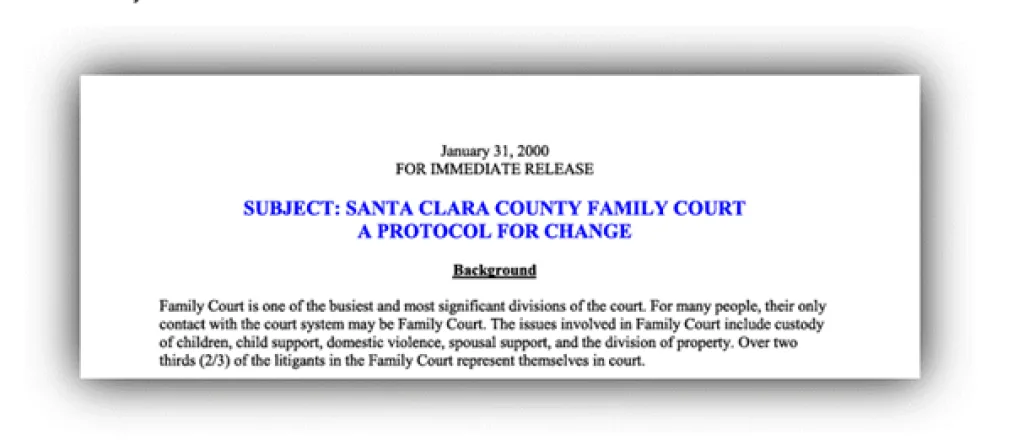
Komar Report published January 31, 2000.
Three Decades of Warnings — Yet Still Going
Following widespread protests by parents over custody practices, then–Santa Clara County Presiding Judge Jack Komar released what became known as the Komar Report. It was intended as a blueprint for reforming the county’s family courts.
Komar identified two central problems.
First, judges were increasingly relying on private “special masters”—attorneys or therapists paid by parents—to make decisions about custody and visitation under Code of Civil Procedure section 638, California’s private-judge statute. Komar warned that custody and visitation decisions are nondelegable judicial duties and that judges may not outsource those responsibilities and simply rubber-stamp the results.
Second, the report warned that the court lacked meaningful rules governing attorneys appointed to represent children in custody disputes, known as minors counsel.
Komar recommended training requirements, written qualifications, a rotation system to prevent repeat appointments, and periodic review to determine whether appointments remained necessary.
The warning was explicit: if judges were going to delegate authority to private decision-makers and attorneys for children, strict guardrails were essential.
Most of those guardrails were never implemented.
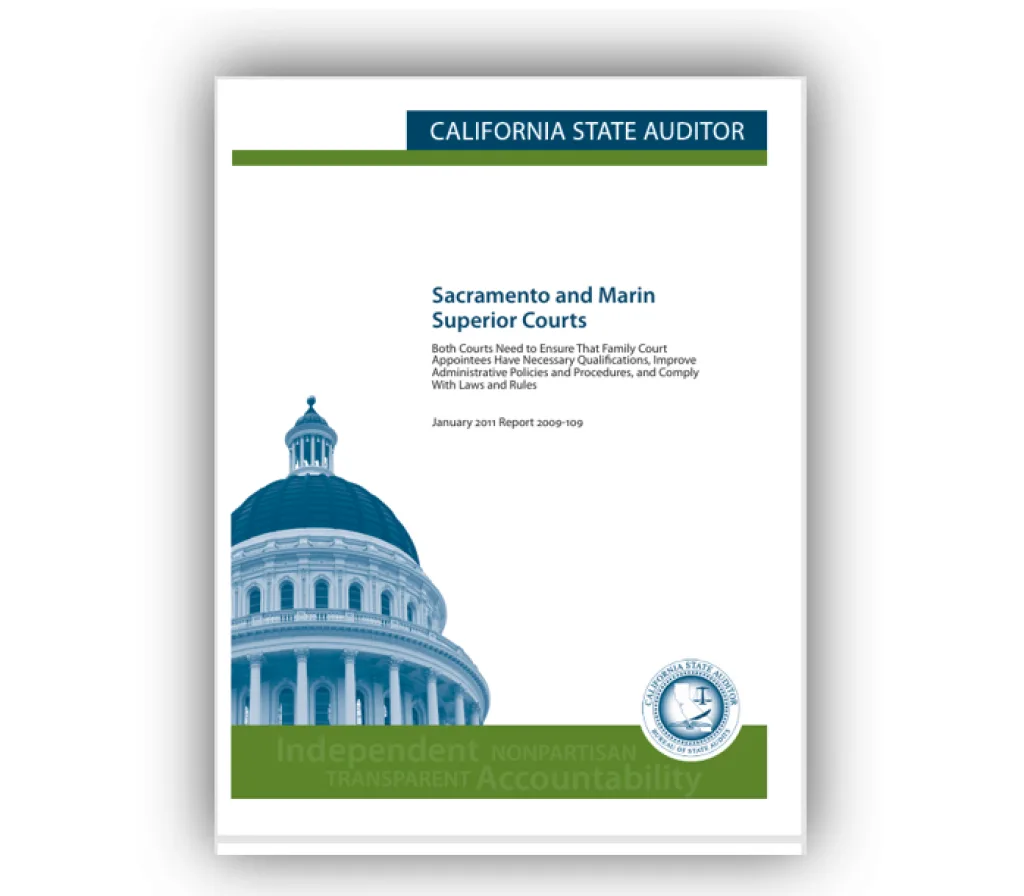
California’s State Auditor Report on Marin and Sacramento Family Courts published in 2011.
State Auditor Confirms the Same Problems in Sacramento and Marin
In 2011, the California State Auditor examined family courts in Sacramento and Marin counties and found many of the same problems Komar had identified a decade earlier. The auditor reported that courts often failed to document whether minors counsel met training requirements and relied heavily on a small group of attorneys while inconsistently applying rules governing who should pay them.
In Sacramento, auditors identified more than $1 million in minors counsel payments over four years, with oversight so lax that non-reimbursable expenses were sometimes approved.
The auditor recommended verifying qualifications, enforcing financial-eligibility rules, tightening billing review, and reducing reliance on favored attorneys.
Sacramento ultimately eliminated public funding for minors counsel. Marin pledged reforms that were never fully implemented.
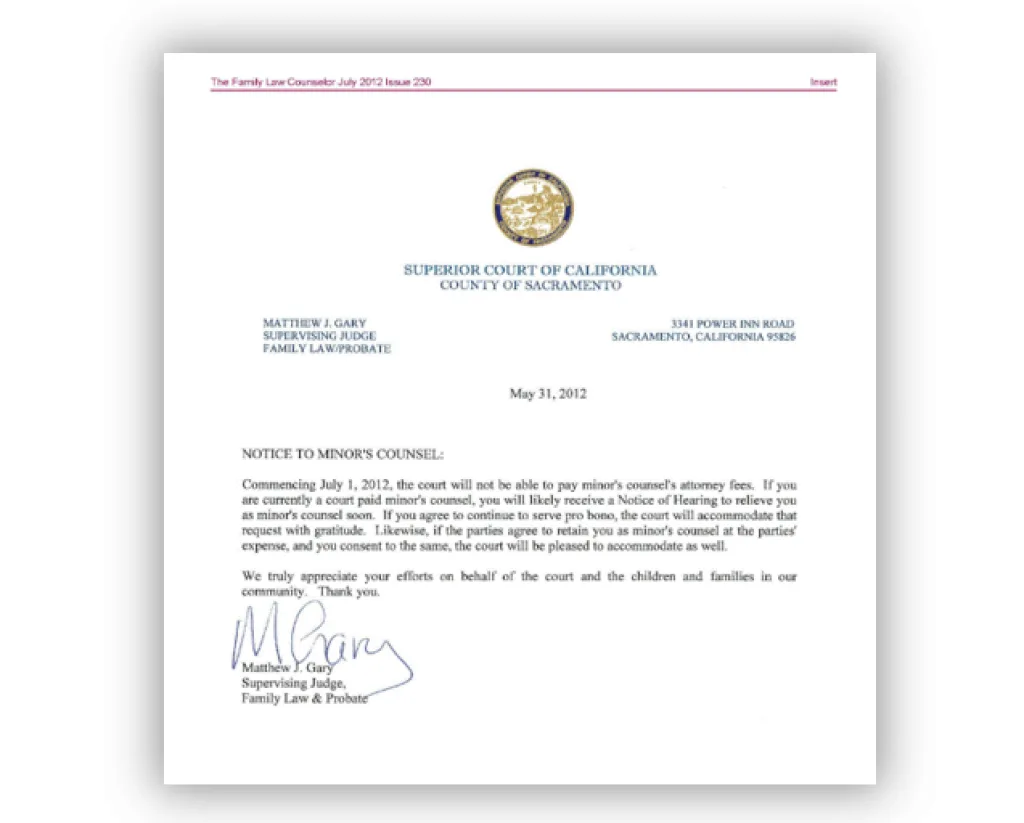
Sacramento Supervising Family Court Judge Matthew Gary announced defunding of public payments to minors counsel in 2012.
By contrast, Orange, Contra Costa, Sonoma, Los Angeles, San Diego, and Santa Clara counties expanded the use of minors counsel and continued delegating judicial authority to attorneys under CCP section 638, rebranding “special masters” as “parenting coordinators.”
“Parenting coordinator” is not defined in statute. It is a label created and used by attorneys and judges and is seen in agreements, or stipulations of the parties, approved by public court judges.
The cost of private judges, rebranded as special masters or parenting coordinators, has not been reviewed in the state since 2004.
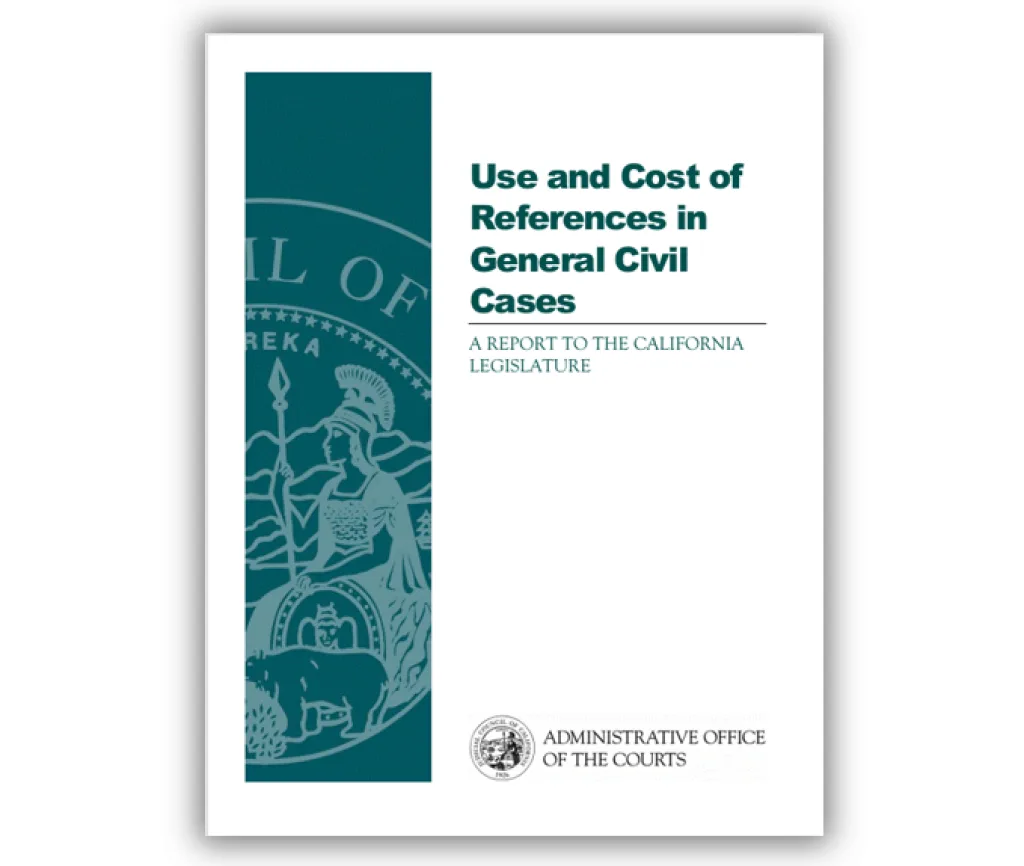
2004 Report on the cost and use of private judges in California’s courts.
One Case, Many Red Flags
A single divorce case illustrates how troubling family court appointment practices persist.
In 2020, Santa Clara County Superior Court Judge Stuart Scott appointed attorney Leslie Holmes as minors counsel for two children in a divorce case filed in 2017. The court record does not explain why minors counsel was deemed necessary three years in the litigation.
Jessica Huey-Gregg, who represented the mother in the case, described the parents’ disputes as “high conflict”. A term often used in family court that frequently precedes the judge appointment of evaluators, minors counsel, and therapists.
The father in the case was represented first by Heather Smith and later by Travis Whitfield.

Minors Counsel Leslie Holmes application for payment submitted in early 2022.
In early 2022, Holmes submitted a fee application for work performed between 2020 and 2021, reporting 17.4 hours billed at her $325 hourly rate, totaling $5,525 in fees for minor child representation.
In her application for payment, Holmes requested that 80 to 100 percent of her fees be paid by taxpayers, asserting the parents could not afford to pay her.
Judge Scott approved Holmes’ public payment, despite both parents being steadily employed—mother at Boston Scientific and father as a firefighter—and paying their own attorneys.
Less than a month after Holmes’ public pay was approved, Nicole Myers was appointed in the case as a privately paid “parenting coordinator” at $400 per hour.
The stipulation appointing Myers lacked a required oath and failed to provide public notice of where hearings she conducted would be held — requirements that apply to attorneys acting as private judges, regardless of whether they are labeled parenting coordinators or special masters.
Despite these deficiencies, continued public funding of minors counsel, and long-standing warnings from the Komar Report, Judge Adams approved the stipulation, granting Myers broad authority and a guaranteed income stream for five years.
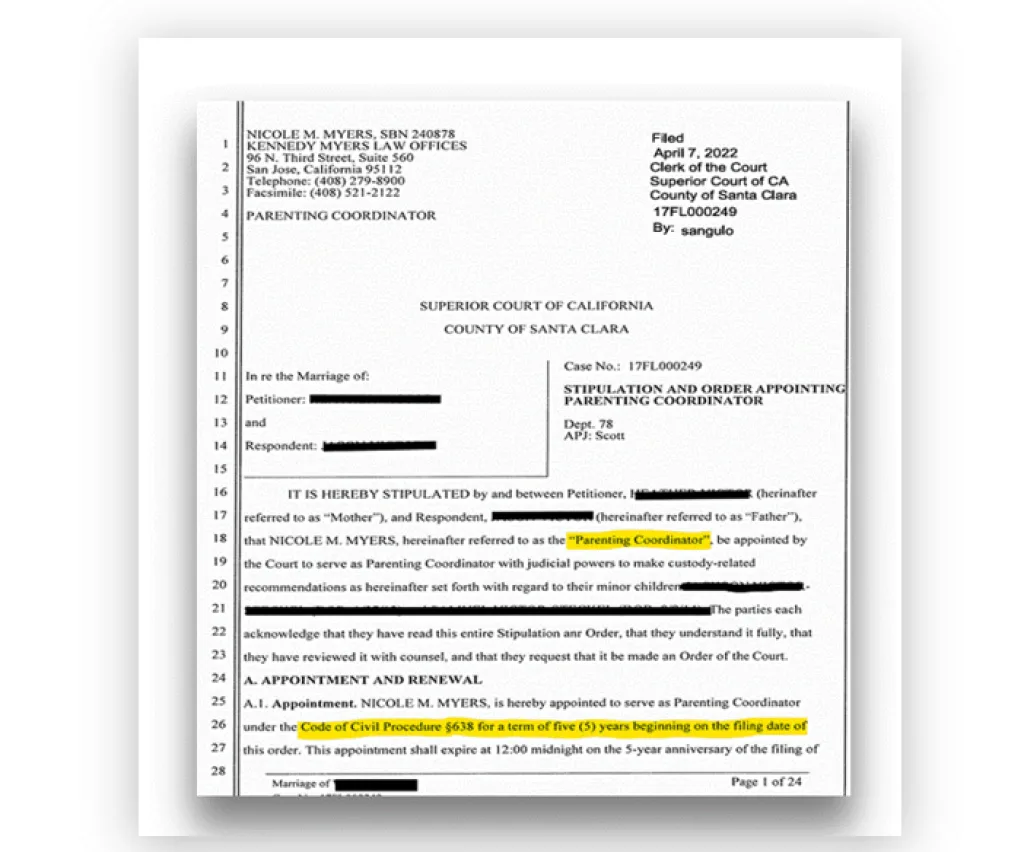
California private judges and parenting coordinators are subject to open proceeding laws.
Under the order, Myers could resolve disputes over the children’s schedules, medical and dental care, therapy, schooling, travel, and parental communications—effectively any issue the parents could not agree upon.
In effect, a privately paid attorney was granted sweeping control over children’s lives while a publicly funded minors counsel remained in place, both claiming to act in the children’s best interests.
Costs mounted.
Months after Myers’ appointment, Whitfield reported that his client had incurred $6,200 in debt to Myers.
This is precisely the layered private authority Komar warned against—an arrangement that expands costs, invites conflicts, and erodes judicial responsibility.

Travis Whitfield at his law office in San Jose, California. Photo by Susan Bassi
Transparency on Paper, Not in Practice
California law requires private judges, including parenting coordinators, to take an oath, disclose conflicts, and publicly list hearing locations so proceedings remain accessible to the public.
When reporters visited the Kennedy Myers law firm seeking Myers’ parenting coordinator notices, office staff forced the reporters out and locked the door, refusing to answer questions about the firm’s private-judge work.
The Komar Report warned that private judging without transparency undermines court integrity. Parents throughout California have expressed concern that the warning has not been heeded.
Private judges rebranded as parenting coordinators are subject to California’s open proceeding laws.
Minors Counsel: On and Off Panel Appointments
These issues extend far beyond a single case.
Under California law, family court judges must appoint minors counsel from a county-published panel list unless they state specific reasons for appointing an attorney from outside the panel. Court dockets across the state, however, show repeated off-panel appointments with no recorded justification.
Before announcing her retirement, Santa Clara County Superior Court Judge Cindy Hendrickson repeatedly appointed attorneys Nicole Ford and Dennis Ingols as minors counsel, even though neither appeared on the court’s approved minors counsel panel list.
Both attorneys had publicly supported Hendrickson’s political campaigns. In addition, Ford had served with Hendrickson for years on the county Domestic Violence Council. Hendrickson did not disclose these relationships when appointing Ford and Ingols as minors counsel or when approving their payment requests.
In another case, Caycie Favier of the Hoover Krepelka law firm was appointed to represent two children despite not being listed on the court’s minors counsel panel list. The court file contains no justification for the off-panel appointment.
In 2025, Favier applied for $8,285.47 in fees at her standard rate. Court records show Judge Hendrickson approved $1,820.47 in payment to Favier from public funds.
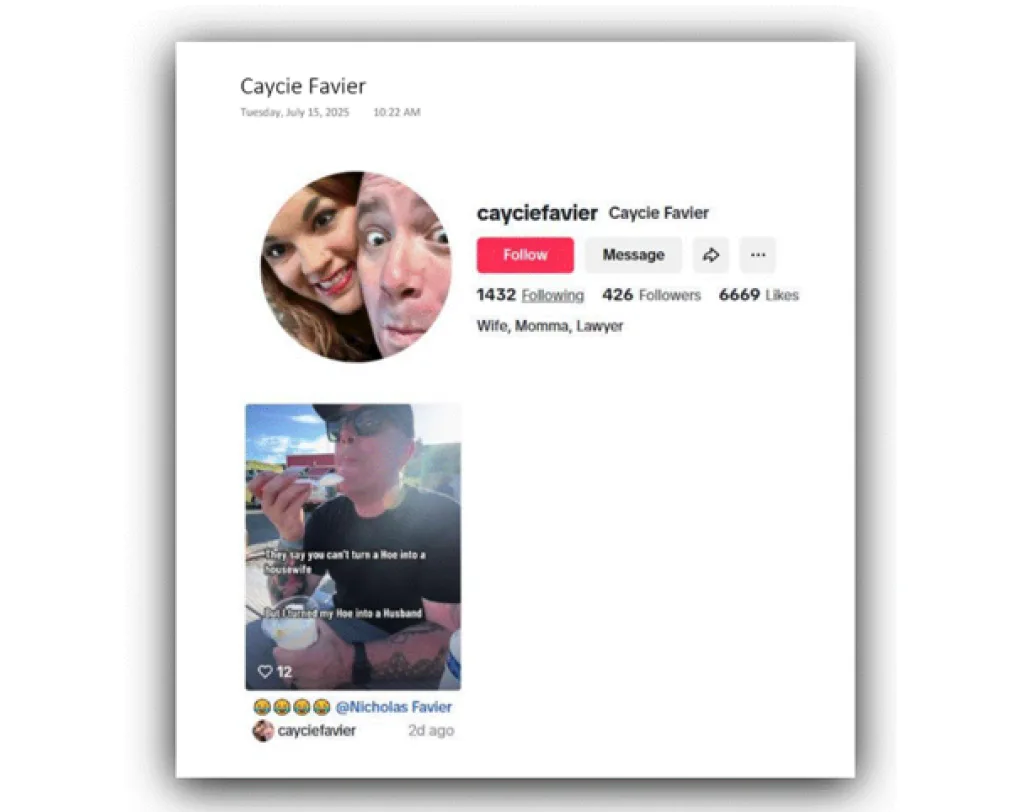
Shortly thereafter, on her own motion, Hendrickson removed Favier from the case. The removal appears to have stemmed from the parents’ complaint regarding Favier’s posting on TikTok.
Both the Komar Report and the state auditor have warned against judges repeatedly appointing a small group of favored attorneys as minors counsel or making off-panel appointments involving undisclosed conflicts of interest.
To litigants, such practices resemble cronyism rather than justice.
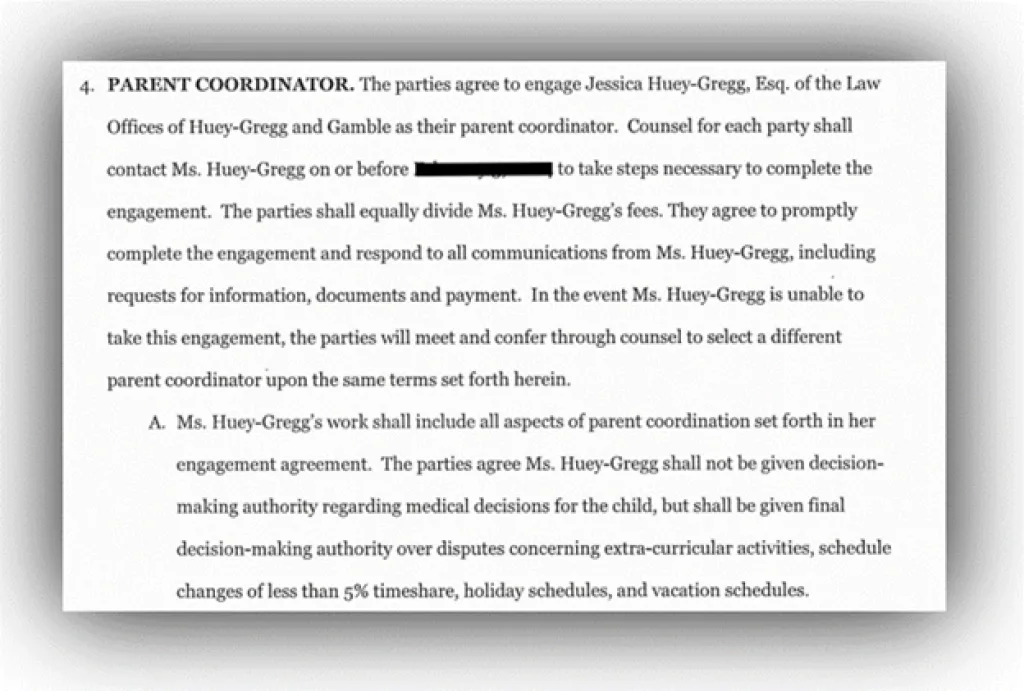
Jessica Huey- Gregg appointed parenting coordinator in a case where Nicole Ford was appointed minors counsel.
From Attorney for Children to Parenting Coordinator
For nearly six years, Jessica Huey-Gregg chaired the Santa Clara County local bar association’s Minors Counsel Court Liaison Subcommittee while receiving more than 240 appointments as minors counsel herself.
In 2023, Huey-Gregg began soliciting work as a parenting coordinator.
During that period, other minors counsel—including Elise Mitchell—encouraged clients to hire Huey-Gregg as a parenting coordinator without disclosing potential conflicts of interest or explaining that parenting coordinators function in a quasi-judicial role similar to private judges.
When contacted, Huey-Gregg said she had never been appointed as a parenting coordinator.
Court records, however, show that Huey-Gregg was appointed as a parenting coordinator in a case in which Nicole Ford served as minors counsel—two years after Ford had represented Huey-Gregg in her own divorce.
As Huey-Gregg sought to expand her practice as a parenting coordinator, she was appointed as minors counsel in another case involving a single child. In that case, Nicole Ford also acted as minors counsel for the child, despite not being on the court’s panel, lacking a formal appointment order, and failing to file the required paperwork accepting the appointment.
Court records show that Ford was paid $6,500 in public funds pursuant to an order by Judge Johnene Stebbins. At the same time, Huey-Gregg was also paid as minors counsel for the same child while promoting her services as a parenting coordinator.
Stebbins has disclosed that Nicole Ford endorsed her 2024 political campaign for judge.

Santa Clara County Superior Court Judge Stebbins approves public pay for minors counsel Nicole Ford.
Attorney’s Fees and Cost of Public Trust in the Courts
Following reporting by The Davis Vanguard and the viral Ledgerwood video, Santa Clara County Superior Court Judges Jon Haeberlin and Cynthia Chen convened a mandatory meeting on December 16 for attorneys in the county serving as minors counsel.
The meeting focused on billing practices and included the announcement of new fee-application forms that will take effect in 2026.
The new forms appear to prohibit minors counsel from billing for overhead expenses and to bar the use of liens and wage garnishment to collect their fees from parents—practices that can prevent the children they represent from benefiting from generational wealth.

Attorneys appointed as minors counsel in Santa Clara County will be required to submit applications for fees on the new form in 2026.
Although these payment reforms mirror recommendations made decades earlier, the meeting did not address judicial oversight of minors counsel appointments or the concentration of those appointments among a small group of attorneys in the county.
Nor did it address the increasing number of judges approving attorneys’ service as parenting coordinators.
While the meeting did not address attorneys appointed as parenting coordinators, court records show that Judge Cynthia Chen has ordered parents to select a parenting coordinator—an unusual practice, as parenting coordinators, unlike minors counsel, are typically appointed by stipulation of the parties rather than by judicial order.
Requests for comment from Judge Chen and the court were repeatedly declined.
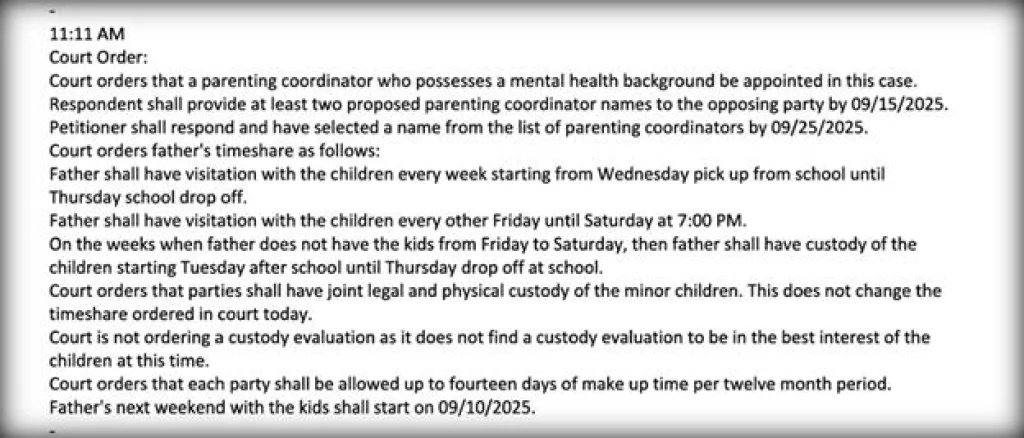
Minute order shows Judge Cynthia Chen ordered parents to select a parenting coordinator.
A Problem Made Visible
For nearly three decades, family court judges have largely disregarded complaints from parents and taxpayers about the cost of minors counsel and attorneys serving as private judges, special masters, or parenting coordinators.
Despite warnings outlined in the Komar Report and by the state auditor, judges across California continue to appoint a small, recurring group of attorneys as minors counsel and as private adjudicators, or parenting coordinators.
For families caught in the system, the consequences are tangible: years spent in court, depleted savings, and fractured relationships.
For taxpayers, the financial burden is hidden in budget line items few ever examine.
The Ledgerwood door-slam did not create these problems. It simply brought them into public view.
Follow the Vanguard on Social Media – X, Instagram and Facebook. Subscribe the Vanguard News letters. To make a tax-deductible donation, please visit davisvanguard.org/donate or give directly through ActBlue. Your support will ensure that the vital work of the Vanguard continues.
