
DAVIS, Calif. — The debate over Davis Joint Unified’s enrollment future continued this week after a recent Vanguard op-ed questioned whether the district’s projections fully account for interdistrict transfers.
The issue was addressed directly by Superintendent Matt Best during the Thursday School Board meeting and highlights not only what the district is assuming, but what the community may be misunderstanding.
His remarks — and the underlying methodology used by MGT — make one thing clear: transfers are counted, but they do not significantly change the long-term math.
Superintendent Best said, “There was an article in the Vanguard about not counting interdistrict students. They are included in the forecasts. Unfortunately it’s kind of buried a little bit.”
He directed attention to the core tables in the report, explaining that resident enrollment is projected to fall sharply through the next decade, even as non-resident enrollment edges upward.
“When you look there’s a big chart that has resident student decline. The projected resident student decline will be around – if the forecast is accurate – around 6,000 resident students by 2034. And there’s about 1,300 non-resident students that are included in the forecast. When you look at that number across those years, it’s increasing slightly.”
Best traced how interdistrict transfers historically helped absorb resident losses.
“Basically what has happened over the last 15-20 years with interdistrict transfers is the rate of interdistrict transfer students was increasing at a pretty high number every year. So we had what I would call net new interdistrict transfers. When you look back at those numbers on that chart you can see those numbers growing by 30, 50, 70, 100 a year, filling those spaces vacated by the resident student decline.”
But his explanation contained a pivot point that deserves emphasis.
“That number is flattening.” And, he added, that flattening informs the assumptions going forward. “And that flattened projection is what is used to move forward. If we see continued flattening from this current year, that will roll into the assumptions going forward. If the assumption starts to rebound and get better, that assumption will play out into the future years. So we sort of use the logic as until we see the change, we’re not going to change the forecast for IDTs.”
He concluded by grounding the resident forecast: “The resident forecast is based on mobility and birth rates primarily.”
That reality squares with the methodology in the MGT report.
The study is explicitly residence-based. Its core model forecasts students who live within DJUSD boundaries, using birth rates, housing patterns and mobility to project enrollment over ten years. Interdistrict transfers — students living elsewhere but attending DJUSD schools — are tracked separately.
They are counted in total enrollment but are excluded from the resident-based forecast used for facility planning. That distinction is intentional, not accidental, because long-term infrastructure decisions depend on where students live, not where they might choose to attend temporarily.
The MGT projections show resident enrollment declining by nearly 1,000 students over the next decade.
Over that same period, transfers are projected to increase slightly, from about 1,293 to approximately 1,424.
Even if transfer numbers meet or exceed projections, the increase offsets only a small fraction of the resident decline.
Transfers soften the slope of declining enrollment, but they do not alter the direction. That is why the district’s forecast can acknowledge transfers without treating them as a strategy.
MGT does project transfers by grade, using historical data. But the firm does not treat transfers as a variable capable of reshaping planning outcomes.
Facility needs, attendance boundaries and long-range capacity decisions have to follow where students live, because interdistrict patterns shift quickly with policy changes, transportation ease, program offerings, and neighboring district decisions.
A transfer trend that exists today can evaporate in a few years. Planning for facilities on that basis risks overbuilding or maintaining underused campuses when transfer demand changes.
Even optimistic scenarios do not shift the trajectory.
Keeping transfers flat rather than allowing modest growth would reduce total enrollment by roughly 130 students by the end of the projection period. Increasing transfers by 10 percent could delay excess capacity by perhaps a year.
Neither reverses elementary decline or eliminates the need to consider school closures or boundary changes.
More aggressive assumptions — such as sustained 25 percent growth — would require policy shifts and regional demand that the MGT study does not assume and that most districts historically fail to achieve over time.
Even under such a scenario, transfers would be unevenly distributed across grades and schools, limiting their usefulness for planning.
The implication is straightforward: transfers help the annual budget, staffing and program offerings, but they are not a substitute for resident population trends.
They cannot provide a stable base for multimillion-dollar capital decisions.
That is why MGT treats transfers as context rather than a driver. Modeling them aggressively would add complexity without changing conclusions — and could create a false impression that enrollment decline is more manageable than it is.
For policymakers and the public, the lesson is clear. Betting on interdistrict transfers to solve enrollment decline risks delaying difficult decisions without avoiding them.
The demographic forces shaping DJUSD’s future are driven by births, housing patterns and mobility within district boundaries. Those forces are larger than any transfer strategy, and no plausible transfer growth scenario is large enough to overcome them.
This is where the discomfort lies. It is easy to imagine transfers as a pressure valve that can relieve demographic trends. It is harder to accept that transfers are a temporary stabilizer, not a solution.
The superintendent’s comments, paired with MGT’s methodology, expose the gap between what the community might hope is possible and what the data says is likely. The difficult work ahead — examining school closures, boundary adjustments, and long-term facility use — will not be made easier by banking on transfers to continue growing at historic rates.
The district’s transparency is welcome, but it does not resolve the core challenge: Davis is projecting fewer resident students because Davis has fewer young families and fewer children per household, driven in part by housing cost and demographic aging.
No model assuming stable or rising transfer numbers can reverse that. And until the city addresses the underlying causes — housing affordability, family-friendly growth and demographic balance — the district will continue planning for fewer resident students.
Transfers are part of the picture, but they cannot rewrite it. The demographic future of DJUSD will be shaped not by who chooses to drive into Davis each morning, but by who can afford to live here.
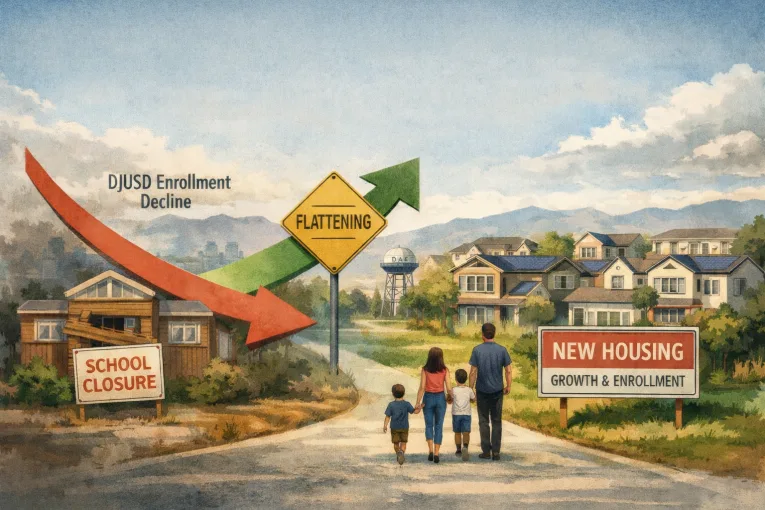
Ultimately, the best way to alter this trajectory is not through optimistic transfer assumptions but through housing. MGT’s own analysis shows that adding significant new housing — specifically Village Farms and Willowgrove — can more than offset projected enrollment decline by bringing more young families into Davis.
Transfers may slow decline, but only housing can reverse it.
Follow the Vanguard on Social Media – X, Instagram and Facebook. Subscribe the Vanguard News letters. To make a tax-deductible donation, please visit davisvanguard.org/donate or give directly through ActBlue. Your support will ensure that the vital work of the Vanguard continues.

Since when must a city keep expanding in order to keep its oversized school system populated?
That is a matter of community choice. In order to make informed choices however people need to be aware of the impact of their policy decisions.
The sheer nerve that it takes to even suggest that an entire city should revolve around a school district’s desires is beyond astonishing.
Such blatant self-interest is normally something that people try to hide; not advertise. Basically, shouting the “quiet part out loud” at the top of one’s lungs, with no shame whatsoever.
Perhaps a sign of societal decline in basic humility, political discourse, etc.
Even if the issue didn’t involve pushing sprawl, it would still be disgusting.
Why is it valid to point out the traffic impacts of building a project but improper to point out the enrollment impacts of not building housing?
The school district and the transportation system should adapt to the City. When the City adapts to the agencies that serve them, something has gone perverse.
“MGT’s own analysis shows that adding significant new housing — specifically Village Farms and Willowgrove — can more than offset projected enrollment decline by bringing more young families into Davis.”
Village Farms and Willowgrove may be one way, but in my view they’re far from the best way. What Davis needs is peripheral development proposals that focus on the next-cycle RHNA requirements, i.e. homes — both for-sale and rental — that are affordable by families with very low, low and moderate incomes. (And don’t forget that “moderate income” does not mean “poor folks”; in Yolo County for 2025 the state defines moderate income for a family of 4 as up to $163,100.00 a year.) Those are the families with kids who’ll fill the K-12 schools. By targeting their housing needs we can solve the DJUSD enrollment problem without adding a bunch of high-end, large-lot, car-centric houses that will attract Bay Area retirees without kids.
The school district has already been using non-resident students as part of its facility planning. Otherwise, they would have shut down a school or two a long time ago.
The district needs to show exactly how they are calculating non-resident enrollment projects – the same as they would any other projection.
It is likely true that (after the 1,600 housing units are built at Woodland’s technology park), there may not be any more massive, sprawling housing developments in Woodland for at least a little while, I assume. Though I believe there are other lands on the south side of town – closest to Davis that already slated for development, as well.
There are no plans to build another school in Woodland, despite the efforts of an organized group of parents. The reason that WJUSD did not build its multiple planned schools in Spring Lake is (no doubt) due to their own projections – including Woodland students attending DJUSD.
(It might be interesting to uncover what communications have occurred between the two school districts, regarding this.)
For DJUSD to claim that this is a “temporary” situation further undermines DJUSD’s credibility.
Honestly, the two school districts should probably be combined into one at some point in the future. Right off the bat, that would save something like $300K/year by eliminating one of the superintendent positions (and a bunch of other administrative positions).
Of course, that would come with its own challenges, since Woodlanders are generally “deadbeats” when it comes to school district parcel taxes – unlike Davis. They’d apparently rather send their kids to schools where “others” pay those parcel taxes. Actually, I’m now wondering why Davis has the reputation of being the “smarter” of the two towns.