
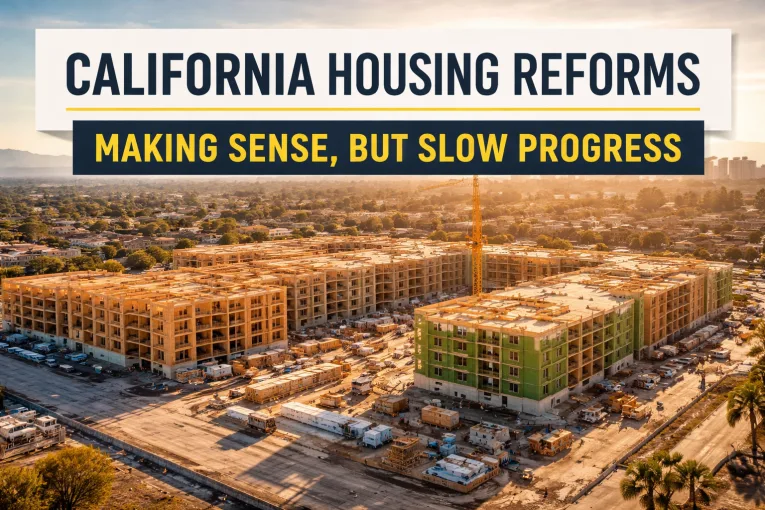
- “California’s much-touted housing reforms ‘make sense’ but are largely failing to deliver results.” – Steven Greenhut
- “The fundamental flaw in California’s housing strategy is its narrow focus on multifamily development.” – Steven Greenhut
An opinion column published this week in Governing argues that California’s much-touted housing reforms “make sense” but are largely failing to deliver results, citing sluggish production, rising home prices and structural barriers that continue to limit construction across the state.
Writing for Governing, Steven Greenhut of the R Street Institute contends that years of legislative action have produced more press releases than homes and that California lawmakers have avoided the deeper reforms needed to meaningfully address the housing shortage.
His column, published Jan. 5, questions whether the state’s strategy—largely focused on streamlining approvals for dense multifamily housing—can succeed without broader changes to land use regulation and the California Environmental Quality Act.
Greenhut notes that California lawmakers passed another round of housing legislation in 2025, which Gavin Newsom described as “historic housing reforms.”
Yet Greenhut argues that several major laws enacted as far back as 2017 have not led to the surge in production that state officials promised. “For all the bill-signing hoopla, the state has witnessed too few new developments,” he writes, pointing out that the Dallas–Fort Worth metroplex continues to permit more housing annually than the entire state of California.
The opinion piece highlights SB 79, which provides by-right approvals for higher-density housing near transit, but notes that the law does not take effect until January 2026. Greenhut contrasts that with earlier measures—such as lot-splitting under SB 9 and streamlining laws for multifamily and affordable housing—that have already been on the books for several years.
Despite those reforms, he writes, housing production has consistently fallen short of need by roughly 100,000 units per year, while median home prices have nearly doubled over the past decade.
At the same time, the column largely treats the absence of immediate statewide production gains as evidence that the most recent reforms are ineffective, even though several of the policies Greenhut criticizes have not yet been in force long enough to plausibly affect housing output.
SB 79 has just taken effect, and the most recent CEQA exemptions apply primarily to projects that are still in early planning or financing stages.
Given the multiyear timelines associated with site acquisition, design review, litigation risk, financing and construction, measurable impacts from those changes would not be expected for several years.
Citing reporting from the Sacramento Bee, Greenhut points to Sacramento’s failure to meet its annual housing targets as emblematic of a statewide pattern. In 2024, the city permitted fewer than half the homes required to remain on pace with its long-term goals.
A central source for Greenhut’s critique is a report from YIMBY Law, which reviewed five major housing laws enacted since 2021. The group concluded that the laws have had “limited to no impact on the state’s housing supply to date,” adding that new requirements imposed during the legislative process have diluted their effectiveness.
“While the hope was that these laws would provide immediate new paths to regulatory relief, they also allow or mandate development requirements that have reduced their effectiveness,” the report stated.
Greenhut acknowledges a few bright spots, including the growth of accessory dwelling unit construction under state ADU laws and faster rebuilding approvals following Southern California wildfires. But he argues that these gains are marginal in the context of a statewide shortage measured in millions of homes.
He also points to a 2023 survey by the Public Policy Institute of California showing that 71 percent of Californians prefer to live in single-family detached homes, not apartments or backyard units.
Much of Greenhut’s criticism centers on CEQA, the 1970 environmental law that requires environmental review for projects subject to discretionary approval. He describes the statute as “an open invitation for lawsuits,” arguing that its broad standing provisions allow virtually any party to delay or derail housing projects.
Citing a study by the Holland & Knight law firm, Greenhut writes that “housing projects were the top target of CEQA lawsuits,” including infill and affordable developments that conform to the state’s stated environmental goals.
The column also faults local governments for undermining state housing mandates. Greenhut quotes YIMBY Law’s conclusion that “cities have actively undermined the goals of state housing laws through restrictive ordinances and creative interpretations,” pointing to resistance in both liberal and conservative jurisdictions.
Greenhut credits Newsom for using budget negotiations to force passage of two housing bills that provided limited CEQA exemptions and for signing SB 79 despite opposition from neighborhood groups.
Still, he argues that political conditions are unlikely to improve, particularly with Sen. Scott Wiener expected to leave the Legislature and the Senate elevating Sen. Monique Limón to a leadership role.
According to Greenhut, the fundamental flaw in California’s housing strategy is its narrow focus on multifamily development.
“Such projects fill a niche and make sense in the state’s biggest cities,” he writes, but without deregulating single-family housing, the state “is not going to make a huge dent in the housing shortfall.”
As an alternative, Greenhut points to a proposed statewide ballot initiative backed by the California Chamber of Commerce that would impose firm timelines on environmental review and judicial challenges under CEQA.
The chamber argues that the measure would move beyond “piecemeal exemptions” and apply to a broad range of residential projects deemed essential.
Greenhut dismisses calls to wait and see whether existing reforms will eventually pay off. Quoting the Southern California News Group’s editorial board, he notes that critics argue Californians should give recent laws more time.
His response is blunt: “We’ve waited long enough.”
Greenhut’s essay captures a growing strain of frustration among observers who see California’s housing crisis as resistant to incremental reform.
The Vanguard has reported in recent weeks that the picture is more complex.
Although housing production remains far below need, state enforcement of housing laws has intensified, permitting timelines have shortened in some jurisdictions, and by-right approvals and the builder’s remedy are beginning to reshape local land-use politics.
The effects have been uneven and slow, but signs are beginning to suggest the reforms are starting to change behavior in ways that were largely unthinkable a decade ago.
Whether those changes scale quickly enough remains the central question.
Greenhut argues they will not do so without far more aggressive reform.
Housing advocates counter that many of the most consequential policies have only just taken effect, and that treating the lack of immediate statewide output as proof of failure risks confusing long-standing structural barriers with the simple reality that housing policy operates on a multiyear clock.
Greenhut’s column can also be read as a warning that if current reforms fail to produce visible improvements in housing production over the next several years, political pressure may shift toward more aggressive proposals that are less environmentally protective and less focused on infill, transit-oriented, and climate-conscious development.
Incremental CEQA reform, by-right approvals near transit and enforcement of existing housing law are, for now, being justified as a way to reconcile housing production with environmental goals.
If that balance is perceived to have failed, future housing efforts may prioritize speed and volume over sustainability, with fewer safeguards for climate, land use and environmental impacts.
Follow the Vanguard on Social Media – X, Instagram and Facebook. Subscribe the Vanguard News letters. To make a tax-deductible donation, please visit davisvanguard.org/donate or give directly through ActBlue. Your support will ensure that the vital work of the Vanguard continues.

Sounds like this guy is advocating to eliminate CEQA in regard to sprawl (building on farmland), in addition to the elimination of CEQA for housing within cities (which has already occurred). Apparently, he doesn’t think there’s already TOO MUCH sprawl that’s occurring throughout the state. He seems to want more of that.
But I have also been pointing out that the state’s “mandates” have been failing. The difference between someone like this guy, vs. me is that I view this as “good news”.
I do have questions regarding this statement:
“Despite those reforms, he writes, housing production has consistently fallen short of need by roughly 100,000 units per year, while median home prices have nearly doubled over the past decade.”
First off, I’m not seeing where home prices have “doubled” in California, and it’s a rather reckless claim to make by lumping together the entire state in this manner.
Also, prices have been going DOWN lately.
How much did prices rise in cities (such as during the pandemic) where growth is more-actively pursued? And how much did inflation in general increase? What was the price of eggs 10 years ago?
But perhaps more-importantly, what does the author of this piece think occurs when prices rise? (Here’s a clue for you – demand goes DOWN. That’s exactly how the supply/demand model works.) If there was only one house allowed in the entire state (all else being equal), it would NOT be worth a trillion dollars. What would actually occur is that the businesses/institutions which create demand would leave – immediately. And the population would immediately plummet.
And where is he getting this 100,000 annual “shortfall” that he’s referring to? Compared to what, exactly? And how does he explain the fact that home prices are going DOWN as his fake shortage is supposedly getting worse each year?
Greenhut writes in his Governing column that median statewide home prices rose from $476,000 to $877,000 over the last decade – an 84 percent increase.
Well, that’s interesting – would have to see where he got that from.
Sounds like California is “falling behind” the rest of the country, however. From AI (and another source):
“U.S. housing prices have roughly doubled (increased by over 100%) in the last 10 years (roughly 2015-2025), with some sources citing a 105% jump, while other data shows a significant rise of around 60% to 90%+ depending on the exact start/end points and data source.”
Doesn’t really answer the rest of my questions, though – including the price DROP (especially in places like San Francisco and Los Angeles) during the pandemic in particular.
Prices are dropping right now in California – including in Davis.
From AI: “Yes, California housing prices have seen recent slight decreases or stabilization after a period of growth, with some areas like Southern California and the Bay Area experiencing modest year-over-year dips (around 0.3% – 2.2% in late 2025), driven by high mortgage rates, increased inventory, and buyer caution, though some regions still see modest increases. While a major crash isn’t anticipated, prices are softening from peaks, with more homes staying on the market longer, notes Redfin and Los Angeles Times.”
(Pretty sure that housing prices have not been keeping up with general inflation, though the cost associated with homeownership such as insurance has skyrocketed. And if you live in Texas, good luck with those property taxes.)
But again, what happens when prices increase? Demand goes DOWN. Seems like some people forget that component of the supply/demand model.
Zillow shows a 58% increase since 2017. Given the bounce back from the Great Recession this is consistent with an 80%+ increase since 2015. https://www.zillow.com/home-values/9/ca/
As I’ve explained previously, housing prices are falling because of rising interest rates, not falling demand. When we look at the monthly housing payment, the price has increased 30%+ since 2021.
Ron is basically looking at statistical noise as though it were a trend.
Ron O
“That’s exactly how the supply/demand model works.”
LOL! You saying this is SO funny because you want to restrict the supply side of the equation–you want it ALL to come from reduced demand! A true market-based response would allow for adjustments both on the demand AND supply side. Market interventions are to justified with a legitimate societal objective. For Davis, and many other cities with restrictive policies, that express desires to achieve equity and diversity in their communities, imposing only supply side restrictions impedes achieving an appropriate demand-supply balance. What you advocate defeats reaching that balance.
Well, if supply is “restricted” as you say, but there continues to be “demand” for an additional 100,000 housing units per year (in reference to the article), shouldn’t prices still be rising exponentially?
How did your model become “broken”, given that prices are declining in the absence of those units? (I already know the answer to this.)
Part of the answer is that “demand” itself adjusts – what David calls “noise”, above. And it does so in more than one way.
Demand is not fixed.
Of course, I’m not the one advocating for more jobs which would increase demand if successful (e.g., DISC). That would be the housing activists, who somehow advocate that outcome.
If those were the only two variables…
Well, you and the YIMBYs are experts at focusing on “one” of those variables. Usually by basing it on past (unsustainable) growth.
While simultaneously advocating for more “demand”.
I, on the other hand, suggest coming up with a size for a city, community, region, or state – and plan around THAT.
I’m not a fan of endless growth, with no goal or end in sight. That would be YOUR purview.
Don’t be afraid of change. Clearly, what I’m advocating for IS the change.
Short-term price movements often reflect noise, not a change in the underlying problem.
Housing prices can fall temporarily because higher interest rates reduce what buyers can finance, even while the long-term shortage of homes remains.
When people delay moving, double up, or leave an area, demand looks weaker on the surface, but that adjustment does not mean the market is in balance.
Treating a rate-driven pause as proof that supply no longer matters is mistaking a temporary signal distortion for a real trend.
Again, prices have been flat or declining for a few years, at this point. Population has leveled off, people aren’t having kids, and immigration is going in reverse.
If there’s a continuing 100,000 housing unit “shortage” (each and every year), that means (according to folks like you) that prices should be rising EXPONENTIALLY, despite what you call “noise”.
A continuing “shortage” of 100,000 units would have a far greater impact in this scenario. It doesn’t take much for prices to soar (due to an exponential effect) when there’s an ACTUAL shortage of something – regardless of what else is occurring.
Ask a dying man in the desert how much he’d pay for a drink of water. THAT’s when supply/demand comes more into play.
The avocado toast crowd has alternatives, and they’re set to inherit EVERYTHING.
Contrast what these whiny Americans “demand”, in comparison to your other guest article today (in Mexico). This is something I’ve noticed when visiting third world areas, myself.
Though truth be told, I don’t really hear much directly from “whiny” Americans. That’s another fiction being put forth by the moneyed interests as a justification to CONTINUE to pave over everything.
Prices do not rise exponentially in real markets because housing is constrained by credit, income, and behavior, not just unit counts. In essence, you are treating housing prices as the only relevant variable while ignoring what’s happening in the real world around them.
Prices are constrained by far more than what you list.
And yet, you and the YIMBYs focus on “supply” exclusively – including the fake 100,000 annual “shortage” per this article. (Actually, I thought it was more like a trillion more housing units per year – that they want. Whatever it is – it’s an entirely fake, unsupported number.)
In any case, you’re actually putting forth MY observation.
Yes, prices are constrained by many factors—that’s exactly the point. But acknowledging multiple constraints does not make supply irrelevant, nor does it turn a long-term shortage estimate into a “fake” number.
You’re completely missing the point of the column at this point. You are always talking about Prop 13, but Greenhut’s views are much more extreme than either mine or Richard’s. So one possibility is that by continuing to block more moderate efforts at housing reform, you open the door for more draconian ones.
There should be some in-depth articles regarding what those fake numbers are based on. As I recall, even you noted that a lot of those “estimates” are based on past growth.
But it’s not just the supply numbers that should be examined; it’s the causes of demand (e.g. increase in jobs) that must be considered. As well as how those jobs are filled (e.g., H-1 visas, from countries that produce more-capable workers than the U.S. does). I’ve met more than one of those workers.
At which point, you might question who, exactly, is benefiting from this pursued increase in “demand” for housing in higher cost areas. (It’s more than one party.)
“So one possibility is that by continuing to block more moderate efforts at housing reform, you open the door for more draconian ones.”
Those “draconian” ones are already occurring, and are causing existing “expensive” areas to become even more expensive.
YIMBY-type interests are not actually about helping “poor” people move to a given area. That doesn’t help the interests which fund them (except for the handful of janitors they might employ, before they replace them with robots).
It seems like homeowners/residents were caught “asleep at the wheel” (e.g., in areas near Silicon Valley), though many of them are probably happy to cash in and move on.
I actually have more faith than you, however, in that I don’t see any possibility of truly wealthy enclaves allowing density/riff-raff in. The same reason that Newsom suspended SB-9 in Pacific Palisades. These are the people who will continue to challenge the state (sometimes with the “cooperation” of the state – as just noted), one way or another.
Then there’s the other groups (more like me) who are actually concerned about sprawl/the environment. The type of people who may defeat something like California Forever – even if it could theoretically benefit them.
The same type of people who helped defeat DISC.
Then there’s the social justice types, who actually are concerned about “affordable” housing that doesn’t pencil out.
Might want to read Greenhut’s column
Already read your article, but wanted to add one last thing:
The true “social justice” types might be the most-formidable of all (in regard to resisting gentrification, as well as eviction prevention and other measures which could make investment unappealing).
These are NOT the YIMBY groups.
As a side note, I sometimes watch a conservative-oriented program on Youtube (California Insider), and they had a small-time landlord on there who got out of the business because of his losses consisting of unpaid rent, during the pandemic. Well that, plus the publicly-funded attorneys who keep coming after him on behalf of his tenants for reportedly frivilous reasons.
Ron O
You’re just a bunch of contradictions. On one hand you say we don’t need housing, but on the other you point to social justice concerns for high housing costs that might increase. Your purported “solution: of low birth rates will take decades until that cohort is actually in the housing market. It’s impossible discern what your real point is behind all of this smoke screen. I’ve brought this up before and you’ve still haven’t answered this question.
And yes, prices are still rising. Again, the monthly payments for housing have risen by over 30% in the last 4 years even though listed prices have not risen by the same amount because interest rates have risen. That’s the price metric that is true benchmark. Simplistic assessments ignore the true market dynamics.
What you (and I) are referring to Richard, is a wealth gap – not a housing shortage.
But you’re factually incorrect – housing prices are not rising at this point (including in Davis). It also varies by neighborhood. For example:
https://www.redfin.com/zipcode/95618/housing-market
And when we’re referring to housing prices, we need to differentiate between rent vs. “for sale” housing. Neither of these are rising.
“Year-over-Year Drops: Data from late 2024/early 2025 shows significant decreases for 2-bedroom units (around -24.7%) and slight dips for 3-bedroom and 1-bedroom rentals in Davis generally.”
On a broader level, they’re declining/leveling-off everywhere – even while the price of everything else is going up.
So I guess my underlying question is as follows:
If California is “underbuilding” by 100,000 units each and every year, shouldn’t prices continue to exponentially rise (instead of leveling-off or decreasing)?
Doesn’t the reality contradict what the development activists tell us, regarding “supply” (and corresponding prices)?
Could it be that the 100,000 unit annual shortfall is just pulled out of someone’s arse?
If you want some actual statistics regarding demand, look no further than 1.6 kids per woman (nationwide), and the 11 million or so illegal immigrants that Trump has targeted. Surely, some of the latter must have self-deported by now. (I’ve heard that this exodus is impacting Las Vegas, at least.)
How about instead we look at the average number of people per household in California rose 10% from 2010 to 2020 from 2.9 to 3.2. That indicates the current housing demand imbalance, not a long run demographic trend that won’t have consequences for decades and may reverse at any time.
Would have to see the link, but (either way) you’re trying to establish a causal relationship when (at best) it’s a correlation (5 years ago).
Perhaps it’s even due to illegal immigrants cramming into apartments, before Trump started deporting them (or encouraging them to self-deport).
One survey may show a preference for single family homes, but buyers recognize the tradeoffs they face. An NAHB survey I’ve reference shows that first time buyers are willing to accept smaller houses, smaller lots and common walls to gain affordable housing. Survey preferences are only indicative and often don’t reflect expected actual market transactions. We shouldn’t build solely for “preferences.”
Developers build for “preferences”, and they’ll continue to do so (e.g., 7 miles north of Davis). Though even there, it’s in the mid $500K range for the smallest new house/property that would be suitable for a “family” – such as “The Cottages” and “Tim Lewis” houses.
I have to laugh at the Tim Lewis houses, since there’s only a few, narrow parking spaces (not on the street itself) for residents/visitors – other than their small garages.
And good luck driving out of there – makes The Cannery’s access look like Hearst’s private driveway.
Can you imagine moving to the “spacious” valley, and getting stuck with something that’s more cramped then almost anything you’d find in the Bay Area?
Ooh, Ooh!
I’ve been waiting for this. Looks like we’ve got our first prices for Harvest Glen in Davis:
Apparently, the cheapest one is starting out in the mid-700K range (1,472 square feet). But hey, you get a “one bay” garage, so there’s that. (Just make sure that you park within that dotted line, in case you want to store a bicycle in there as well.) I figure that the space inside the dotted line might be have the size of a Mini Cooper, but I’m not seeing dimensions.
2 bedroom, 2 bath for all of you “family minded” types.
https://www.centurycommunities.com/find-your-new-home/california/northern-california-metro/davis/harvest-glen/
What you actually need is a time machine to go back in time some 25 years (which frankly, seems like yesterday to me). That’s the ticket!
Go back in time, and buy a dozen of ’em.
So what do you all think of this? (I didn’t submit it until yesterday evening.)
A 1,472 square foot, 2-bedroom, 2 bath, 1-car garage house for around $750K is going to be housing a “family”? Does it even have a yard?
And you think that Village Farms would be better than this if it’s approved (and buildings are completed in a few years from now)?
At least Harvest Glen isn’t dependent upon an unfunded grade-separated crossing for kids/adults to access the city via bicycle/walking.
It would be really interesting to be able to calculate the incremental impact of blocking housing on cost. In essence, your critique accurately describes the symptoms of a housing shortage, then prescribes the very policy—blocking more housing—that guarantees those symptoms will worsen.
The “incremental” cost might be zero, due to alternatives. We’ll never know.
Of course, it also depends upon alternatives that the job-creators might pursue.
Or in the case of students, choice of university (e.g., UC Merced). Or (increasingly) not choosing to go to college at all.
Then there’s the declining birthrate regarding the latter in particular (students at all levels).
And of course, development in places like Spring Lake (where that same house would be at least $200K less). (Seems like that’s where families who are moving to the area primarily choose.)
Spring Lake (in particular) also puts a damper on Davis housing prices.
1,600 more housing units to come at the technology park.
“Spring Lake (in particular) also puts a damper on Davis housing prices.”
Reminds me of a conversation I had with my doctor 35 years ago. I asked him if thinking burns calories, he looked at me and looked at his own stomach, we were both pushing maximum density, and he said, not enough.
They have medication for that now (apparently pretty effective). That’s another example of what we call an “alternative” – in that case, an alternative to diet and exercise.
Punchline being – “not enough “
Well, if you’re referring back to the impact that Spring Lake is (probably) having on Davis housing prices, there’s no way to measure that (nor is there actually a “goal”) in mind.
I don’t know why people (families in particular) are moving to the area in the first place, since UCD isn’t hiring to my knowledge.
Perhaps the reason is that the entire area is an “alternative” to more-expensive locales. That’s the reason I’m around here, at least – got pushed out of my original locale. (Frankly, by people more successful than me, who were better-able to take advantage of the new opportunities being offered.)
Let’s face it – we’re all “flunkies” when you come right down to it. The only question being, how big of a flunkie are we to be living in a flat, hot, floodzone with bad air quality – while trying to convince ourselves that it’s paradise?
You’re missing the whole point we don’t need to measure it. We see the result. Just like we saw the effectiveness of me thinking a lot on my belly.
We did see the result when The Cannery was built, when Spring Lake was (largely) built, etc. Prices rose, and existing homeowners were probably “impressed” with the prices of the new housing (and figured theirs was worth more than they thought).
The entire area is better-suited for crops, then cities.
Prices were also rising in an extreme manner (much faster than Davis) in areas that actively pursued growth, such as Austin. Of course, that’s now being “corrected”.
Prices also rise (and fall) faster in Woodland, than they do in Davis.
Davis is remarkably stable overall (and that’s what I was told some 25 years ago, as well). Not a lot of fluctuation, compared to other nearby locales.
In any case, new families (moving to the area) aren’t going to be interested in a $750K, 1,472 square foot, 2 bedroom, 2 bath, 1-car garage, with no yard (most likely). Even if it’s $10K less than that.
My position is simple: whatever that effect is, it is plainly not enough.
We know this because Davis remains unaffordable, prices remain high, and displacement continues despite decades of “alternatives” in surrounding communities. If offloading demand were sufficient, the problem would already be solved. It isn’t.
At some point, the persistence of the outcome matters more than theoretical dampening effects. A policy that produces chronic scarcity year after year is not a solution—it’s an explanation for why the problem endures.
There are a lot of subjective assumptions in that comment – to a degree that’s overwhelming. You have no evidence, no basis, no reason to believe that Davis housing prices would drop significantly (or even level-off) if something like Village Farms was built.
If that’s what you believe, put forth some numbers regarding how much Davis housing prices would decline if something like Village Farms was approved.
There is a periodic commenter on here who has development experience (and is in no way a “no-growther”) who already told all of us that builders don’t build in order to “lower prices”.
But more importantly (to me, on a personal level) is that I don’t believe that communities should pursue endless sprawl for the purpose of lowering housing prices. This is a backwards way of thinking. The fact is that there’s a limit to how much housing prices will rise (or not) which is dependent upon all kinds of factors (as you already mentioned, yourself).
At some point, a lack of development itself will keep prices in check, since “overpriced” housing markets aren’t necessarily appealing to potential employers (and their employees). That’s partly why we saw, and continue to see, the “California Exodus”.
Also, families moving to the area (and even some moving from Davis) obviously don’t share your prejudice regarding Davis being that much “superior” to other nearby locales. Maybe you should get out more, to see where they’re actually buying.
You do realize, I’m sure, that most home sales (by far) across the entire United States consist of pre-owned houses.
You’re also failing to recognize that a home in Springlake might not be viewed as equivalent to a home in Davis. For as much as you object to someone pointing out you live in Woodland, you did choose to move from Davis to Woodland, but for people like me, I’d rather rent in Davis than buy in Woodland and your calculations do not take that possibility into account.
It’s not about “me” or “you” – it’s the overall trend.
Most families moving to the area (not sure why they’re moving here in the first place) will choose a new house in Woodland (for some $200K or so less) than they would for a new house in Davis.
But on a personal level, you’d probably be better off getting the heck out of there yourself, unless your Affordable (subsidized) housing is a good-enough deal to keep you there. (My guess is that it probably is – nothing wrong with that.)
Someone whom I knew very well (he unexpectedly died, recently) truly benefited from rent control in San Francisco. That individual paid less in rent for a 3-floor flat with a garage (and a rooftop deck with a view of the Golden Gate Bridge) for less than most newomers in THIS area pay in property taxes.
Perhaps a better than the deal you have, and his rent was not based on income.
But that type of deal is not necessarily available to newcomers, whether it’s Affordable housing or rent control (the latter of which doesn’t even exist in Davis).
But of course, the individual I’m referring to did not die with any equity to pass on in the form of housing at least. (Then again, he didn’t stupidly get a reverse mortgage, either.)
Also (while waiting for my other comment to post), why not let those who “think” that Davis is worth $200K more pay for it, then?
Why is it a societal responsibility to ensure that prices are the same in Davis compared to Woodland (assuming that was even possible in the first place).
Prices aren’t even the same WITHIN a given city – INCLUDING Davis.
Truth be told, the true “flunkies” are getting pushed out to Knight’s Landing, at this point. Woodland is too expensive for them, apparently.
At what point does all of this nonsense come crashing down? And by nonsense, I’m referring to the “right” of anyone, especially non-residents, to dictate housing prices in a given locale.
This is the same reason I don’t try to dictate prices in Tiburon or Atherton, though I’ll be sure to let the CEOs of the tech companies (who DO live there, and sometimes buy up neighboring properties for privacy) know that I’d like to live there at the right price. I’m sure that they would welcome me, if they knew of my desire.