

- Our concern arises from the high prices of the majority of the units planned by the projects: both Village Farms and Willowgrove are largely devoted to detached, single family houses, for which our market has set a very high minimum price.
The Davis Joint Unified School District (DJUSD) as well as others have asserted that Village Farms and Willowgrove must pass a Measure J/R/D vote and be built in order to prevent the closure of several district schools. DJUSD has proposed closing one or more schools, including Patwin and Birch Lane, as well as possibly a junior high if the two projects are rejected through Measure J/R/D votes.
We should be skeptical, however, that what is being proposed actually gives us a sustainable solution. Our (Planners) group is concerned that any bump in students from these projects is likely to be a short-lived “sugar high” that will bring older students but very few that will attend our elementary schools, where the need to prevent closures is greatest. And once those older students have graduated, their parents are likely to stay in place and Davis will simply gain more empty nesters who block further openings for families with students of any age.
Our concern arises from the high prices of the majority of the units planned by the projects: both Village Farms and Willowgrove are largely devoted to detached, single family houses, for which our market has set a very high minimum price. A quick search through Zillow or Redfin shows that even the smallest detached houses in Davis, older and in need of repairs, sell for at least $740,000 (which contrasts with the published claim that the average selling price in Village Farms will be $740,000). Families who can afford that price range are generally older, further into careers, and with older children if any at all.
But very few families with children of elementary school age will be able to afford the housing being offered at either development.
In fact, the high cost of housing likely has caused the displacement of at least 4,500 middle-income households who work in Davis but now have to commute in. These are university staff and service sector workers, and the district would likely have had 2,000 more students if these families had the option to live in town. Unfortunately the proposed unit mix of both Village Farms and Willowgrove will have little, if any, influence to counter this.
How can we be so sure? It’s not rocket science, as there are several sets of data that, when put together, point to this conclusion .
Let’s go back to that minimum detached house price of $740,000. The income required to purchase such a home is easily calculated and is at least $175,000 per year (with 20% down, current mortgage rates of 6.2%, and a debt to income ratio of 28%). Sure, we hope interest rates will drop and incomes will go up, but prices could also move up in conjunction.
There are also good data sets that correlate income to age, and it’s pretty typical in our region for a two-person family earning that much to be mid-40’s (see chart below) or mid-career.
And there are good data sets that correlate the age of women to when they have their first child. This age has been increasing over time, and today there’s a wide plateau between the mid-20’s to mid-30’s, but still falling off by 40 (see below). The average mother’s age at first birth is 27.6 years and for all births is 30.6 years.
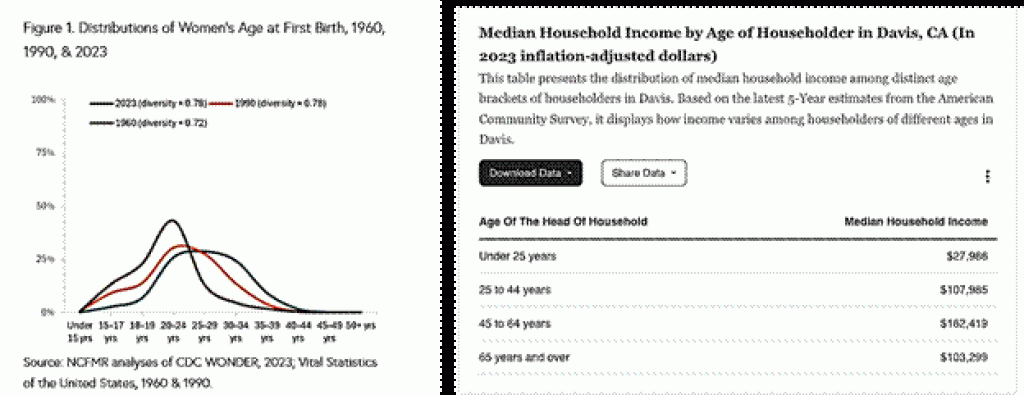
The problem is that most parents of elementary school students are in their mid 30s to early 40s, and most households in our region and in that age bracket cannot afford a single family house in Davis.
The District would have more sustainable enrollment if new students are elementary-school aged, as they will also be likely to remain in Davis schools through high school. Digging further into the national data correlating children’s age with household income (see below, from national statistics), the trend is clear that higher incomes bring more older children and fewer younger ones.
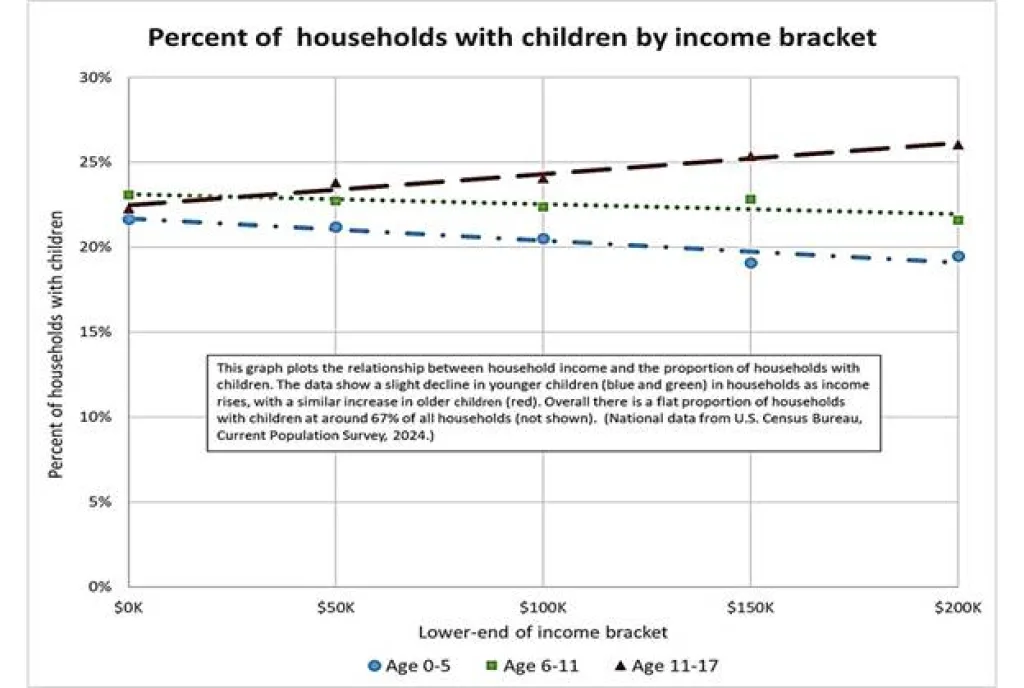
In other words, Village Farms and Willowgrove will likely increase the number of students attending the junior high schools and high school, but contribute little to enrollment at the elementary schools.
This effect will get worse over time. As the older students age through the system, many of their parents will stay put—this is a great place to live, after all, and really comfortable for older people. Yes, Baby Boomers will be turning their houses over, but only to the same age bracket that can afford the larger single family house prices—i.e. the mid-40’s on up with older children. This is the median age of larger new home buyers. But in this scenario there’s no backfilling elementary school enrollment, and it’s likely even more schools than those currently threatened will have to close.
What to do? If we want more elementary-age children then we need to be building housing that families with young children can afford, i.e., actual starter homes, which in Davis, at least, is NOT a detached, single family home. The term “starter home” is thrown around a lot in the published material for both Village Farms and Willowgrove, but we feel that’s more promotional than real.
Ideally, a starter home is one that a young family, near the beginning of their earning cycle, can afford to start a family in. Over time, they may move into more expensive housing, thereby freeing the starter home for another incoming younger family. And we shouldn’t be trapped into the language that implies a starter home is only a for-sale purchase. Renting is where most of us actually started, after all.
Again, the data sets correlating age to income indicate we need opportunities to move to Davis that are affordable to families making considerably less than $175,000. Housing that is attainable to low income families is income restricted and generally only covers those making less than 80% of the area median income ($135,000 for a family of four in Yolo in 2025) or $108,000. But households making between $108,000 to $150,000, also known as “the missing middle,” make too much to qualify for legally-defined “Affordable” housing, and not enough for a detached single family house here, even a small one.
Indeed, both Village Farms and Willowgrove offer detached houses on some very small lots: the smallest in Village Farms are about 2,500 square feet, in Willowgrove about 3,200 square feet (measurements taken off published plot plans). But in the Cannery, there are several dozen lots about 2,500 square feet that contain detached houses, e.g. Golden Sunray Terrace or Earlygirl Terrace, and according to Zillow are worth more than $800,000. The term “affordable by design” is floated in promotional materials for Village Farms and Willowgrove, but unfortunately our market does not support the concept if the house is detached, even if by just a couple of feet from the next one.
OK, what prices/rents can the missing middle afford? Applying the math to that $150,000 income (20% down, interest 6.5%, California taxes) results in a price point of at least $540,000, possibly stretching to $600,000 without a larger down payment.
Is it impossible to hit that price point here in Davis? No. There are duplexes and townhouses that can be had at those prices—again, take a look at Zillow. Yes, there are a couple of dozen detached houses with zero yard space being built now in Woodland that sell for about $550,000 (see Ruby Cottages) and are affordable to part of that missing middle, but Davis has many advantages that would make purchasing an attached house here attractive.
And the concept of a starter home, one that a young family can start to have children in, should not be limited to for-sale products. Even in our market, rental apartments are affordable here for 4-person families making less than $150,000, albeit the UC Davis student population has driven that market, and there are few options with the unit types and amenities suitable for families with children. But there could be such apartments, ideally 3-stories or less (so you can watch your children at play from even the top floor), 2-3 bedrooms, not rented by the bed, and with fenced play areas. Ironically, the best family-friendly apartments in Davis are the income-restricted, Affordable units including those at the Cannery.
To be sure, both Village Farms and Willowgrove are providing some attached housing that presumably will sell for the low $600,000’s, affordable to households earning at least $150,000, but that is exactly what they are building the least of: just 12% for Village Farms and (definitely a better balance) of 23% for Willowgrove. Village Farms has just recently adjusted their Affordable (income restricted) housing figures by placing 80 units in the “Moderate Income”–affordable to 80-100% AMI– category, but Willogrove still appears to not be providing for that income range (it’s early yet and they may adjust). In any case, in order to serve the most young families with elementary-school aged children, we really should be pumping up the housing that the missing middle can afford, but that’s not happening.
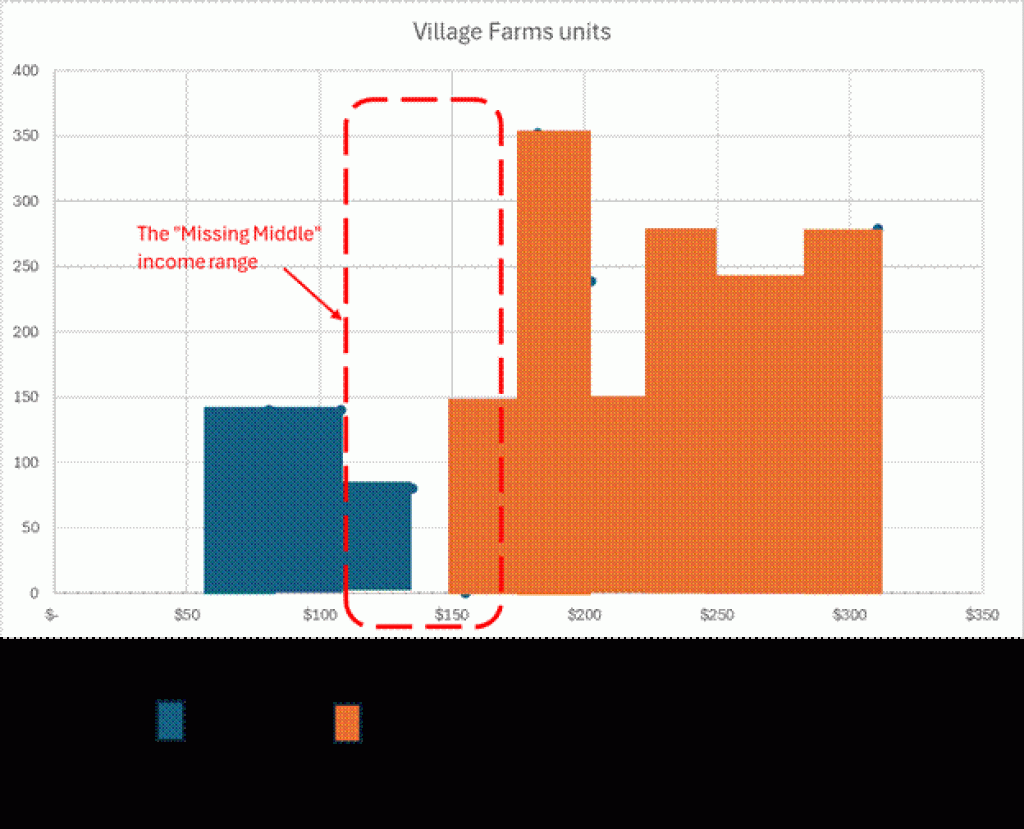
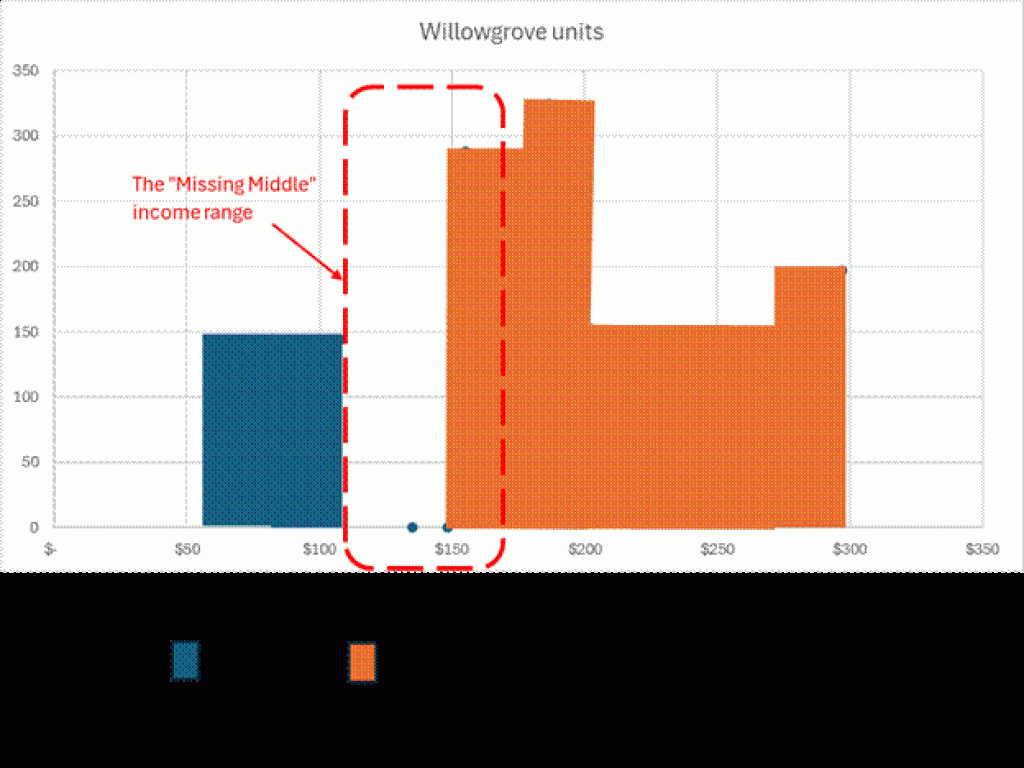
(Note: These graphs are derived from publicly available information about the projects and data from the sources noted above. Both projects are clear that their unit mix is subject to refinement going forward.)
The developers of these projects have likely left out significant “missing middle” price points in their proposals because they simply return lower profits. Or they may just be trapped in their traditional development paradigms, which are reinforced by financial institutions who lend the necessary funds. This is one of the negative byproducts of a planning process where the developer is pretty much the only one in the driver’s seat: rather than lean toward the actual needs of the community, they lean toward what they have done before. Understandable, but the community’s voice, other than a Measure J/R/D veto, is absent from the plans, and the current proposals just give us more of what spurred the creation of the Measure in the first place.
Projects that include more market-rate apartments and more attached houses like duplexes and townhouses are being built all over our region, so we find it hard to accept the assumption that sufficient money cannot be made on these products. In fact, the sales and rent revenue per acre goes up with density, and so does the amount of housing and revenue per acre are higher.
So will the projects as they stand today have hardly any families with wage earners in their 30’s and children of elementary school age? Not quite. Most of us here in Davis likely know of at least some families like that who have recently bought into our existing housing stock at prices well over $800,000. It’s anecdotal to be sure, but those families known to some of our group all had financial assistance–i.e. some wealth transfer– from their Baby Boomer parents, and that pattern will certainly continue to mitigate the loss of elementary school students here even with our high home prices. But we (Davis Citizens Planning Group) don’t think that will make a serious dent, and it will obviously exclude families who have not accumulated the necessary resources.
In our opinion, we believe that what Davis needs most is more housing that young families with young children (including those without wealthy parents) can afford, both to help maintain our elementary schools and to try to restore the vibrancy we have been losing (described well in prior Vanguard articles) as we become an older, even wealthier community with a big hole in the middle of our demographic mix. If you have any doubts about the unbalancing of our population, at least one clear sign is the declining portion of in-town school enrollment.
Is it inevitable? Hopefully not. Yes, birth rates are declining, largely due to the unaffordability of housing. But Davis has an inordinate amount of amenities, especially our schools, that make settling for a townhouse or even an apartment an attractive option. We don’t need to cede all of the younger families with young children to Woodland and West Sacramento.
Moreover, at least 1/3 of all existing detached houses in Davis are occupied by people over 65 and they will be turning over more quickly in the years ahead. And those houses will mostly be sold to the same demographic as the proposed developments are aiming at. The question becomes, why build more of the same when we could really use something else?
Bottom line, only a significant increase in housing in the missing middle categories– townhomes, cluster homes, larger-unit market rate apartments and condos–will enable us to avoid the extent of school closures we are being warned of. The product mix of Village Farms and Wilowgrove will largely go to wage earners over 40, whose children, if any, will typically be older–junior high and high school–and will age out of the system without replenishing the elementary schools. We all will face a difficult choice in upcoming Measure J/R/D votes, but it’s important to at least be clear-eyed as to what is being offered and what is not. We believe these projects will not arrest the decline in students for our elementary schools.
Davis Citizens Planning Group
Alex Achimore
Anthony Palmere
Richard McCann
Tim Keller
David Thompson
Follow the Vanguard on Social Media – X, Instagram and Facebook. Subscribe the Vanguard News letters. To make a tax-deductible donation, please visit davisvanguard.org/donate or give directly through ActBlue. Your support will ensure that the vital work of the Vanguard continues.

“minimum detached house price of $740,000”
And remember that $740,000 price is just the starting point before any upgrades or additional amenities.
(edited) this article isn’t worth reading past the first sentence. How much time do you guys spend writing this nonsense? You vote no and schools close but more importantly if these projects fail how long do you predict it will take until new housing of the kind you want gets built? Five additional years, ten? Its been 20 years since Measure X failed.
Ron G
Here’s a cautionary tale from Vacaville that shows that just building McMansions won’t get us to increased school enrollment. Just simply voting “yes” to stupid proposals that steer us way from sustainability that caters to the housing market that we really need won’t solve our problems.
This Bay Area exurb is full of McMansions — and may be the ‘next frontier’ of the housing crisis
https://www.sfchronicle.com/bayarea/article/vacaville-rent-housing-crisis-21169458.php
“And once those older students have graduated, their parents are likely to stay in place and Davis will simply gain more empty nesters who block further openings for families with students of any age.”
Nobody is ‘blocking’ anyone. Demographics are not a professional football game, just the aggregate of what people do. The school board, the Council, parents, this article — there is this bizarre bizarre bizarre thinking that seems to have originated with the school board, I believe to deflect the holy h*ll that is going to come down upon them for closing schools (happens everywhere) onto the voters for not voting in more student ‘stock’. Moo.
Everything is backwards. I agree that there should be better planning and variety of housing stock. But building that argument on the back of stocking schools with students is building on a mud flow. Davis should have requirements for developers that meet its housing goals and create robust and safe transportation corridors. The schools should look out at where things are going to be once the JeRkeD votes pass or not and close schools as necessary. And the City should massively accelerate repair of the roads and bike paths and go back to being a world-class city for alternative tranportation, as it is currently a clown show.
The bicycle museum — if it’s even still there as no one knows or cares — should close and be replaced by a clown museum, staffed by one part-time sad clown.
Did they really say we shouldn’t vote for housing because people stay in houses longer than they have kids? A complete agglomeration of nonsense. I wonder how many of them are sitting on empty nests? By the way single family homes have been the preferred choice of housing for families since post WWII Levittown in 1947.
Ron G
What a weird interpretation. We said that if we want more housing for families that will cycle through with more students, we should build for younger families that are more likely to ready to move up to a larger home later in life after their children graduated.
I’ve posted here several times the National Association of Home Builders survey that shows younger households are much more concerned about affordability and willing to live in common wall housing. It’s becoming increasingly obvious that starting out in a SF house is no longer an available path.
Alan
You miss the intent of this article–read the title. The question of whether we build to fill our schools is already on the table. Our point is that the solution put before us–just build anything that any developer puts in front of us–will not achieve that goal. So if we’re going to maintain school enrollment, then we need to build smarter than that.
I agree that building to fill schools should not be our primary focus, but if we’re going to build for rising demand, then we should build for people that are currently closed out of our community. Those people also happen to be the ones who have the children that we need most to have a sustainable enrollment level.
Our school district is providing a much more enriching program than any other in our region. It’s why we have a 50% house price premium over all other communities in the Sacramento Valley. If we want a better educated workforce to support our retirements, we should be attracting more students here. (I work with Davis students as a volunteer several times a week and they are truly amazing with outstanding ethics. They are willing to reach out and support students in other locales.) To me that’s the prime motive for keeping more schools open.
“Our school district is providing a much more enriching program than any other in our region. It’s why we have a 50% house price premium over all other communities in the Sacramento Valley.”
I’m not sure that’s true, as I’ve heard places like Roseville have a pretty good school district (and without as much of a “premium”). (Premium compared to what, exactly?) In any case, it’s not 50%, but I thought you were opposed to a “premium” in the first place?
How much of a “school district premium” do those moving from Davis to places like San Francisco or Los Angeles have to pay to attend schools that are WORSE than Davis’ school system?
“If we want a better educated workforce to support our retirements, we should be attracting more students here. (I work with Davis students as a volunteer several times a week and they are truly amazing with outstanding ethics. They are willing to reach out and support students in other locales.) To me that’s the prime motive for keeping more schools open.”
You want to attract students to support your own personal retirement? I don’t think it works that way in the first place, since most retirements are not sourced from the backs of “local workers”.
As for “reaching out an supporting students in other locales”, what are you talking about? And are you referring to school districts which LOSE students due to DJUSD’s poaching activities?
Obviously, it’s the wrong goal in the first place. But the school district itself claims that a school will close unless BOTH proposals pass (which doesn’t seem likely under any scenario).
So maybe folks just have to accept that a school or two will likely close. If folks find this traumatizing, let me know and I’ll come down and hold their hands.
But what this group advocates for is not likely to be appealing to young families, either. It’s more likely to be occupied by UCD students.
Families (e.g., 2 kids, 2 adults) demand a minimum 3 bedroom, 2.5 bath, 1,800 square foot (or thereabouts) house, with a 2-car garage and a yard. And they’ll get it for at least a couple hundred thousand less 7 miles north of Davis.
The school district is already relying upon those non-residents to temporarily avoid closure, but it’s still not enough for them to avoid closing a school (or so they say). 1,800 more housing units to come at the technology park (in addition to however many are left to build in the original part of Spring Lake). I recall that there are other long-range plans to build on other large parcels on the south side of Woodland (closest to Davis), as well.
Obviously, if the current proposal is approved, it will appeal to some demographic – probably older, established couples from the Bay Area with grown kids (same thing that this group noted).
Truth be told, the school lunatics would have a better chance of avoiding closure if they advocated for more sprawl OUTSIDE of Davis, due to the reasons described above. (However, the school district would miss out on substantial one-time fees under this scenario, and may not continue to receive other, voluntary contributions from this developer. Would have to look up how much voluntary contribution they’ve received so far from him.)
Looks like it’s around $500K over the years, to the “community” (primarily aimed at those associated with the school district):
“The event was serenaded by the Davis High School Baroque ensemble and attended by most of the DJUSD school board, as well as numerous teachers from around the district who applied for a grant. In turn, each gave a small speech as to what the grant money received will be going to.”
https://www.davisenterprise.com/news/schools/once-more-tandem-foundation-donates-40k-to-davis-schools/article_d15c718b-0a31-5d3b-9331-a58bf1f8be6a.html
Are some of these individuals (associated with the district) the same ones who are actively advocating for sprawl that would benefit this developer? And/or, are they the same ones who could benefit from his continuing “generosity”?
“Houston, we may have a problem” as they say. (But not the one claimed by the school district itself.)
Seems to me that the sprawl for school campaign has some serious credibility problems (in more than one way).
Ron O
(Edited)
Have you looked at the NAHB survey that I linked showing the younger families are not aiming for detached SF housing? We’ve provided evidence; all you offer is speculation based on outdated impressions from an earlier time.
And why would we want to increase housing in Woodland to fill our schools? It only increases traffic down Poleline into town, increases the VMT and GHG emissions, further decreases the vitality of Davis (and increases the value of your Woodland house.)
If you have any doubts about what families moving to the area “want”, all you have to do is look at who is living in Spring Lake.
I don’t “want” Woodland students to attend DJUSD. It’s DJUSD that’s encouraging that, not me. And truth be told, I suspect that WJUSD is also encouraging this situation to avoid building another school (and all of the associated/continuing costs).
There was a group of organized, local parents who were quite upset about the lack of another school in Spring Lake, but I believe they’ve given up.
As for the value of anyone’s house in Spring Lake, this situation INCREASES its value, if anything. So regardless of what you believe regarding “my” situation, it’s not driven by self-interest. Apparently, that’s difficult for you to believe (but that’s not my problem).
I support DJUSD right-sizing itself to correspond with the community’s needs.
You don’t want Woodland students to attend DJUSD but if their parents work in Davis or UC Davis they are entitled to AND by actively blocking housing you are creating the conditions that make possible what you don’t want
David: There is no way to prevent Woodland from providing what families seek (at a much better price than what Davis offers), in regard to “new” housing.
But it sounds like UCD might have some responsibility to address this situation itself.
I don’t know why families (or anyone else) is moving to this area in the first place, since UCD (for example) isn’t hiring.
Most of the families living in Woodland likely consist of both parents working, and it’s unlikely that both of them are working at UCD. There is probably a pretty good chance that one of them is, or is working for Davis’ oversized school district themselves. If DJUSD wasn’t poaching students from Woodland, those DJUSD workers might have to find themselves a job in Woodland’s school district in the first place. And in that case, there’d also likely be another school built for them in WOODLAND.
You seem to forget that UCD isn’t the center of the universe around here. Sacramento is. (The same reason that so many Davis residents work at state agencies in Sacramento.)
What does anything this have to do with the facts on the ground:
1. The law permits students whose parent(s) works in the confines of DJUSD to attempt school there
2. By blocking housing in Davis, you prevent people who work at UC Davis or in Davis from buying homes there (or at the very least limit it and make it more expensive)
3. The effect is then to create the situation that you claim to not want
“To attempt school there”. (Right – it’s not “required”.)
UCD isn’t hiring in the first place.
There is nothing anyone can do about the price differential, which will continue regardless.
It seems to me that you should be blocking housing in Woodland, “so that” it’s built in Davis instead.
Ultimately, I can only weigh in where my “message” is even considered in the first place. And it’s certainly not embraced in Woodland (or anywhere else around here). I’m clearly in the minority in a place like Woodland. If I could make any difference there, I certainly would try. (Though I actually was pretty successful regarding a somewhat related issue, more than once.)
Ultimately, it comes down to “act locally” (where one can), and “think globally”. There are places that simply have to be written-off. I’d almost put Woodland in that category, though it does have an exceedingly “generous” voter-approved urban limit line.
By the way, whatever happened to the plan for UCD to build housing for its own employees, like they already did years ago behind the mall downtown?
“UCD isn’t hiring in the first place.”
Temporary and likely to change quickly, certainly not a situation to plan for the next 10 to 20 years.
“There is nothing anyone can do about the price differential, which will continue regardless.”
They can make it worse by not building
“It seems to me that you should be blocking housing in Woodland, “so that” it’s built in Davis instead.”
LOL
“Ultimately, I can only weigh in where my “message” is even considered in the first place. And it’s certainly not embraced in Woodland (or anywhere else around here).”
TGFSF
“By the way, whatever happened to the plan for UCD to build housing for its own employees, like they’ve already done behind the mall downtown?”
You blocked it.
“Temporary and likely to change quickly, certainly not a situation to plan for the next 10 to 20 years.”
What has changed is that there’s going to be a dearth of new students based on demographics alone. Now, if UCD wants to compete for a declining pool of students, maybe that’s something they should plan for (in regard to housing for its own employees, since they’ve supposedly already addressed plans for students). First, they should probably figure out where they’re planning to get funding to accommodate their hoped-for growth, and then figure out the number of new employees they think they’ll need – if that’s actually the plan in the first place.
“They can make it worse by not building”
It’s not going to get “worse” or “better” by building more housing in Davis, since prices are ALREADY kept in check by a host of factors, including (but not limited to) what they’re building in surrounding communities.
Truth be told, housing in Houston impacts prices in California.
Prices are going down in Davis, and not as a result of what’s being built there.
“You blocked it.”
I haven’t blocked anything, let alone housing for employees on campus.
I will acknowledge this, however: I don’t care if housing prices rise as a result of demand increasing faster than supply. Instead, I would generally look at the causes of demand, and address those (if the market doesn’t already do so – which it does).
If you build a Google headquarters in your community (or perhaps even a DISC), demand increases as do prices.
To me, step #1 is to decide how large a given community should be. And then, plan around that. If that’s done in the first place, there wouldn’t be “housing shortages”.
I look at something like the Village Farms and Shriner’s sites as an intangible benefit to Davis as is. There is no benefit to Davis to develop them. The negatives OVERWHELMINGLY outweigh any perceived positives – not even close.
Your step 1 is the problem and it’s guaranteed to create a housing shortage. You need to assess not how large a community should be, but rather what the needs of the community are and how best to meet them.
Step #1 is absolutely not going to create a housing shortage, if a given community isn’t pursuing job-creators. There are places in California (including some in the Bay Area) which essentially haven’t changed in my lifetime. And the primary reason for that is that there are no jobs to speak of, in those areas.
Regarding addressing the “needs of a community”, do you see no irony in the fact that this is exactly the opposite of what you advocate in regard to the actual, decreasing needs of Davis – in contrast to its oversized school district?
Don’t be afraid of change, my blogging friend.
I just noticed how similar the word “friend” is to “fiend”.
Just like “underserved” is to “undeserved”. Truth be told, I mentally “switch” those two words myself at times, just for my own amusement.)
“Step #1 is absolutely not going to create a housing shortage, if a given community isn’t pursuing job-creators. ”
You basically want a city that doesn’t work, creates artificial scarcity, and yet is affordable and cohosts a world class university that is currently at 40,000 people. Doesn’t seem like you are making a realistic assessment of Davis and its needs.
There is, however, a brand-new community pool at the senior/community/sports park center in Woodland (technically adjacent to Spring Lake I think), which likely further appeals to young families.
For those who haven’t seen that facility, you really should check it out. It’s far more impressive than anything Davis has, and attracts families from throughout the region.
Just a couple of comments to address things brought up in a couple of points above:
“if we build missing middle housing it will likely be taken by students”
The number of students at UCD is a fixed number, the university wont accept more students based on how much housing we build. To the extent that we do build apartments and townhomes that do get taken by students, it can only help to free up “mini dorm” house rentals in the single family market, of which there are many… that isn’t a bad thing.
We want to be building more missing middle housing, but even building more student housing will produce more single family homes that way.. if that is what you are worried about ( we arent)
The “UCD Isnt hiring” and “the population isnt growing” arguments
So long as we have a net migration IN of people who are priced out.. then it makes sense to build.
That number is 17,000 people per day 6,000 of those people are university staff, the rest is our local workforce. The flattening of prices, the lack of population increase, the excess of homes on a national level… none of those arguments matter so long as we have a LOCAL shortage, which we undeniably do. The fact that there is an excess of housing in places like Detroit is a total sequitur.
If you add in all of the many many very good reasons why building single family houisng should rightfully be our last priority ( affordability / sustainabiilty / traffic / water use / Civic service costs etc) then it makes even less sense for us to think that approving large sprawling single family tract home developments is a good solution.
“So long as we have a net migration IN of people who are priced out.. then it makes sense to build.”
As long as prices are “different”, Davis will ALWAYS have a net migration of people in to UCD (not to Davis, itself).
But I like how some Davisites apparently think they “own” the university, much like they think they “own” I-80.
Most households are likely commuting to more than one location, as well.
There is likely a net migration “out” of Davis, if employment at UCD is not considered. (And actually, UCD itself is not in Davis. A lot of it isn’t even in Yolo county.)
There’s an article in the Vanguard today from someone complaining about the new toll lanes that will impact people commuting OUT of Davis.
So maybe I’ll return to my original suggestion, that those commuting “out” of Davis meet on the causeway with those commuting to UCD, and “duke it out” on the causeway.
Of course, the “losers/winners” might also have to switch spouses, depending upon where THEY work.