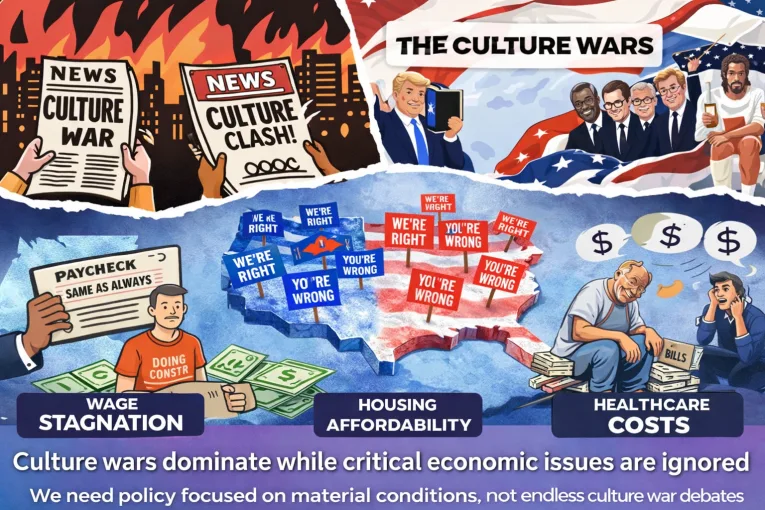
The culture war did not appear by accident. It functions too well for that.
Every election cycle, every media panic, every viral outrage follows the same pattern: symbolic conflict surges to the foreground while material conditions continue to erode in the background. Wages lag. Housing tightens. Healthcare costs climb. Infrastructure decays. Then the conversation shifts to language, identity, and spectacle.
Public energy is finite. When it is consumed by symbolic battles, it is unavailable for structural change.
Culture wars are cheap. They require no legislation, no budget fights, no confrontation with concentrated wealth or entrenched interests. They can be fought endlessly without resolution, which makes them ideal for political actors who benefit from attention without accountability. Nothing has to materially improve for anyone. The fight itself is the product.
Economic policy is the opposite. It demands trade-offs, enforcement, and winners who are not donors. It requires sustained focus and measurable outcomes. It also threatens existing power structures. That makes it inconvenient.
So economic anxiety is redirected. Rising rents become moral decay. Job insecurity becomes cultural invasion. Healthcare precarity becomes personal failure. Structural problems are reframed as symbolic enemies, and the public is encouraged to fight one another instead of the systems producing the stress.
This is not to say cultural issues do not matter. They do. But their elevation to total dominance in public discourse is not proportional to their impact on daily survival. A household cannot symbolism its way out of a rent increase or a medical bill. Moreover, some culture wars go beyond symbolic battles; they question the very existence and rights of certain groups within the country. These deeper conflicts can obscure the urgent need for economic reform and create a climate of fear and division.
The result is a politics heavy on identity performance and light on material delivery. People are mobilized emotionally but left economically stagnant. Outrage substitutes for improvement. Alignment replaces outcomes.
Meanwhile, the underlying conditions worsen quietly. Prices rise faster than pay. Public services thin out. Risk shifts downward onto individuals who are told to argue about values while absorbing costs. According to recent studies, the average rent in major cities has increased by 30% over the past decade, while wages have stagnated. Meanwhile, healthcare costs have risen by 50%, putting immense financial strain on families. These are not abstract numbers; they represent real people struggling to make ends meet.
This arrangement is stable precisely because it is exhausting. When everyone is locked in cultural combat, coalition becomes impossible. Shared material interests dissolve into factional suspicion. Economic reform requires solidarity, and solidarity is the one thing culture war logic cannot allow.
The solution is not silence on culture. It is proportionality and discipline. To combat this, we need policies that prioritize economic stability. This includes investing in affordable housing, raising the minimum wage, and expanding access to healthcare. These are not just economic issues; they are fundamental to a just society.
Public discourse must re-anchor itself to material conditions. Every symbolic fight should be met with a simple question: what does this change for people’s ability to live, work, stay housed, and stay healthy? If the answer is “nothing,” then it should not be allowed to crowd out the issues that do.
Media has a role here, but so do voters. Attention is political currency. Where it is spent determines what power responds to. If outrage continues to be rewarded more than outcomes, nothing structural will change.
Economic deterioration is not abstract. It shows up in stress, debt, shortened horizons, and quiet despair. No amount of symbolic victory compensates for that.
Culture wars absorb energy. Material reform requires it. The choice is not between values and economics. It is between performance and survival.
It’s time to shift our focus from symbolic battles to material improvements. Vote for candidates who prioritize economic reform. Support policies that address housing affordability, wage stagnation, and healthcare costs. Engage in community efforts to demand structural change. Your attention and energy are valuable; spend them on issues that truly matter.
Follow the Vanguard on Social Media – X, Instagram and Facebook. Subscribe the Vanguard News letters. To make a tax-deductible donation, please visit davisvanguard.org/donate or give directly through ActBlue. Your support will ensure that the vital work of the Vanguard continues.