
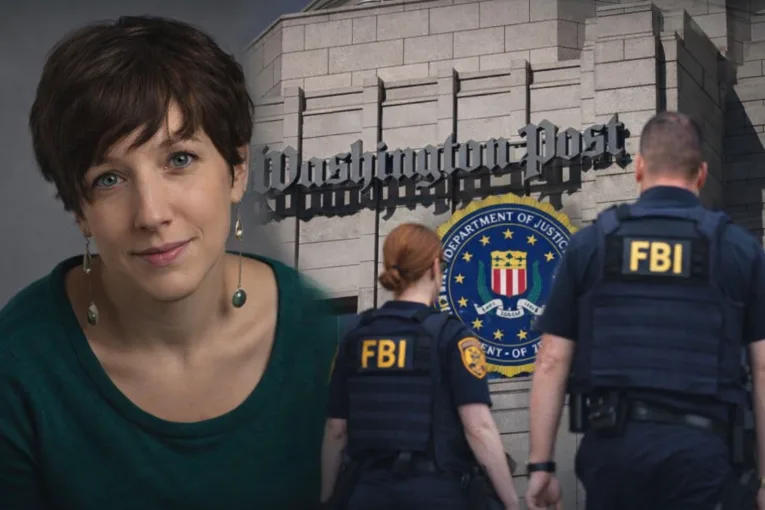
WASHINGTON — In an opinion piece published in The Intercept, journalist Lauren Harper argued that a decision by Attorney General Pam Bondi last year to rescind media protections that had barred searches of journalists’ records in federal leak investigations led to the FBI raid on Washington Post reporter Hannah Natanson’s home on Jan. 14, an action Harper described as unnecessary and based on a sham pretext.
Harper asserted that the raid was part of “the Trump administration’s war on press freedom.” According to the article, the search of Natanson’s home was allegedly tied to an investigation into government contractor Aurelio Perez-Lugones, who is accused of illegally retaining classified information, a move press freedom advocates say infringes on First Amendment rights.
The Intercept reported that a Freedom of Information Act request filed by the Freedom of the Press Foundation showed that Bondi’s justification for reversing the protections was “nonsense.” Harper further wrote that Bondi’s decision to rescind “Biden-era media guidelines” stemmed from the administration’s dissatisfaction with journalists’ reporting on Trump’s invocation of the Alien Enemies Act “to deport Venezuelans” last spring.
According to The New York Times, a “newly declassified” memo contradicted Trump’s claim that the Venezuelans deported to El Salvador were affiliated with the gang Tren de Aragua and tied to Venezuelan President Nicolás Maduro. The article cited the memo as stating that “spy agencies do not believe that the administration of Venezuela’s president, Nicolás Maduro, controls a criminal gang, Tren de Aragua.”
Harper wrote that, in addition to The New York Times, The Washington Post had uncovered similar information undermining Trump’s original justification for the deportations. The Washington Post reported that the intelligence product found, while there were some low-level contacts between the Maduro government and Tren de Aragua, or TdA, the gang does not operate at the direction of Venezuela’s leader.
Harper noted that, following the publication of those findings, Bondi claimed that “leaks about the memo were ‘illegal and wrong’ and made it more difficult to ‘keep America safe.’” Harper wrote that, to test Bondi’s assertions and the reasoning behind rescinding media protections, she made a journalistic decision.
“I filed a FOIA request for the intelligence community memo the same day Bondi reversed the DOJ’s media guidelines,” Harper wrote. She added, “I didn’t believe her claims that public awareness of the memos caused any harm to national security, and I know that agencies are required to take public interest into account when reviewing even properly classified information for release.”
Seven days after filing the request, Harper wrote that the document was “declassified and released” to her. She argued that the release showed that “Bondi’s accusations about journalists and her reversal of media protections have gone unchecked and are now being weaponized by law enforcement against journalists and their sources.”
Harper further wrote, “Not only did the official disclosure back up initial reports that the Trump administration had no basis for invoking the Alien Enemies Act, but it also showed the information could be released without making it any harder to protect America.” She also pointed to what she described as a long-standing tendency of presidential administrations to classify “too much information.”
Under the Trump administration, Harper wrote, this practice is taken to an extreme, with officials treating everything “from kitchen cabinets to foreign movies” as matters of national security. She added that she has studied government secrecy for more than 15 years and tracked both Trump administrations closely, writing, “I have never seen them take a good-faith approach to this rule.”
The article noted that, even when information meets standards for classification, agencies are supposed to weigh the public interest when making declassification decisions. Harper argued that “Congress should have stepped in years ago to protect journalists by passing a federal shield bill or reforming the Espionage Act so national security reporters and whistleblowers aren’t treated like foreign spies.”
Harper also noted that journalist Seth Harp was recently subpoenaed by the House of Representatives. In a post on X, Rep. Anna Paulina Luna wrote, “I have made a motion to subpoena Seth Harp before Congress to face accountability for leaking classified intel about Operation Absolute Resolve, including doxxing a Delta Force commander.”
Concluding the piece, Harper wrote that as long as classified information is “obtained lawfully,” journalists are constitutionally protected in publishing it under the First Amendment. “The entire federal government needs a refresher course: The public has a right to know what the government is doing and why,” she wrote.
Follow the Vanguard on Social Media – X, Instagram and Facebook. Subscribe the Vanguard News letters. To make a tax-deductible donation, please visit davisvanguard.org/donate or give directly through ActBlue. Your support will ensure that the vital work of the Vanguard continues.
