
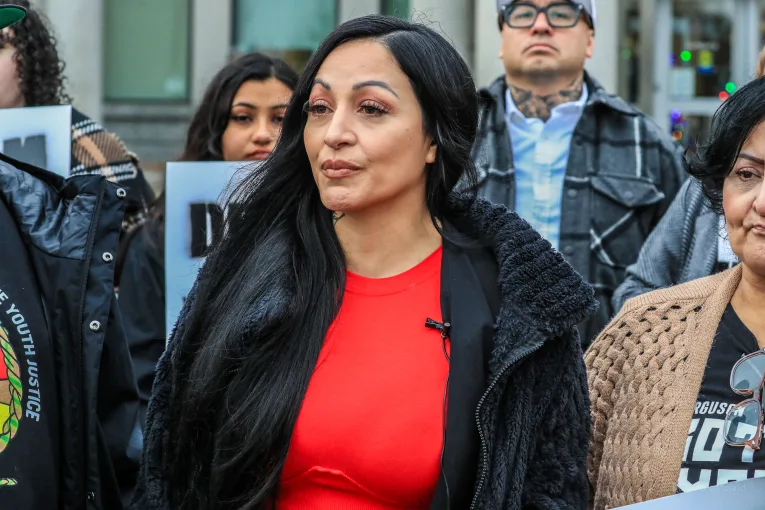
WOODLAND, Calif. — A Yolo County Superior Court judge on Monday dismissed criminal charges against Marissa Barrera, concluding that prosecutors failed to identify speech that could overcome constitutional protections under the First and Fourteenth Amendments and failed to meet the statutory requirements of California Penal Code section 653.2.
Catherine Hohenwarter granted the defense motion to dismiss after reviewing a YouTube video posted by Barrera in December 2024 and hearing extensive argument focused on whether her speech could lawfully be treated as incitement or electronic harassment.
“I cannot get past the language of the statute,” Hohenwarter said in ruling from the bench. “There was no speech identified by the People that would qualify for those qualifications included in the statute.”
The charge arose from a video Barrera posted while civil litigation was pending over the killing of her brother by a Woodland police officer.
Prosecutors alleged the video was intended to place the officer and his family in fear and to incite unlawful action by third parties.
Defense attorneys argued the case sought to criminalize opinion speech critical of government conduct.
At the beginning of the hearing, Deputy District Attorney Stephen J. Ribet told the court that the People were prepared to proceed on the motion to dismiss and said the entire video must be considered in context.
“You can’t parse out any 30-second clip from this five-minute, 40-second video,” Ribet said. “It’s important to take the entire thing altogether in the context that the whole video provides.”
Ribet argued that the video’s references to the officer’s family and location created an implicit threat.
“Any reasonable person is going to feel threatened by that,” he said, adding that speech could be regulated where it was “likely to incite imminent unlawful action.”
Deputy Public Defender Martha Sequeira immediately framed the dispute as a constitutional one. She argued that the prosecution’s theory ignored the statute’s strict requirements and attempted to substitute inference and speculation for proof.
“The charge is my client’s words,” Sequeira said. “The actual words and the constitutional protection that the First Amendment would give her in being the immediate family member of a victim who was murdered by the perpetrator that she’s speaking about.”
Sequeira objected to the prosecution’s reliance on an affidavit submitted in support of the People’s position, saying it could not be treated as evidence and did not resolve the central question before the court.
“An affidavit cannot be taken as evidence absent a stipulation by the defense,” she said. “This is a government-brought charge for a violation of a law that is protected by the defense’s position under the First Amendment contextually.”
After the court recessed to watch the video in chambers, Sequeira delivered an extended argument attacking the prosecution’s reliance on Supreme Court precedent. She said the People misread Brandenburg v. Ohio, which requires intent to produce imminent lawless action and a likelihood that such action will occur.
“The two-pronged test of Brandenburg is not an either-or,” Sequeira said. “There was no call for immediate illegal activity, absolutely none.” She added, “The prosecution was making an inference based on what he believes was circumstantial evidence to prove her intent, and that inference was not based on facts from her speech itself.”
Sequeira emphasized that Barrera’s video was opinion speech tied to a civil case and relied on information developed through litigation. “It’s simply an opinion that she has a right to have, which is protected by the First Amendment,” she said. “Speech critical of the government, even very critical speech, does not make it not an opinion.”
She also rejected the claim that Barrera published private or identifying information. “That is reposting publicly available information,” Sequeira said, noting that the images at issue were shared by the officer’s family on social media. “That is not disseminating private information.”
Ribet responded that incitement does not require explicit commands. “You don’t need to identify the specific unlawful action you’re inciting,” he said. “It’s merely that you’re providing a statement that is likely to incite that action.”
Judge Hohenwarter repeatedly questioned that interpretation, asking what unlawful conduct Barrera was allegedly urging.
“What is the call to action?” she asked. “Because remember, we’ve got all these police brutality cases all over the United States. We all watch the videos.”
She also noted that the video had been online for approximately a year without any subsequent harassment or unlawful acts. “What’s happened in the last year since this has been posted?” Hohenwarter asked.
In granting the motion, Hohenwarter said she viewed the video in the light most favorable to the prosecution but still could not reconcile it with the statute. “This is free speech, no question about it,” she said. “It’s her own opinion and only her opinion.”
Outside the courthouse before the hearing, Barrera was joined by advocates and impacted family members who described the prosecution as retaliatory and warned of broader implications for families who speak out about police violence.
George Galvis, identified as co-founder and executive director of Courage Communities United for Restorative Justice, said supporters had gathered “mobilizing in support of Marissa Barrera.”
Galvis said, “Marissa is an impacted family member. Nine years ago, her brother, Mike Barrera, was murdered by the Woodland Police.” He added, “To add insult to injury, the officer, one of the officers who’s responsible for her brother’s death, has filed charges for her simply having the audacity to expose his corruption and his abuse.” Galvis said, “These are charges that should have never been filed. They’re erroneous charges.”
Galvis also criticized the manner in which the charges were brought, saying Barrera learned about them only after discovering there was a warrant for her arrest. “The fact that she wasn’t served properly,” he said, “put her at risk and put her in danger.”
Speaking at the press conference, Barrera identified herself and described her advocacy since her brother’s death. “My brother was murdered by five Woodland Police in 2017,” she said. “Next month marks nine years.”
Barrera said she had spent years researching her brother’s case and other incidents involving law enforcement.
“I’ve learned how to do investigative research,” she said. “I’ve done a lot of research into my brother’s case, as well as into other corruption cases out here in Yolo County and across the country as well.”
Barrera said the video at issue drew from information developed during civil litigation. “I created a video called ‘Exposing,’ and I named that officer,” she said. “I shared what he did to my brother. I shared information that is public record. I shared information that came out while we were fighting our civil case.”
She described learning months later that there was a warrant for her arrest. “Seven months later, I found out that there was a warrant for my arrest,” Barrera said. “Nobody ever told me. I was not contacted.” She added, “I felt like that was putting my life in danger.”
Barrera rejected the allegation that her conduct constituted harassment or threats. “I did nothing wrong,” she said. “I feel like I was doing exactly what I was supposed to be doing because my brother did not get justice.”
Asked what message she wanted to convey, Barrera said, “I want to remind law enforcement and everybody involved in covering up my brother’s case that we are going to continue speaking up for Michael and demanding justice and accountability.” She added, “This isn’t the first time I’ve been targeted or harassed through even legal measures because of speaking out.”
Laurie Valdez, identified as an impacted family member from Santa Clara County, spoke in support of Barrera and said the charges compounded harm to families already affected by police violence.
“This kind of treatment of an impacted family member is just adding more trauma to the trauma that her family and every family has already been subjected to,” Valdez said. “Police cannot just go after family for speaking the truth.” Valdez added, “What Marissa has done is not a threat.”
Galvis closed the press conference by characterizing the case as part of a broader pattern. “These are clearly retaliatory tactics,” he said. “This is part of their general playbook.” He added, “This is intimidation to try to silence family members.”
Barrera ended by reiterating her innocence. “I’m completely innocent of the charge that they are trying to put on me,” she said. “If anything, I feel I have done a great service to the community by providing the truth.”
The case was dismissed.
Follow the Vanguard on Social Media – X, Instagram and Facebook. Subscribe the Vanguard News letters. To make a tax-deductible donation, please visit davisvanguard.org/donate or give directly through ActBlue. Your support will ensure that the vital work of the Vanguard continues.


Do you have a link to the video in question?
I think they said it was on YouTube, they quoted from it during their arguments, but the judge watched the whole thing in her chambers.
I met this woman many years ago and heard her story from her. I believe it was a Vanguard event like maybe at Sophia’s, though I can’t imagine why I would be a Vanguard event (unless I was there to be annoying). I believed her story at least hearing her perspective, and she was deeply wounded by the loss of her brother.
The defense attorney kept using the word ‘murdered’ which implies the officer was convicted? I would assume, or he couldn’t use that word in court? Or can he? He also says ‘killed by’. I haven’t followed closely enough to remember if there was a conviction.
How this technically falls I do not know. I am certainly concerned anytime there are threats or potential threats to law enforcement, victims or witnesses, and their location is given. But in today’s world, privacy is impossible — everyone can find out where anyone lives. I tried for years to keep my location private — PO Box, private number, etc. — but a few decades ago that became impossible — I remember the day I gave up. I was talking to someone I didn’t know on a political matter, and said I didn’t want to give my address. I then heard him typing in the background and he told me where I lived a few seconds later.
But I was disturbed by the quote “What’s happened in the last year since this has been posted?”. That can’t be the measure of whether someone has a legitimate threat — whether they have been attacked or not. Let’s look at the hypocrisy — only if you believe that statement as a defense that is. All the groups in town that claim either they are being doxxed for things that aren’t doxxing, or the people who claim the attacks have happened due to the so-called violence of words. These all can’t be true only when the politics fits one’s own model of making or being the victim of a threat or assault. It does still go both ways.
Alan – to your last point which I think is well considered… The judge explained that imminence is not optional under Penal Code section 653.2 and that the prosecution failed to establish it in any meaningful way.
She said that the statute requires intent to cause imminent unlawful action by a third party
“This was posted when?” she asked. When told it was December 2024, Hohenwarter followed up: “So we’ve had a year where this has been out there. Has there been any further harassment?”
“What was the call to action?” Hohenwarter asked. “Because remember, we’ve got all these police brutality cases all over the United States. We all watch the videos.” When the prosecution argued that incitement does not require an explicit call to action, the judge pointed back to the statute itself and pressed on the immediacy requirement. “The statute says, let me stop you, ‘for the purpose of imminently causing that other person unwanted physical contact, injury or harassment by a third party.’ How do I get past that language?” she asked.
I think your concern – correct me if I’m misstating this as its not my intention – what happens in the dog doesn’t bark scenario where someone clearly crosses the line but nothing happens.
I found this fascinating because they are actually going back to Justice Holmes and the seminal free speech cases during and after WWI, but that was always the problem – at what point is there a clear and present danger from speech.
I think the judge points out here: She explained that without evidence of imminence or likely unlawful action, the court could not reasonably send the case to a jury.
But I actually think it’s the combination of no harassment and the fact the there was no direct call to action that necessitated it rather than just the lack of harassment.
Ok, thanks for the clarifications. Those legal nuances are hard to follow, but I get the logic.
Good points.
Regarding “murder”, it would be interesting to know if a police officer (who is being called out for actions conducted on the job) could sue for slander or libel. (This is another area where free speech isn’t necessarily free – even if it’s not an incitement for violence.)
A potential civil case; not a criminal one?
As a side note, I just read that there were criminal convictions in France for essentially hurting the feelings of the president’s wife (as described in the article I read, at least).