
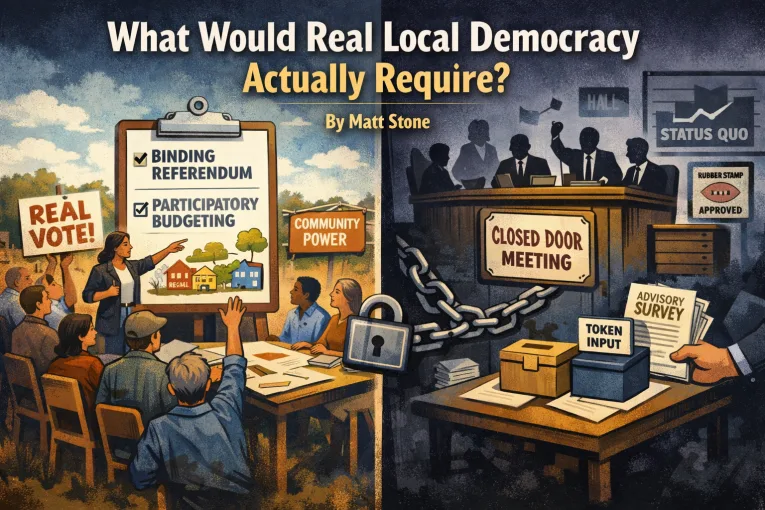
Local governments speak fluently about participation. Public comment is scheduled. Surveys are circulated. Task forces are formed. Input is collected, summarized, and thanked. The performance is polished enough that it feels like democracy is happening, even when nothing about the outcome changes.
What residents are being offered is access, not authority.
This distinction matters because access can be granted without risk. Authority cannot. Listening does not require surrendering control. Binding decisions do. The gap between those two things defines most local governance today, and it is not accidental.
At the local level, democracy is carefully managed. Ballot measures are limited in scope. Advisory votes are encouraged in place of binding ones. Major land use decisions, long-term contracts, and budget priorities are treated as technical matters best handled by professionals, even when they reshape entire communities. When public opinion conflicts with institutional preference, procedure almost always wins.
That pattern repeats in participatory budgeting. These programs are often presented as proof that residents have a seat at the table, yet the table itself remains off limits. The funds allocated for public decision making are typically small, symbolic, and peripheral. Residents may choose between projects that have already been deemed acceptable, while the core budget that reflects the city’s real priorities remains untouched. Engagement is celebrated. Control is retained.
Accountability follows the same logic. Recall mechanisms exist, but thresholds are set high enough to discourage their use. Officials may campaign on specific commitments, reverse course once elected, and face little immediate consequence. The public is told to wait, to be patient, to vote again later. In the meantime, decisions move forward, often in direct opposition to expressed community opposition.
Even when councils respond to pressure with promises, those commitments are rarely enforceable. Timelines are flexible. Language is softened. Follow-through becomes optional. Without binding mandates or material consequences, public trust becomes something residents are expected to supply indefinitely, regardless of performance.
This is usually defended as pragmatism. Direct democracy is framed as messy, risky, or unsophisticated. Residents are warned that they lack the expertise to make complex decisions, as if complexity has ever been a neutral barrier rather than a convenient shield. What is being protected is not good governance, but concentrated authority.
What is missing here is not some abstract democratic ideal, but the will of those in power to surrender any of their own.
Real local democracy would require more than improved outreach or better messaging. It would require binding referenda on consequential issues, not merely advisory gestures. It would require participatory budgeting that controls a meaningful portion of public funds, not decorative slices at the margins. It would require recall processes that function as real safeguards, not theoretical threats. It would require public mandates that are enforceable, with clear benchmarks and consequences for failure.
None of this is impossible. It is simply uncomfortable.
Local government is the level of governance closest to daily life. It is where decisions about housing, safety, infrastructure, and public space are made. If democracy cannot function here, where proximity is greatest and stakes are most tangible, it is difficult to argue that it functions anywhere.
The distance between public input and public authority is not the result of confusion or inertia. It is maintained through policy choices that preserve control while projecting inclusivity. Participation is welcomed so long as it does not interfere with outcomes.
The question, then, is not whether communities care enough to govern themselves. It is whether those currently governing are willing to allow it.
Until power is shared rather than managed, local democracy will remain a performance, not a practice.
Follow the Vanguard on Social Media – X, Instagram and Facebook. Subscribe the Vanguard News letters. To make a tax-deductible donation, please visit davisvanguard.org/donate or give directly through ActBlue. Your support will ensure that the vital work of the Vanguard continues.

Some examples would be nice. Here in Davis, we have direct democracy for rezoning ag land, the result has been a shortage of housing, driving up prices and excluding young families of moderate means from community membership and opportunity to participate in direct democracy.
Matt lives in Winters. He also has a third piece that will likely run tomorrow.
Hello,
While I have drafted this for each community to be able to use such thoughts for their own particular circumstances, I am indeed willing to provide examples.
Here are a few Davis-specific examples that illustrate how “managed participation” can create structural exclusion, contrasting with the rezoning issue you raised:
The Peripheral Projects vs. Core Discretion
While Davis residents get to vote on “permanent” changes like rezoning agricultural land (Measure J/R), they are often excluded from the bulk of the fiscal discretion. The City Manager and staff control the daily operational budget, which accounts for the vast majority of spending, while the public is often only presented with pre-vetted “participation” opportunities for the fringe. For example, the Participatory Budgeting process involves residents debating how to allocate a relatively small slice of discretionary funding (often for one-time projects like park benches or art). This gives the appearance of direct control, but it keeps the public away from the structural levers of power—the massive general fund, the pension liabilities, or the salaries of the administrative class that actually runs the city.
The “NIMBY” vs. “YIMBY” Friction
You touched on Measure J/R. This is a prime example of how “direct democracy” can be weaponized to serve a specific constituency. While it was sold as a tool to preserve Davis’ character, the structural reality is that it empowered the existing landed class (homeowners) to control the supply of new housing. By making every rezoning a vote of the general population, the system inherently favors those who have the time, resources, and tenure to participate in local politics. It structurally sidelines the “moderate means” young families you mentioned—the very people who are priced out by the scarcity it creates. The “participation” isn’t neutral; it’s weighted against those who aren’t already here.
The Advisory Committee Trap
Look at the Social Services Commission or the Planning Commission. These are pitched as venues for “managed participation”—places where citizens can roll up their sleeves and do the work. However, these commissions are often structurally hamstrung. They are advisory only. They can spend hours debating a policy or a grant, only to have the City Council ignore their recommendations or defer to the “expertise” of staff. This effectively uses the energy of engaged citizens to provide the illusion of rigorous vetting, without actually ceding the power to approve or deny. It creates a buffer where passion goes to die in a meeting room, rather than disrupting the agenda at the Council level.
The Circular Definition of “Growth”
In Davis, “managed participation” often looks like the General Plan update process. The city holds countless workshops and charrettes asking residents to draw maps and give feedback on “growth boundaries.” Residents dutifully participate, creating a consensus that favors preservation and low-density housing (driven by the same exclusionary forces in your example). The Council then adopts this “community vision” and uses it as a shield to reject development or state-mandated density requirements. The participation was real, but it was managed to produce a pre-determined outcome: entrenching the status quo and using the “will of the people” to justify why no one new can afford to live here.
This comment should have been your article. Actually it could be the core for four articles.
I’m not here to hold the hand of every community. Should I wipe for you, too?
MS say, “The ‘participation; isn’t neutral; it’s weighted against those who aren’t already here.”
I remember Gloria Partida making a similar comment several years ago, about those not yet here no being able to vote. As then, I’m trying to understand how such a system could be structured — one wherein future residents get to vote in Davis. Could we just go with people who really really really really want to live here? I’d also like to remind the author that (8.1 billion minus 70,000) people don’t live here yet, so the ballot process itself could bankrupt the County.
You are intentionally missing the point to score cheap points.
I was not referring to “future residents” having the right to vote before they move. I was referring to the mechanisms of local control—zoning, planning, and development—that are deliberately structured to prioritize the interests of those who are already entrenched (homeowners) over those who are trying to get in.
The system isn’t neutral; it is weighted by wealth and tenure. You don’t need to strawman the argument into a logistical nightmare about 8 billion people voting to admit that the cost of entry into this community is rigged. It is designed to protect the asset value of the landed class at the expense of everyone else.
“Cheap shots” you say, coming from the guy who just called me a racist, while asking another commenter if he wanted him to “wipe” for him.
8 billion people?
The system is not designed to raise housing costs; it’s designed to discourage haphazard development on farmland – something that we CONTINUE to have far too much of.
Your argument completely falls apart in regard to a development like DISC, which would have INCREASED the demand for housing. And yet, the people pushing for that were the SAME ONES who constantly whine about “housing shortages”.
How is it that dolts don’t understand this (or “pretend” that they don’t)?
Settle down
” . . . we have direct democracy for rezoning ag land, the result has been a shortage of housing, driving up prices and excluding young families of moderate means from community membership and opportunity to participate in direct democracy . . . ”
And if the new families had direct democracy because the direct democracy excluding them were revoked, they too could keep out new families by using direct democracy, except that right was already taken away so that they could have that right by moving here.
“Matt lives in Winters.”
Well, if he wants some help in instituting a Measure J type proposal there, maybe he can let me know. I’d be willing to walk around the neighborhoods with flyers.
Though I haven’t gone hiking for awhile at Stebbins Cold Canyon, it breaks my heart a little each time I see that city encroaching in that direction.
But we could also use some help in Woodland, as it appears that those associated with development interests are the ones who came up with the “voter-approved” urban limit line. (In other words, a take-it-or-leave-it choice.)
They’re also hoping to get taxpayers to fund levee improvements, so that they can sprawl their way toward Natomas. (But that effort isn’t going very well, last time I checked. In fact, there was some kind of ballot measure where local voters were asked to fund a “tiny portion” of it as I recall, but it still failed. So maybe there’s hope for Woodland after all.)
Personally, I think Winters is more worthy of saving than Woodland, however. Scenic mountains in the background, etc.
“The “participation” isn’t neutral; it’s weighted against those who aren’t already here.”
Imagine that – discriminating against non-residents. How unfair!
Hmmm….
As I mentioned, I’d be willing to help Matt support a proposal to preserve farmland/open space in “his” city, if he’s interested. Even though I’ll likely never live there, myself. I trust the local voters more than those who end up getting elected, regarding this issue. (Apparently, only those who support sprawl end up as a “choice” on ballots in the first place. The system ensures that.)
I do not work with racist. I work against them
You work against yourself, as someone who advocates for racist policies such as Affirmative Action?
That’s definitely a challenge, I would think.
Though last time I checked, preserving farmland doesn’t have a skin color.
Perhaps it is, however, increasingly concerning that some extreme “social justice” types are increasingly willing to destroy the environment. Or even worse – claim that they’re doing so in regard to some convoluted, nonsensical argument.
Oh you took that statement as me calling you a racist?
I was just informing you of my hard lines.
But since we are being clear, I will indeed call you one now. You are a racist. I will point directly to your previous comments on this article so that others may also be the judge: https://davisvanguard.org/2026/01/build-white-panther-party/
To be clear, this will be the last energy that I give to you, ever. Your racism-based logic has no place at the adult table where people are actually attempting to make positive change.
“You are a racist.”
Without even looking at what I said, I’d consider it an “honor” if you called me a racist.
The problem is that it isn’t true. I’m not even an advocate for my “own team” in regard to growth/development issues (or anything else).
This is also the reason that I simply don’t care (on a personal level) if Asians and women are over-represented at universities. Neither of which I’m a member of.
Now, if you want to address societal issues (e.g., some groups being left behind and the ramifications of that) – that’s a different issue. Of course, some of the local growth activists don’t actually care about that, in regard to their advocacy to “poach” students from other (inferior/predominantly brown?) school districts.
Come on Ron O, if one doesn’t suffer from white guilt they must be a racist.
Ron Glick, following your recurring example of calling David a hypocrite, I believe your comment here is just as hypocritical, if not more. You regularly make comments like the one above that tout your support for young families of moderate means living and voting and owning a home in Davis, which is a goal I wholeheartedly support, but you then turnaround and support Village Farms in which the least expensive owner-occupied residence needs a minimum annual household income of over $270,000. That income level is the antithesis of the expression “of moderate means.” So you are speaking out of both sides of your mouth simultaneously … saying you support adding moderate means families to Davis while supporting a project that clearly excludes them. That is textbook hypocrisy.
To make matters worse you have on many occasions touted your support for DJUSD teacher ownership of a home in Davis. How many teachers have an annual household income of over $270,000 even when two teachers incomes are added together. Here too as-proposed Village Farms is excluding the very people you profess to support. As documentation of how off the numbers are, please share with the Vanguard readers what the starting teacher income figures are for DJUSD teachers. That number multiplied by two won’t even come close to $270,000.
Bottomline, stop calling David a hypocrite, or stop being a hypocrite yourself … preferably do both.
On behalf of the “anti-choice” Ron, I don’t believe he’s being a hypocrite. Unrealistic is a better word.
I personally don’t believe that any development put forth is going to be affordable for any young family who don’t already have assets.
They could build small units at a lower price, but families (by definition) are not going to be their customers. Instead, they’re going to spend $200K less in Spring Lake, and get what they demand (3 bedrooms, 2.5 baths, 2-car garage, a yard, etc.).
Whatever shoebox they build in Davis would not be occupied by a “family” with kids.
The best deal for a family or anyone else remains a pre-existing house, in any city (including Davis). Usually, without any – or little Mello Roos, to boot.
Honestly, any young family who wants to move to a suitable house in Davis has an opportunity to do so right now, and that opportunity is not going to “improve” in the future – regardless of any sprawling development outside of the city.
Stanley Davis houses, for example, sell for the $700K range – and are exactly what families seek. Granted, they aren’t “brand new”, but they’re made with better materials, in a better location, on wider streets, with garages, yards, mature landscaping, etc.
If that’s not “good enough” for them, what we have here is Goldilocks seeking something that won’t exist.
Really O, I can speak for myself.
Here is the deal Matt. I’m for all of it. I’m a Democrat who is into abundance and a Republican who favors supply side economics. BTW they are the same thing. For people of means there will be a supply at Village Farms and I say good for them. But there will also be 16 acres of land dedicated for Affordable housing.
As for the teachers lets build Affordable by design on school district land. In fact I support that too. For young families lets build something like Tim Keller wants with townhouses and duplexes. Also in the past I supported senior housing now being built and student housing that never got built. So I have been pretty consistently supporting whatever additional supply comes along because I long ago realized that the solution to our housing conundrum is to build.
So I really don’t know what I’m being hypocritical about, sorry.
“BTW they are the same thing.”
They certainly are, though I’m starting to have more faith in (local) Republicans – at least in regard to their own communities. Go Huntington Beach (though I’m just guessing at their makeup).
The main challenge is how to get them to look beyond their own communities, when challenging the state.
In any case, these are the types of communities that are more likely to instigate a revolt – just like with Proposition 13.
It’s not going to be the namby-pamby semi-social justice communities like Davis that would lead the way. Or at least, it’s not showing much leadership regarding that.
And housing prices and rents have gone *down* in the last two years.
“They are advisory only.”
They all are, until they run up against Measure J (or apparent lack of feasibility in regard to proposals that developers themselves have pursued – e.g., Trackside, tearing down the movie theater adjacent to the UDSA building, etc.). Though I suspect that the student dormitory on the Hibbert site will eventually “pencil-out”, even if students are then parking nearby instead. It’s pretty easy to tear down that infrastructure, and the site itself is quite large.
And yet, rents/vacancies and sale prices are apparently declining, regardless of the relative dearth of “build, baby build”. Even when accounting for the apparent unfeasibility of Nishi.
Perhaps ultimately having to do with lack of demand.
“To make matters worse you have on many occasions touted your support for DJUSD teacher ownership of a home in Davis. ”
I don’t remember doing that perhaps I did a long time ago. Maybe you could try to find a specific quote. Not that I don’t support houses for teachers but the best opportunity for that isn’t at Covell and Russell . Its at Mace curve or C St. on DJUSD property.