
MINNEAPOLIS — Federal immigration enforcement actions in Minnesota have intensified scrutiny and backlash after the fatal shootings of two U.S. citizens, raising serious concerns about public safety, political accountability and federal obstruction of local investigations, according to a detailed report by The Intercept.
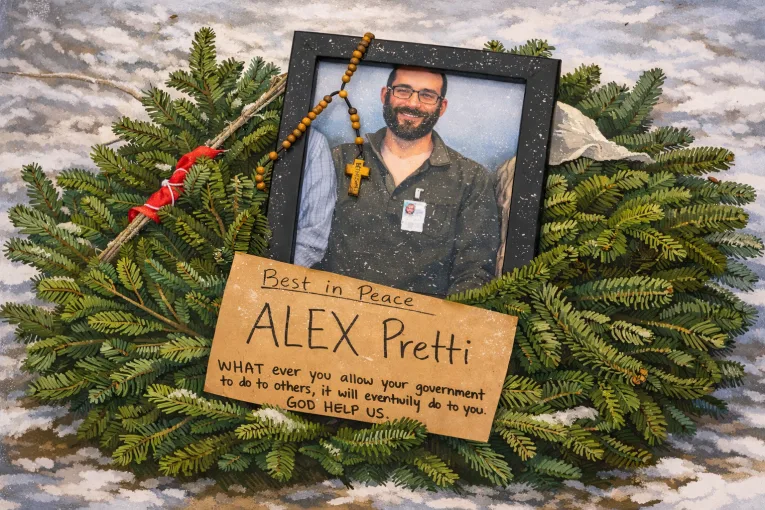
In its article, “Even the Top Prosecutor in Minneapolis Doesn’t Know the Identity of the Agents Who Killed Alex Pretti,” The Intercept reports on escalating federal immigration actions in the state and the growing fallout following the deaths of Renee Good, a poet and artist, and Alex Pretti, an ICU nurse.
According to The Intercept, federal agents have shot three people in Minnesota since December and killed Good and Pretti during a surge in immigration enforcement ordered by President Donald Trump. Host Akela Lacy states that the agents “descended on the state in December as part of President Donald Trump’s massive surge in efforts to hunt down immigrants.”
The administration promoted strict enforcement, leading Homeland Security Secretary Kristi Noem to state, “If you are considering entering America illegally, don’t even think about it … we will hunt you down.”
The Intercept reports that the administration attempted to label Good and Pretti as “domestic terrorists” after the shootings. Noem claimed, “If you look at what the definition of ‘domestic terrorism’ is, it completely fits this situation on the ground.”
Senior Border Patrol official Gregory Bovino echoed that characterization, saying, “This looks like a situation where an individual wanted to do maximum damage and massacre law enforcement.”
By contrast, Lacy said that “video evidence circulating online and digital investigations from various news outlets flatly refuted those claims.”
Trump later responded to the backlash by softening his stance, telling Minnesota Gov. Tim Walz that they were “on a similar wavelength,” The Intercept reports. Walz said Trump agreed to consider reducing the number of federal agents in the state.
Bovino and several agents prepared to leave Minnesota soon after that conversation, with Tom Homan expected to take over operations. Ultimately, the two agents who fired at Pretti were placed on administrative leave, but their identities remain undisclosed.
The Intercept centers its reporting on Hennepin County Attorney Mary Moriarty, who says federal agencies have obstructed local investigations. “The federal government has blocked our state BCA,” Moriarty said, referring to the Minnesota Bureau of Criminal Apprehension, which typically investigates police use-of-force cases.
Moriarty said officials initially agreed to a joint investigation into Good’s killing, but that cooperation abruptly ended when “Washington, the administration” intervened. “Suddenly, the BCA got kicked out,” she said.
As reported by The Intercept, Moriarty’s office turned to the public for help amid the federal interference. She said her office “set up a portal and asked the community to send any kind of videos or any other kind of evidence” in an effort to gather as much information as possible.
Moriarty said the BCA “was also blocked physically, actually, by federal agents from processing the scene” in the Pretti case. Even after a judge signed a search warrant, “federal agents would not allow access to the scene,” according to The Intercept.
The obstruction prompted Moriarty’s office to file a lawsuit and seek a temporary restraining order. She said the purpose was “to force the federal government to preserve and not alter any of the evidence.”
Although a judge granted the order, Moriarty told The Intercept she does not believe it guarantees access to the scene.
The Intercept reported that Moriarty disputes claims that members of the public prevented investigators from entering the area. Video footage instead showed “federal agents standing about two feet apart with large batons,” she said.
“We’ve not gotten anything from the federal government,” Moriarty said. “We are getting our information from the media.”
As summarized by The Intercept, Moriarty continues to press for transparency regarding the identities of the agents involved. When asked whether she knows who shot Pretti, she said, “No — they haven’t shared that with us.”
She explained that federal agencies are difficult to subpoena because they operate under a special legal process known as Touhy regulations, which “doesn’t mean you’re actually going to get” the requested information.
The Intercept and Moriarty describe mounting legal barriers and a climate of fear in Minnesota. Moriarty said many agents are masked and unidentifiable, calling the situation “frightening.”
The report notes that many Minnesota parents are now speaking with their young children because they are “frightened that ICE is going to hurt them.”
Moriarty recounted incidents involving an elderly Hmong man marching outside in freezing weather and a young boy wearing a “bunny hat” who was taken along with his father.
She criticized the government’s language, saying officials use words such as “detain” when, in reality, “We’re talking about a cage. We’re talking about a jail, a prison — for a five-year-old child.”
The Intercept also highlights community responses, including the work of Jill Garvey, co-director of States at the Core. Garvey said her organization trains residents to safely document ICE activity.
“This isn’t an individual activity,” Garvey said. “If you do it together, you are much safer, and it is much more effective.”
She added, “The more people watching, the less likely that there will be an escalation of violence.”
Garvey acknowledged, “We can’t stop all this aggression,” adding, “The aggression is the point of these operations.”
She emphasized the importance of community documentation in uncovering what happened to Good and Pretti.
The Intercept concludes that Minnesota has become a focal point of federal immigration enforcement, with attorneys warning that unchecked conduct in the state could spread nationally.
As local officials continue investigations amid federal resistance, The Intercept reports that community members remain active in documenting enforcement actions and demanding accountability.
Follow the Vanguard on Social Media – X, Instagram and Facebook. Subscribe the Vanguard News letters. To make a tax-deductible donation, please visit davisvanguard.org/donate or give directly through ActBlue. Your support will ensure that the vital work of the Vanguard continues.
